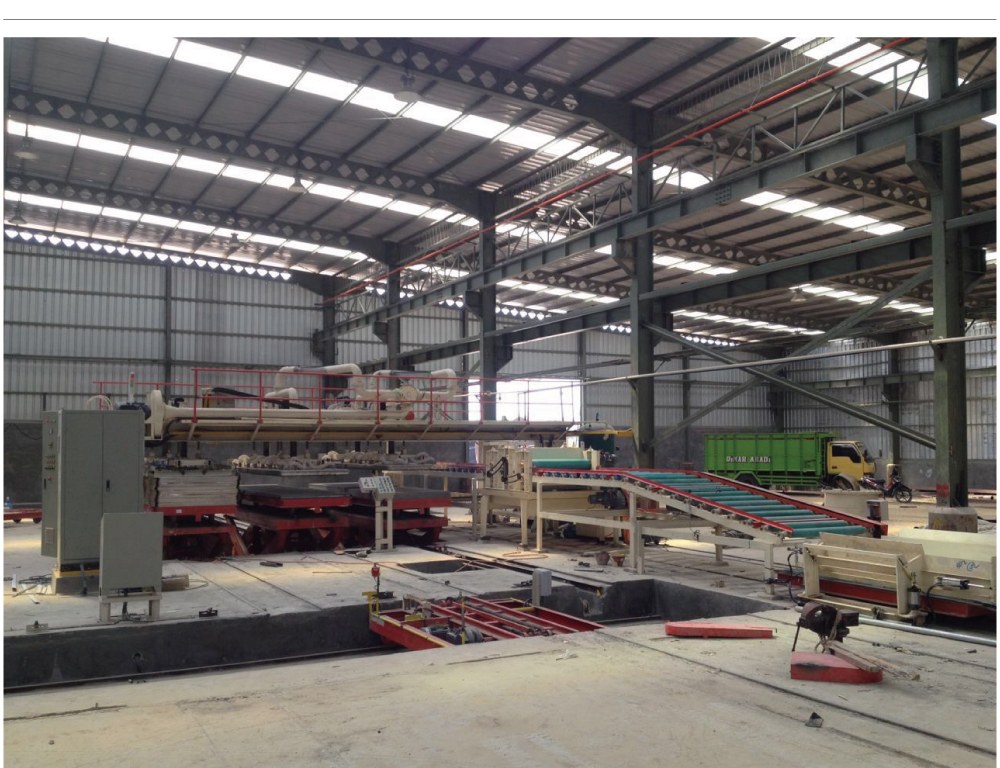

Turnkey lineXinhuibo
Fiber-cement and asbestos-cement sheet production line
Sheet format2440×1220mm
- TAMINOTA part number
- TMN-XHB-01
- Stacking cycle
- 12–15 с
- Blank moisture
- 27–35%
A full-cycle process line: raw material preparation, grinding, paper stock preparation, cleaning, mixing, sheet forming, pressing, autoclave curing and finishing. Forming follows the Hatschek process. Sheet thickness is set by an electronic gauge, and the slurry-to-water ratio is adjusted automatically against the actual thickness of the blank. Control is by two touch panels and PLCs; the plant has supplied lines with a Russian-language operator interface. From raw material dosing to stacking the line is run by four operators. The plant takes on the whole project: design, manufacturing, delivery, installation, commissioning and process support.
- Brand
- Xinhuibo
- Category
- Turnkey line
- Industry
- Asbestos and fiber cement
- Availability
- Project supply
What to send for selection
- 01Part number or the number on the nameplate
- 02Photos of the unit and its nameplate
- 03Model of the machine the unit is fitted to
- 04Quantity
Specifications
TMN-XHB-01
- Forming
- HATSCHEK
- Autoclave
- 0.8–1.1 MPa · 12–20 h
- Operators per line
- 4
- Control
- PLC · 2 сенсорные панели
- Equipment
- SIEMENS · SCHNEIDER · ABB · OMRON
How to get this item
- 01You send the part number or a nameplate photo
- 02You get the plant’s invoice and a lead time
- 03Inspection at the plant, delivery, documents
Related articles
- Do you need a certificate for equipment and parts from China?It depends on the product. A certificate of conformity is required if the product is on the list of goods subject to mandatory conformity confirmation. Whether it is, you check by the HS code (TN VED) and the description of the goods. The 2018 simplification for equipment and parts imported "for your own production" was repealed in February 2026.
- How to check a plant in China before your first orderA plant is checked in three layers: papers, register, shop floor. Ask for the business license, check it against China's official register, and see the workshop live, by video or in person. No single check proves anything on its own. Together they tell a plant from a trading company and from a fly-by-night firm.
- What to put in a contract with a plant in ChinaThe contract should cover everything you may later dispute: what exactly is supplied, how many, on what delivery and payment terms, how it is inspected before shipment and on acceptance, what happens with defects, what warranty applies, and under which law and where a dispute is settled. What is not in the contract, the plant does not owe you.
- Warranty on equipment from China: from which day and what it coversHow long the warranty lasts and from which day it runs is decided by the contract. If the contract sets no date, under Uzbek law the period runs from the handing over of the goods. The warranty covers manufacturing defects; wear, breaches of operating rules and repairs by others are usually not covered.
- Supervised installation and commissioning: what to prepareIn supervised installation the plant's engineers do not assemble the line themselves: they direct your crew and answer for what is assembled to their drawings. Commissioning is the next step: adjustment and trial runs up to the working mode. By the time they arrive, the foundation, power, water, lifting equipment, people and raw material must be ready.
- Slate line machines and which parts wear out firstA fibre-cement sheet line is a chain of stages: raw material preparation, milling, fibre opening, the forming machine, press, curing, demolding, autoclave, cutting. What wears out first is whatever rubs against the slurry and the sheet: forming felts, screens, knives, shaft bearings and slurry pumps.
- Passport and manual in Chinese: what to require in RussianAsk for the passport and manual before shipment, not after. A plant usually supplies them in Chinese and English. For some equipment in Uzbekistan the law requires documents in the state language, for example for boilers and other pressure equipment. A Russian translation for your own mechanics is written into the contract separately.
- Cylinder mould screen: which mesh to fit and when to replace itThe screen decides how much fibre and cement stays on the cylinder and how much leaves with the water. Choose the mesh by the slurry (asbestos cement or fibre cement), by its number (meshes per inch) and by the wire material. Replace it by condition: clogged, torn, sagging or giving an uneven layer.
- Format drum: what wears out and how it shows on the sheetOn a format drum the covering (rubber or other lining), the bearings of the drum and the press roll, and the cutting groove and knife wear out. Covering wear gives uneven thickness and a repeating mark, bearing wear gives runout and stripes. Re-cover or regrind the covering when the defects already show on the sheet.
- Edge runners and hollander: opening asbestos and what gets replacedChrysotile is opened in two steps: edge runners or a roll machine knead the bundles, then a hollander or hydro-opener splits them into fibers and mixes them with cement. In the edge runners the rollers, the pan and the scrapers wear; in the hollander, the drum knives and the bedplate under it. Wear decides the degree of opening, and that decides the strength of the sheet and how the stock gives up its water.
- Corrugating machine: how the sheet gets its wave and what breaksA raw flat sheet gets its wave in two ways: it is laid on corrugated steel templates (spacers), or a vacuum corrugator first forms the wave and then transfers the sheet onto a template. What wears is the suction cups and their rubber, the flexible table belt, the vacuum valves and hoses, the drives and the templates themselves. An uneven wave, cracks on the crests and a wave shifted toward the edge are signs the unit needs a look.
- Autoclave or air curing: which to choose for the sheetThe choice between an autoclave and curing in air is a choice of mix composition, not only of equipment. The autoclave gives fast strength gain and lets ground sand replace part of the cement, but it needs steam, a boiler and a pressure vessel. A mix with PVA fibre does not survive the autoclave; it is cured in air.
- Can flat sheet be made on a corrugated slate lineIt can: flat and corrugated sheet are formed in the same way, on the same Hatschek machine. A corrugated sheet is made from a flat blank on a corrugator, and a flat sheet bypasses it. But a marketable flat sheet usually needs sections that a corrugated line lacks or has only weak ones: a press, flat pallets, and for facade boards an autoclave, drying, sanding and painting.
- An old line: repair, modernize or replaceThe decision starts not with a catalog of new lines but with a survey of the old one: what is worn and whether a unit can be replaced. If the frame, beds, shafts and format drum are alive and the problems are in the drive, automation, press or individual machines, it usually pays to modernize unit by unit. Replacing the whole line makes sense when the technology itself is out of date or the line cannot give the needed product and volume however much it is repaired.
- The Hatschek process in plain words: how a sheet is made from slurryIn the Hatschek process the sheet is built from many thin films. A mesh cylinder in a vat of liquid slurry filters out the water and leaves a film on the screen, the felt lifts it off and carries it over the vacuum to the format drum, and the drum winds it on layer after layer to the required thickness. Then the wrap is cut open, the sheet is corrugated or left flat, and sent to curing.
- Slurry concentration in the vat: why it sets thickness and strengthConcentration is how much solid (cement, fibre, filler) there is in the water of the vat. It decides what film lies on the screen in one turn: a thicker slurry gives a thicker, denser film, a thinner one a thinner film. If the concentration wanders, the sheets come out with different thickness and different strength. It is held constant: recycled water is added by measurement, and measurements are taken regularly.
- Why slate is pressed and how the press affects strengthThe press squeezes the raw sheet further after forming: it forces out water, brings the layers and fibres closer and removes some of the pores. A pressed sheet is denser, stronger, holds frost and water better and is flatter. That is why the interstate standard for flat sheets divides them into pressed and unpressed ones with different requirements. Corrugated slate is usually not pressed; the press is needed first of all for flat sheet and higher-grade products.
- How slate gets its wave and why the profile comes out unevenThe wave is given to the raw flat sheet right after the wrap is cut, while it is still soft. The corrugator (rod, chain or vacuum type) bends the sheet to the profile, then the sheet is laid on a corrugated spacer or in a profiled cart and held in that shape until it hardens. An uneven wave almost always comes from three places: sheet moisture and thickness, wear of the corrugator, and the condition of the templates and carts.
- Flat fibre-cement sheet: how the technology differs from slateA flat sheet is formed the same way as slate, on a Hatschek machine. The differences start after the format drum: no corrugating, but often a press; the sheet hardens on flat pallets or in an autoclave; the requirements for flatness, the face and the edge are stricter. The main defects of a flat sheet are warping and marks on the face, which are almost unnoticeable on a corrugated sheet.
- GOST 30340-2012: what it requires of a corrugated sheetGOST 30340-2012 is the interstate standard for corrugated chrysotile-cement sheets and their fittings. It sets two profiles, dimensions and tolerances, strength, density, impact toughness, water tightness and frost resistance, and requirements for appearance, marking, acceptance and storage. It replaced GOST 30340-95 and, for corrugated sheets, GOST 8747-88 and GOST 30301-95.
- GOST 18124-2012: requirements for flat sheetsGOST 18124-2012 is the interstate standard for flat chrysotile-cement sheets. It divides sheets into pressed (LPP) and unpressed (LPN) and sets dimensions, flatness, bending strength, density, impact toughness and frost resistance. Amendment No. 1, in force from 1 January 2019, requires every sheet to be marked or to carry a label.
- EN 494 and ISO 10904: when you need them instead of GOSTEN 494 is the European standard for fibre-cement profiled sheets, ISO 10904:2011 the international one; ISO 9933 was withdrawn in 2011 and replaced by ISO 10904. Both describe asbestos-free sheets and test them differently from GOST: classes by profile height, breaking load and bending moment, and ageing tests. They are asked for in exports outside the CIS and in projects where the client works to European or international norms.
- Marking slate and lots: what to write on the sheet and in the documentA corrugated sheet to GOST 30340-2012 is marked with the manufacturer (trademark or name), profile, thickness and lot number, on the face of the overlapped part. The OTK quality control stamp goes on at least 1 % of the sheets in a lot. A flat sheet to GOST 18124-2012, after Amendment No. 1, is marked on every sheet or carries a label. Every delivery is accompanied by a quality document with the test results of the lot.
- How a lot of slate is accepted: sampling and retestingA lot of slate is the shift output of one line. Every lot goes through acceptance tests: appearance, dimensions, load or bending, density. The other indicators are checked periodically. Sheets for checking are taken from different stacks, leaving out the outer ones. If the defects fall between the acceptance number and the rejection number, a second sample is taken. If a periodic test fails, control is switched to every lot.
- Is a certificate needed to sell slate in UzbekistanThe answer depends on the current list of objects subject to mandatory conformity confirmation (Cabinet of Ministers Resolution No. 43 of 30.01.2021) and on the HS code under which the sheet clears. The old 2011 list, which had products of cement and asbestos cement, lost force on 1 May 2021. Since 2026 a reform of technical regulation has been under way and the lists are changing. Check for your own sheet and for the current date.
- Selling slate in Kazakhstan and Kyrgyzstan: which documents are neededIn Kazakhstan slate falls under the national technical regulation on the safety of building materials (order No. 435 of 09.06.2023, in force since 19.12.2023). Asbestos-free corrugated sheets are in its mandatory certification list. There is no general EAEU regulation for building materials yet; it is being drafted. In Kyrgyzstan the 2010 national building materials regulation lost force in 2015; what is required now must be asked of the country's authority.
- Felt, screen, format drum: a glossary of the slate plantShort explanations of the words heard on the floor of a slate plant: from the vat and the cylinder screen to demolding, the autoclave and trimmings. The glossary is for the buyer who writes the request and for a new person on the line. Each word says what it is and which article to read next.
- Chinese names of slate line units: felt, screen, autoclaveAt a Chinese plant the felt is 毛毯, the drying mesh is 螺旋干网, the autoclave is 养护釜 or 高压釜, the demolding machine is 脱模机. One unit often goes by two or three names: one word in the catalog, another in a patent or in correspondence. So the Chinese name in a request helps, but the photo, dimensions and nameplate decide.
- Screen mesh number: mesh, opening in mm and wire diameterMesh is the number of openings per inch of length. To get the opening in millimeters, divide 25.4 by the mesh and subtract the wire diameter. So the same mesh with different wire gives different screens. The Russian number under GOST 6613 works the other way round: it is the opening size itself in millimeters. In a request, write the mesh, the wire, the material and the weave.
- Water ring pump nameplate: what 2BE, SK and VVN meanIn the VVN (ВВН) and SK designations, the number after the letters is the approximate capacity in cubic meters per minute: ВВН1-12 and SK-12 pump about 12 m³/min. In the 2BE designation the number is a size code, not the capacity: look it up in the manufacturer's table. For a replacement, the letters matter less than the capacity at your vacuum, speed, power, drive, ports and casing material.
- Rubber-covered rolls: Shore hardness and when to recover themOn a slate machine the rolls that press on the felt are rubber-covered: the couch roll over the cylinder screen, the roll that presses the felt to the format drum, some guide and transport rolls. Cover hardness is measured on the Shore A scale. A roll is recovered when the cover peels, cracks, wears unevenly or goes out of tolerance on hardness and diameter.
- Process regulations of a slate plant: what they must containThe process regulations are the plant's main technical document: which raw materials, which recipe, which modes at each stage, what to check and how often, which tolerances and what to do on a deviation. The GOSTs for corrugated and flat sheets require them to be made according to regulations approved by the plant. The chief process engineer maintains them; they are revised when raw materials, equipment or products change.
- Thickness sensor on the format drum: which one and whyOn a Hatschek machine the sheet thickness builds up from turns of film on the format drum. It is controlled in two ways: by counting turns or drum revolutions, and by directly measuring the thickness with a sensor, a contact roller or a non-contact sensor. On some modern lines the sensor sends a signal to the controller, which adjusts the slurry feed itself. What fails in a sensor is the mechanics, dirt and the cable.
- New slate line: what to decide before talking to a plantBefore you ask a manufacturing plant for a line quotation, decide seven things: which sheet you will make, from what raw materials, how many sheets per shift the market needs, how the sheet will cure, where the line will stand, where steam, water and electricity will come from, and who will run it. Without these answers, quotations from different plants cannot be compared.
- Slate line capacity: why sellers quote different figuresDifferent sellers state line capacity in different units: tonnes per hour, square metres, sheets per shift, conventional sheets. And they calculate it differently: at the machine's top speed, with no stoppages and no rejects. To compare quotations, ask each seller to convert output into your sheets and your shifts and to state what is built into the calculation.
- Workshop for a slate line: what to prepare before equipment arrivesBy the time the line arrives, the workshop must be ready to receive it: foundations and pits poured to the manufacturing plant's drawings and cured to strength, water, drainage, electricity, steam and compressed air brought to the connection points, the overhead crane working, access routes clear. The buyer does all this under the brief that the plant issues with the workshop plan.
- Chinese, European or used line: how to compareLines are compared not by country and not by the first figure in the quotation, but by five things: what is in the supply, which units wear fastest and where to get spare parts for them, who starts the line up and trains the staff, what documents come with it, and which risks stay with you. A table with these items for each option is the comparison.
- Buying a used slate line: what to check before payingBefore paying for a used line, it is inspected on site while it is still assembled and, best of all, running: year of manufacture and hours of operation, condition of the shafts, vats, screens, format drum and press, electrics and controller programs, autoclave and boiler documents, completeness against the inventory. Separately, decide who will dismantle, transport and reassemble it, and how.
- Technical specification for a slate line: what to write to the plantA technical specification is your requirements for the line on paper: which sheet and to which standard, from what raw materials, how much per shift, how it cures, what is in the supply, what automation, in what language the documents are, which spare parts and training, how you will accept it. It is attached to the contract, and the line is later accepted against it.
- Accepting a line at a plant in China: what to check at the trial runAt the manufacturing plant you can check completeness, assembly, no-load running of the machines, automation and documents. Output and sheet quality on your raw materials are checked only at your site after start-up. Whatever is found before shipment is corrected there and recorded in the protocol: after shipment it is harder to correct.
- Starting a new line: what goes wrong in the first weeksIn the first weeks a new line almost always gives less sheet and more rejects than promised: the slurry and felts are not yet matched to your raw materials and water, the shifts are learning, the units are running in, small installation flaws surface one after another. This is normal if every stoppage and every kind of reject is recorded: these records are needed both for tuning and for the warranty.
- Whom to train and in what when starting a slate lineWhen a line is started, five groups are trained: operators of the forming machine and adjacent stages, the technologist, the mechanic, the electrician and the laboratory technician. Each needs its own training, on the line and on paper. Training is written into the contract with the manufacturer: whom, in what, when, in what language, and how it is checked that people have learned.
- Corrugated sheet types: profiles, wave count, useA corrugated sheet is told apart by its profile, meaning wave height and pitch, and by its number of waves. The current interstate standard GOST 30340-2012 knows two profiles: 40/150 with symmetric edges and 51/177 with asymmetric edges. The old designations (54/200, the "unified" and the "reinforced" profile) come from withdrawn standards, but they still turn up in orders and designs.
- Slate sheet sizes under GOST: length, width, thickness, tolerancesGOST 30340-2012 sets for a corrugated sheet the length, the width by wave count, several thicknesses, the wave height and the edge width, each with a tolerance. The most common sheet, 40/150, is 1750 mm long and 980 mm wide with seven waves or 1130 mm with eight. Sizes are checked on every lot, and on the line they are held by the templates, the cutting and the format drum.
- Fibre cement facade boards: can a slate plant make themA facade board can be formed on the same Hatschek machine as slate. But a facade board is a different product: it needs a press, curing to the board's own recipe, precise cutting, often sanding, primer and a coating on the face, and to be sold under European requirements it needs EN 12467 tests for strength and resistance to water, frost and temperature swings. It is not "slate without the wave" but a separate process stage and a separate market.
- Coloured slate: what you need to start productionColoured slate is made in two ways: pigment in the mass, so the colour runs through the whole thickness, or a coating on the surface of the sheet. To start production you need a decision on the method and the palette, a section for coating or pigment dosing, colour standards, an abrasion test of the coating to GOST, separate packing and storage under a roof. Start with a trial coloured batch and a talk with dealers, not with buying a line.
- Packing and storing slate at the plant to avoid breakageBreakage in the finished goods yard most often has three causes: the sheet was handled before it gained strength, the pack stands on an uneven or weak base, or sheets are dropped and knocked when moved. GOST 30340-2012 sets what to pack the sheets in, the maximum size and mass of a pack, how many tiers to stack and how to store coloured sheet. Storage at the manufacturer follows the plant's process regulations.
- How to load and haul slate so it arrives in one pieceSlate arrives whole if it has already gained strength, is packed in strapped packs on pallets, the packs stand tight and are secured against shifting, and they are loaded with textile slings and a spreader or a lifting beam, with no impacts or dropping. GOST 30340-2012 allows any mode of transport but leaves placing and securing to the rules of that mode: for railcars the technical conditions for placing and securing cargo, for containers the rules for packing cargo units.
- Slate or profiled steel sheet: a slate plant's argumentsAgainst profiled steel sheet, slate has four honest arguments: it is noticeably quieter in rain, it does not rust, it conducts heat worse, and less condensate drips from it on the cold side. It has weak points too: the sheet is heavier, brittle under impact and careless installation, and the choice of colours is narrower. A slate seller does better to know both sides and talk to the buyer about the conditions of his roof, not about what is "better in general".
- Selling slate to neighbouring countries: what to check firstBefore the first shipment of slate to Kazakhstan, Kyrgyzstan or Tajikistan, check five things: the HS code of the sheet, which conformity document the buyer's country requires, whether there are temporary import restrictions, whether a certificate of origin is needed, and which side handles customs and transport. Requirements differ in every country and change, so the answer comes from the country's own documents with the edition date, not from someone else's experience.
- Oversize equipment (press, autoclave): how it is shippedOversize cargo is cargo that does not fit an ordinary container or the road clearance in width, height, length or weight. It travels on platforms and in open containers, with transit permits and a planned route. The main decisions are made before packing: what the plant will dismantle, what packages that leaves and how each one will be lifted.
- Documentation in Chinese: what to translate firstYou do not need to translate everything at once. First come the documents without which it is dangerous to operate and impossible to repair: safety instructions, electrical and hydraulic diagrams, the lubrication and maintenance chart, the spare parts list, the operator panel texts and the fault codes. A technical translator translates, and an engineer who knows the machine checks.
- Import benefits for equipment in Uzbekistan and how to check themYes, but not on everything. The Customs and Tax Codes exempt from duty and VAT new process equipment that has no analogue in Uzbekistan, if its HS code is on the Cabinet's list. The benefit is tied to the code, to the age of the equipment and to the spare parts arriving with it under one contract. Check it before the contract is signed, not at customs.
- Equipment from China on lease: how it works in UzbekistanIn a lease the lessor buys the equipment, from the Chinese plant of your choice, and hands it over for your use for more than a year against lease payments. Until buyout it belongs to the lessor but stands on your balance sheet, and the risk of damage and loss is, as a general rule, yours from the moment you receive it. Who imports and clears it is decided by the contracts and must be written down before signing.
- Importing equipment from China to Kazakhstan: step by stepKazakhstan is a member of the EAEU, so equipment from China is imported under the Customs Code of the union. The declarant is the Kazakh party to the deal. Before filing the declaration you need to know the EAEU HS code and check whether the goods require a declaration or an EAEU certificate of conformity. After release the goods become goods of the union.
- TR CU 010/2011: is a declaration of conformity needed for equipmentTR CU 010/2011 is the EAEU technical regulation on the safety of machinery and equipment. For some machines it requires a certificate, for most a declaration of conformity. Equipment for the building materials industry and pumps go by declaration in the current list. Spare parts for repair and used equipment are not subject to confirmation.
- Importing equipment from China to Kyrgyzstan: Torugart, IrkeshtamKyrgyzstan is an EAEU member, so equipment from China is imported under the Customs Code of the union and the Kyrgyz law on customs regulation. There is no railway from China: cargo goes by truck over the Torugart or Irkeshtam passes. The declarant is the Kyrgyz party to the deal, and an EAEU conformity document is needed before the declaration is filed.
- Importing equipment from China to TajikistanTajikistan is not in the EAEU; it has its own Customs Code and its own goods nomenclature. Apart from narrow exceptions, the declarant on import can only be a Tajik person. The country has a single crossing with China, Kulma in the Pamirs, so heavy equipment is often shipped in transit through Kyrgyzstan or Uzbekistan.
- Cement for slate: what GOST requires and what to check in a lotThe GOST for the chrysotile-cement sheet says one thing about cement: the sheet is made from chrysotile and Portland cement, and the raw material must meet its own standards. Which cement exactly to take is set by the plant's technological regulations. General-purpose cement is supplied to GOST 31108-2020, and the general rules of acceptance and storage are given by GOST 30515-2013. Below is what to read in the quality document, how to take samples and how to store the lot.
- Chrysotile for slate: GOST groups and grades, acceptance, safetyGOST 12871-2013 divides chrysotile into nine groups by fibre length, and within groups 0–6 and 6K into grades by screening on four sieves. Grade 6-45 means: group six, not less than 45 % of the fibre on the main sieve. Below is how to read the grade and the lot passport, how to take a sample at acceptance, how to store chrysotile and what the norms require for protecting people: WHO classes all forms of asbestos, including chrysotile, as carcinogens.
- Verifying scales and instruments at a slate plant: law and GOSTA sheet test result is worth as much as the instrument it was obtained with. GOST 30340-2012 sets the accuracy of the scales, the caliper and the bending testing machine. The Uzbek law "On Metrology" names the areas where measurements are under state control: accounting of material assets, industrial safety, quality of certified products, conformity assessment. Instruments for such measurements are, as a general rule, verified; where the law allows calibration instead of verification, check with the metrology service.
Request
Send a part number or a photo — we will find the factory
Items from the catalog · 1
- TMN-XHB-01 · Fiber-cement and asbestos-cement sheet production line