Can flat sheet be made on a corrugated slate line
It can: flat and corrugated sheet are formed in the same way, on the same Hatschek machine. A corrugated sheet is made from a flat blank on a corrugator, and a flat sheet bypasses it. But a marketable flat sheet usually needs sections that a corrugated line lacks or has only weak ones: a press, flat pallets, and for facade boards an autoclave, drying, sanding and painting.
In short
5minutes to read
6sections
6sources
4catalog items
In this article
- 01What the owner needs to decide
- 02What is the same as on the corrugated line
- 03What is added
- 04Limitations of the old line
- 05What to prepare before deciding
Contents
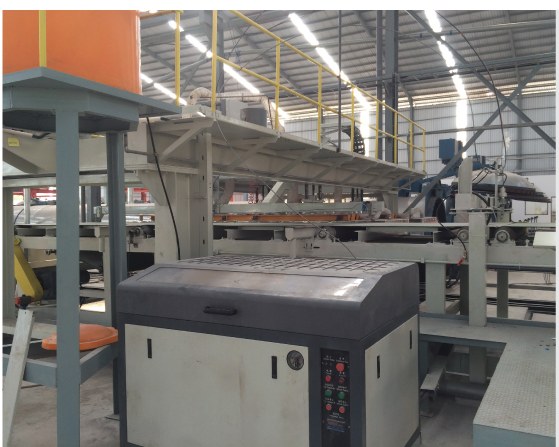
Flat sheet can be made on a corrugated slate line because they are formed in the same way. The Hatschek machine builds up a layer on the format drum, the layer is cut and taken off as a flat blank. For corrugated slate the blank is then bent on a corrugator; for flat sheet it is not. So the simplest flat sheet, unpressed, can be turned out by a corrugated slate line almost without modification. The difficulties start when you need a sheet for sale with other requirements: pressed, flat, with exact dimensions, smooth or painted. This needs a press, flat pallets, sometimes an autoclave, drying, sanding and painting. Before deciding, it is worth answering which flat sheet exactly your buyers need.
What the owner needs to decide
| Which sheet is needed | What is required on top of the corrugated line |
|---|---|
| Unpressed flat sheet | flat pallets for flat sheet, a bypass around the corrugator, its own cutting to size |
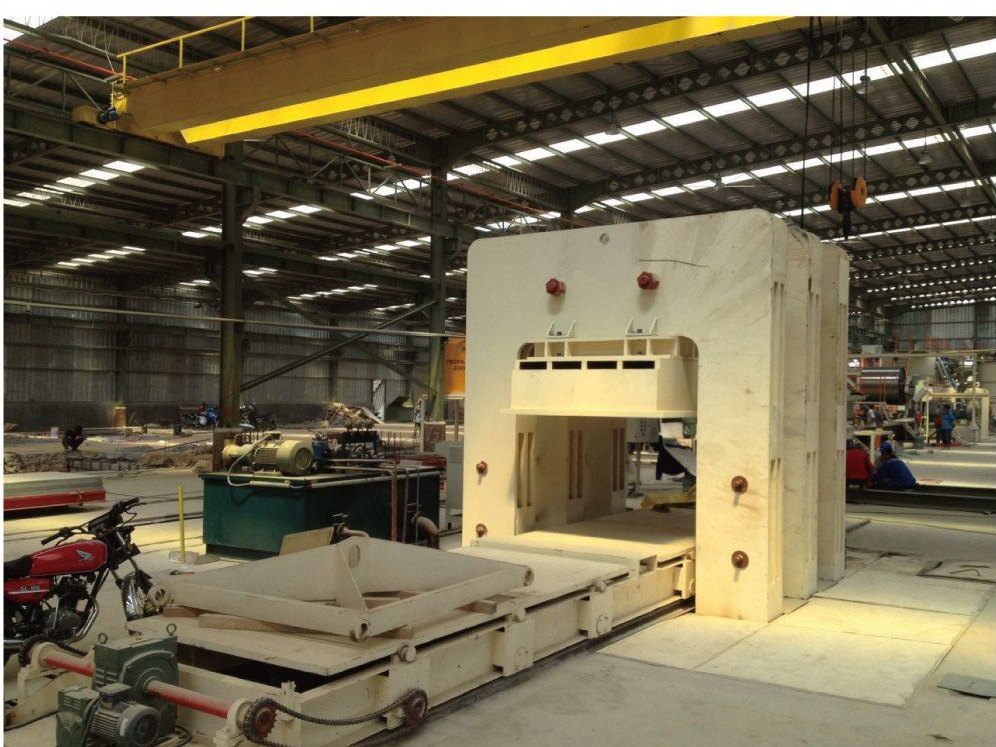
| Pressed flat sheet | a hydraulic press, sheet interleaves or pallets for the press, a restacking section |
| Board for facade and interior finishing | mix composition and curing for dimensional stability, often an autoclave, drying, calibration or sanding, painting |
The interstate standard for chrysotile-cement flat sheets distinguishes exactly two kinds: unpressed and pressed. A pressed sheet, after being taken off the format drum, is additionally compacted under pressure. For a pressed sheet the standard allows a noticeably smaller deviation from flatness than for an unpressed one. This says directly that a press is needed for a flat sheet.
What is the same as on the corrugated line
- raw material preparation, fibre opening, mix preparation;
- the forming machine: vats, screens, felt, vacuum, format drum;
- cutting and taking off the green blank;
- curing, demolding, stacking;
- recycled water and sludge.
So the forming machine spares and consumables are common. The felt and the screen are chosen for the mix and the thickness, not for the shape of the sheet.
What is added
The press
The press compacts the green sheet, reduces porosity and raises density and strength. The textbook literature on asbestos cement describes that facing sheets and roofing tiles are additionally pressed, and small tiles are pressed in stacks on a hydraulic press at high pressure. The press brings with it interleaf sheets or pallets, mechanisms for loading and unloading the stack, and hydraulics with its seals and pumps.
Flat pallets and layout
Corrugated sheet hardens on corrugated templates. A flat sheet needs flat pallets or interleaf sheets. If there are none, the sheet hardens with a bend and later warps.
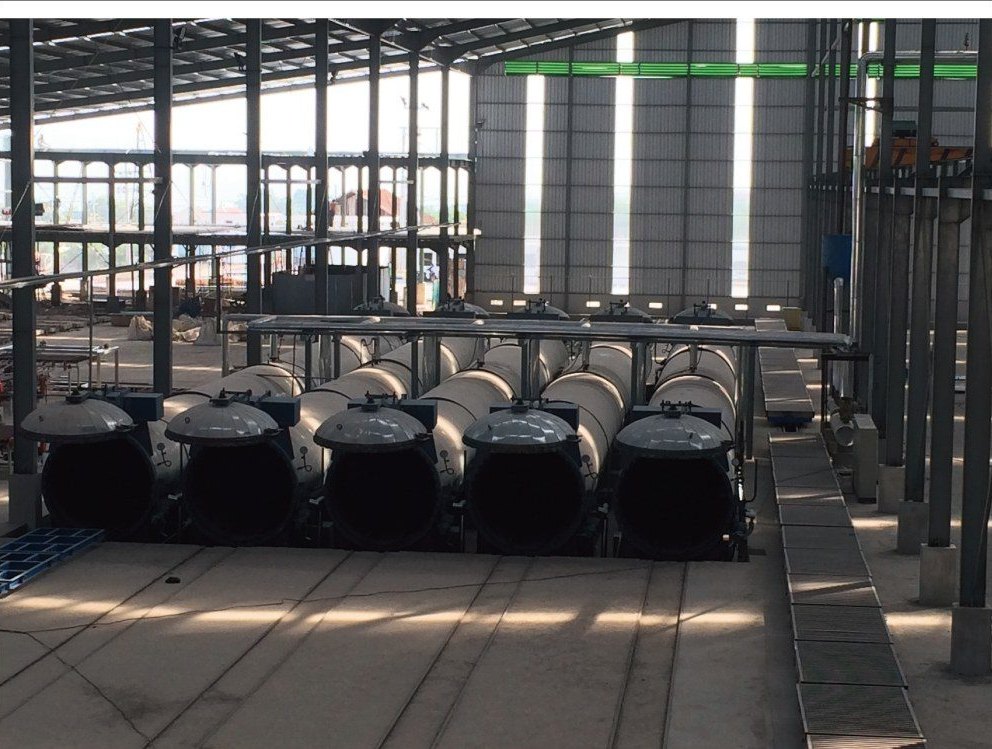
The autoclave
For facade and interior boards, dimensional stability when humidity changes is often important. It is provided by the mix composition and autoclave curing. Whether there will be an autoclave depends on the fibre: a mix with PVA does not survive the autoclave. The details are in the article on the autoclave versus natural curing.
Drying, sanding, painting
A board for finishing is dried to the required moisture, calibrated or sanded to thickness and painted. The standard for chrysotile-cement flat sheets contains no requirements for sanding, but it allows sheets with a protective and decorative coating and sets requirements for it. The European standard for fibre-cement flat sheets divides them into categories by conditions of use and classes by strength; manufacturers of facade boards state this category and class in their declarations.
Cutting
A flat sheet needs exact dimensions and straight edges: the standard limits deviations from squareness and straightness of the edges. Trimming is done with disc knives or a water jet.
Limitations of the old line
- Width and length. The size of a flat sheet is limited by the width of the forming machine and the length of the development of the format drum.
- Thickness. Flat sheets are thicker than corrugated ones. Whether the machine has enough slurry and vacuum capacity for a thick sheet is a question for the process engineer.
- Press. An old press may not give the needed force over the area of the sheet or may not hold pressure because of wear.
- Floor area. A pressed sheet needs a restacking section, a board needs a drying store and a place for sanding.
What to prepare before deciding
- Which flat sheet and for whom: dimensions, thickness, pressed or not, painting.
- The standard under which the sheet will be delivered to the buyer.
- The forming machine passport: working width, development of the drum.
- Whether there is a press, its force and condition.
- How the sheet cures now: chambers, autoclave, store.
How we do it
- From the photo, dimensions and the passport of the unit, we look for the item at the manufacturing plant. What we find, with the price, photos and specifications, we send before the order.
- Where the answer has to come from the plant (the composition of the line, the recipe, the mode), we ask them and pass on their word.
What this article relies on
Below are the documents and materials we refer to, so that you can check what is said for yourself.
Standards and documents
- GOST 18124-2012 "Chrysotile-cement flat sheets. Specifications": unpressed and pressed sheets, deviations from flatness and squareness, coated sheetstext ↗
- EN 12467:2012+A2:2018 "Fibre-cement flat sheets. Product specification and test methods": scope (sheets for external and internal finishing of walls and ceilings) — standard recordtext ↗
Reference materials
- Rybyev I. A. "Building Materials Science" (Строительное материаловедение), section "Fundamentals of asbestos-cement product manufacturing": cutting the blank off the format drum, corrugating, additional pressing of facing sheets and tilesstudme.org ↗
- Swisspearl, declarations of performance of facade boards under EN 12467: application category, strength class, level of dimensional deviationsswisspearl.com ↗
- Patent US 6676744: the European pressed air-cured sheet and the autoclaved sheet without a presspatents.google.com ↗
- taminota.com catalog: fibre cement and asbestos-cement sheet line, hydraulic press, autoclave, waterjet cutting, manufacturing plant descriptions.
EN 12467 is not retold from the text in this article: only the standard's record and manufacturers' declarations were opened. The composition of the line for your sheet comes from the equipment manufacturing plant.