Workshop for a slate line: what to prepare before equipment arrives
By the time the line arrives, the workshop must be ready to receive it: foundations and pits poured to the manufacturing plant's drawings and cured to strength, water, drainage, electricity, steam and compressed air brought to the connection points, the overhead crane working, access routes clear. The buyer does all this under the brief that the plant issues with the workshop plan.
In short
4minutes to read
5sections
4sources
4catalog items
In this article
The equipment arrives in containers, and the engineers of the manufacturing plant come to install it for a limited time. If by that day the foundations are not ready or there is no water and power at the connection points, installation stands and the crew's time is wasted. So the workshop is prepared in advance, under the brief from the plant: a machine layout plan, drawings of foundations and pits, loads and a list of connections. This brief must be obtained as early as possible and made part of the contract.
What the plant's brief includes
Ask the manufacturing plant in writing for:
- a workshop plan with the layout of all machines and the dimensions of aisles;
- foundation drawings: dimensions, levels, positions and type of anchor bolts, embedded parts, loads;
- pits and channels: for the forming machine vats, for the pumps, for recirculated water, cable channels;
- connection points: water (quantity and pressure), drainage and slurry discharge, electricity (power and entry point for each cabinet), steam, compressed air;
- the height to the underside of the overhead crane and its lifting capacity for installing the heaviest units;
- the weight and dimensions of the largest shipping unit, so that it passes through the gate.
If any item is missing, ask before construction starts. Redoing a poured foundation costs more than asking a question.
What to prepare, by section
Foundations and pits
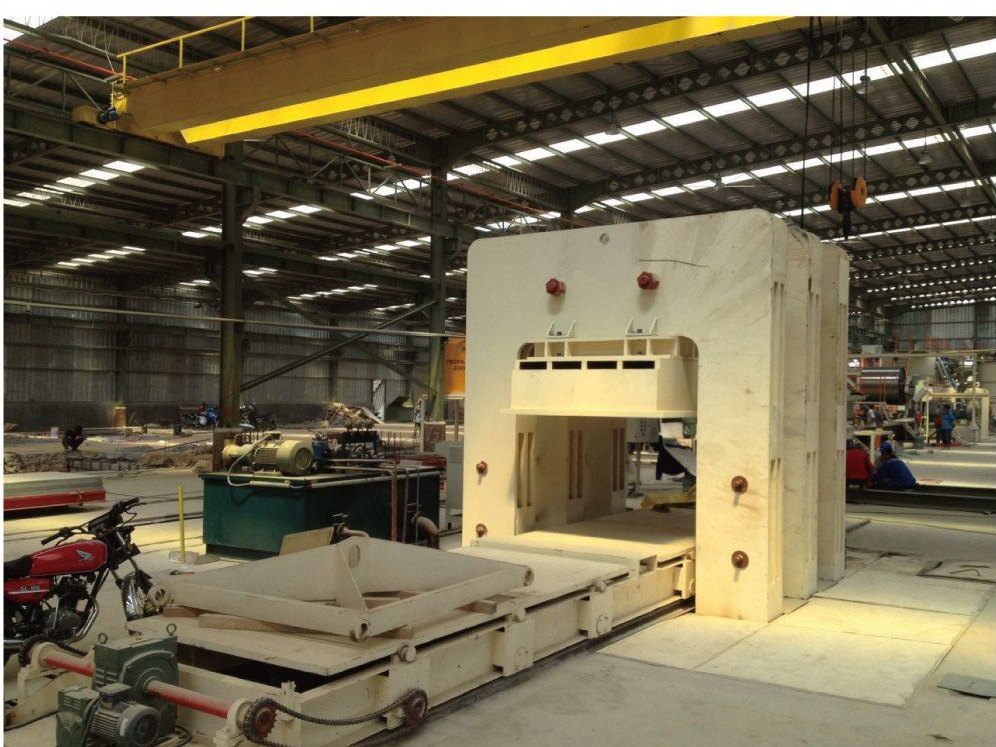
Foundations are poured strictly to the plant's drawings: for the forming machine, the press, the autoclave, the mills, the stacker and the demoulding. The concrete must reach design strength before the machines are set and grouted; how long this takes depends on the concrete and the weather, and your designer states it. Before the installers arrive, the levels, the distances between anchors, plumb and the projection of the bolts are checked: the installation crew will check these against their list first of all.
Water and drainage
The Hatschek machine needs water for the slurry and for washing the felt and screens, and the used water goes into a recirculation system with settling tanks. The settling tanks, tanks and pipes for recirculated water are often part of the construction, not of the supply. Find this out in advance.
Electricity
Power at the input, the transformer, cables to the control cabinets, earthing. The electrical equipment of the machines is usually designed for a certain voltage and mains frequency: check this against your grid before ordering.
Steam and heat
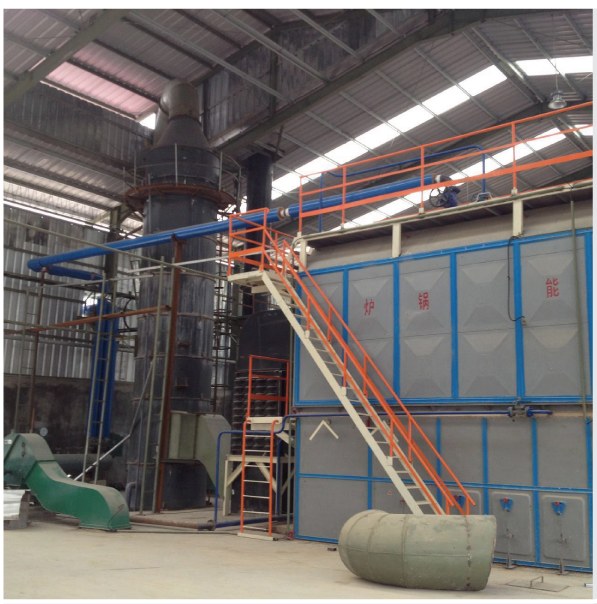
If the line includes a boiler, steam curing chambers or an autoclave, you need space for a boiler house, fuel and steam pipelines. The boiler and autoclave are pressure equipment with their own rules of siting and admission to operation in your country. These are clarified before the design, not after.
Compressed air
Pneumatics of the stacker, the demoulding, the valves. The compressor, receiver, dryer and pipes are either in the supply or yours. In detail, see the article on the compressor and pneumatics.
Crane, access routes, areas
The overhead crane in the workshop is needed both for installation and later for changing shafts and felts. Gates and access routes must suit the largest unit and the forklift. Areas for raw materials, for curing of packs and for finished products follow the plant's plan.
Before the installers arrive
Check together with your builder:
- The foundations are ready, levels and anchors match the drawing.
- Water, electricity and compressed air are brought to the connection points.
- The crane works and is cleared for operation.
- There is covered space for unloading and storing the crates.
- Welfare conditions for the crew are ready: an interpreter, communications, a place for drawings.
- Your mechanic and electrician are assigned, to work alongside the installers and learn.
Engineering layer: what the mechanic looks at
- Anchor bolts come in sleeves so that they can be moved during alignment. The clearance in the sleeve is checked before the frame is set.
- The machine frame is set on shims or leveling screws and grouted after alignment; the anchors are tightened after the grout has set. The grout material and the order follow the plant's instructions.
- Grout is placed on cleaned concrete without a weak top layer.
- Every check (levels, tightening, alignment) is recorded in a protocol. These records are needed if you later have to work out whether it was a defect of the unit or an installation error.
How we do it
- Supervised installation and start-up are done by the manufacturing plant. We organize the trip of its engineers, translation and access to the site.
- Where the answer must come from the plant (foundation drawings, loads, connections), we ask it and pass on its words.
What this article relies on
Below are the documents and materials we refer to, so that you can check what is said for yourself.
Standards and documents
- Expro (Saudi Arabia), "Project Construction Rotating Equipment Checklist": list of checks before setting machines: anchor bolts, foundation preparation, grouting, concrete strength, alignmenttext ↗
Reference materials
- Turbomachinery Magazine, "Best practices for machinery installation": setting the frame on shims, alignment, grouting, tightening anchors after the grout has setturbomachinerymag.com ↗
- Fosroc, "Conbextra Cementitious Grouts Application Guide": curing of concrete before grouting, removal of the weak top layer, anchor bolts in sleevesfosroc.com.au ↗
- Rybyev I. A. "Building Materials Science" (Строительное материаловедение), section "Fundamentals of asbestos-cement product manufacturing": recirculated water for washing the screen and feltstudme.org ↗
Foundation dimensions, loads and demand for water, steam and electricity are given by the manufacturing plant for your line; requirements for the boiler house and pressure vessels follow the norms of your country.