Why slate is pressed and how the press affects strength
The press squeezes the raw sheet further after forming: it forces out water, brings the layers and fibres closer and removes some of the pores. A pressed sheet is denser, stronger, holds frost and water better and is flatter. That is why the interstate standard for flat sheets divides them into pressed and unpressed ones with different requirements. Corrugated slate is usually not pressed; the press is needed first of all for flat sheet and higher-grade products.
In short
4minutes to read
6sections
6sources
3catalog items
In this article
- 01What the owner needs to decide
- 02What the press does to the sheet
- 03How pressing is done
- 04Which errors show on the sheet
- 05What to attach to a press spare parts request
Contents
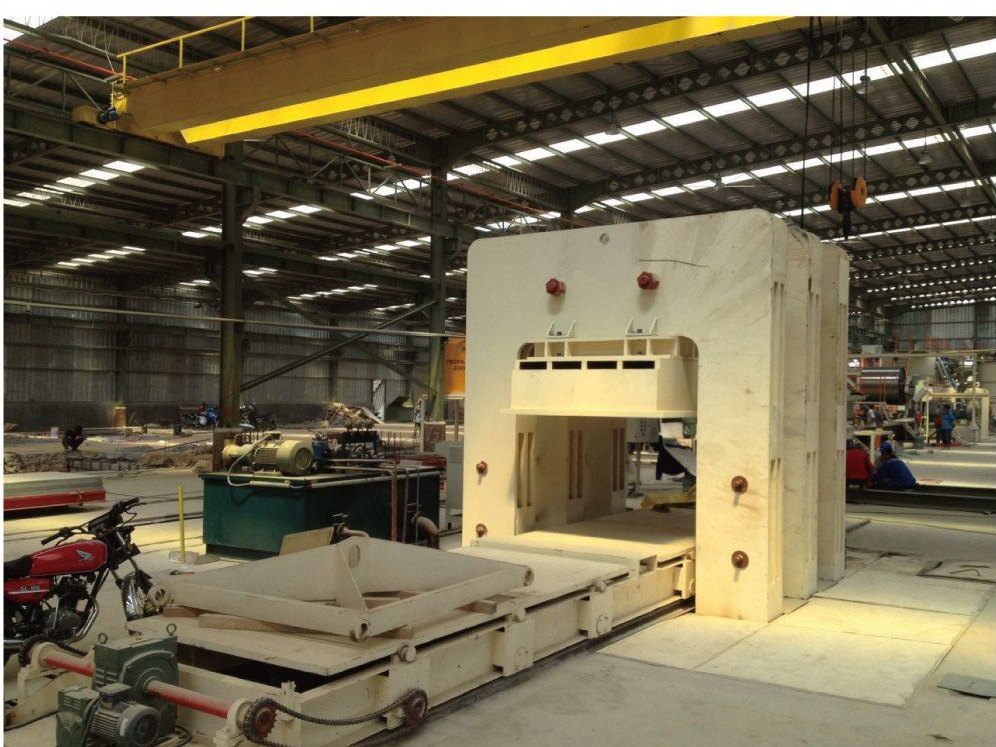
Pressing is extra compaction of the raw sheet after it has been taken off the format drum. The press forces water out of the sheet, brings layers and fibres closer and closes part of the pores. The sheet becomes denser and stronger, resists frost and water better, and warps less. GOST 18124-2012 for flat chrysotile-cement sheets expressly divides them into pressed (LPP) and unpressed (LPN): pressed sheets have higher requirements for bending strength, density, impact toughness, frost resistance and flatness. Corrugated slate is usually made without a press: the compaction on the format drum is enough for it. The press is needed for flat sheet, facing boards and products with higher requirements.
What the owner needs to decide
- Which product you want to sell. If the plant moves to pressed flat sheet or a facade board, these requirements cannot be met without a press. For corrugated roofing sheet a press is usually not installed.
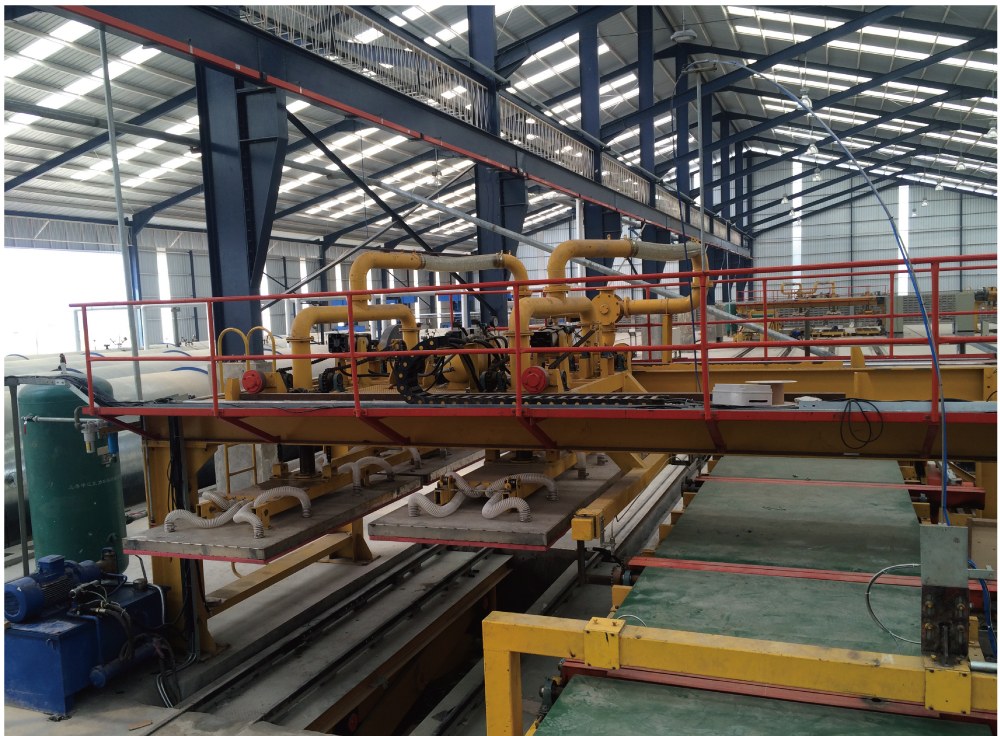
- A press is not one machine but a section. You need a stacker that lays the sheets with separator plates (pallets), a lifting table, the press itself with a hydraulic power unit, and a way to break down the pack after the press. The stroke height of the press is designed for the height of the stack.
- Press spares are hydraulic cylinder seals, power unit valves, pressure sensors and high-pressure hoses. These are consumables, and they are kept in stock. Breakdowns of a hydraulic press have their own article.
What the press does to the sheet
| What changes | Why |
|---|---|
| Density rises | water is forced out, solid particles come closer |
| Strength rises | more contacts between cement and fibre and between layers |
| Porosity and water absorption fall | pressure closes large pores; in studies of fibre cement, pressed material shows a clearly smaller volume of large pores |
| Frost resistance rises | fewer open pores, so less water that freezes inside |
| Flatness improves | the sheet is levelled between flat separators |
| Thickness decreases | the sheet is formed with a thickness allowance, and the press takes it off |
In a patent on air-cured fibre cement, pressed samples of the same composition clearly outperformed unpressed ones; pressing is named there as a way to raise the density of the raw sheet.
How pressing is done
After the wrap is cut, the raw sheets are laid in a pack, interleaved with flat steel separator plates. The pack is rolled into a hydraulic press and compressed. Pressure is raised in steps, held and released; the mode is set by the press program. After the press the pack goes to pre-curing, and the separator plates are then removed, cleaned and oiled. Shaped products, if they are pressed, are pressed one at a time, with shaped separators in the pack.
Which errors show on the sheet
| What is on the sheet | Where to look for the cause |
|---|---|
| Sheet of different thickness across its area | uneven or bent separator plates, a skewed press platen, uneven cylinder load |
| Delamination or blistering after the press | pressure raised too fast: water does not have time to leave and tears the sheet from inside; the sheet arrived too wet |
| Imprints, sticking | dirty or poorly oiled separator plates |
| Cracks along the edge | a skewed pack, the sheet stuck out beyond the edge of the separator |
| Density and strength below normal | pressure or hold below the regulations, leaks in the hydraulic system, the press does not hold pressure |
The link "fast pressure rise, delamination" is a conclusion from the fact that water does not leave a thick pack at once; this is exactly why presses have steps and holds.
What to attach to a press spare parts request
- The nameplate of the press and of the power unit.
- Rated force, number and diameter of the cylinders.
- A photo and dimensions of the worn seal or valve.
- The size and thickness of the separator plates, if they need replacing.
How we do it
- From a number, drawing or photo of the unit, we look for the item at the manufacturing plant. What we find, with the price, photos and specifications, we send before the order.
- The press and the stacker are in the catalog; a unit can be requested separately or as part of a line.
- We check the batch at the plant before shipment: article number, dimensions, batch, packaging.
What this article relies on
Below are the documents and materials we refer to, so that you can check what is said for yourself.
Standards and documents
- GOST 18124-2012 "Flat chrysotile-cement sheets. Specifications" (Листы хризотилцементные плоские. Технические условия): pressed and unpressed sheets, the difference in requirements for strength, density, impact toughness, frost resistance and flatnesstext ↗
Reference materials
- Rybyev I. A. "Building Materials Science" (Строительное материаловедение), section "Fundamentals of asbestos-cement product manufacturing": facing sheets and tiles are additionally pressed in stacks on a hydraulic pressstudme.org ↗
- "Building Materials and Products" (Строительные материалы и изделия), § 8.14 (bibliotekar.ru): pressing for higher strength and density of sheet productsbibliotekar.ru ↗
- Patent US 11773023 "Methods for producing air-cured fiber cement products": pressing raises the density of the raw sheet, pressed samples are better than unpressed, metal separators between sheets, shaped sheets are pressed one at a timepatents.google.com ↗
- Patent US 8383031 "Method for modifying pore size distribution zones in fiber cement composites": pressed fibre cement has a smaller volume of large pores, pressing reduces water permeabilitypatents.google.com ↗
- taminota.com catalog: hydraulic press for a pack of sheets, manufacturing plant description (steps, hold, stroke for the stack height).
Pressing pressure and time for your line are set by the process regulations.