Flat fibre-cement sheet: how the technology differs from slate
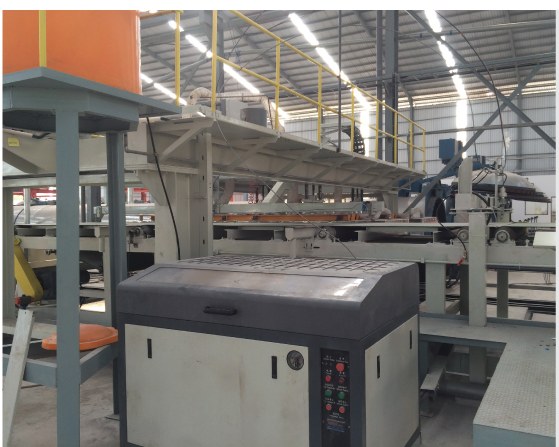
A flat sheet is formed the same way as slate, on a Hatschek machine. The differences start after the format drum: no corrugating, but often a press; the sheet hardens on flat pallets or in an autoclave; the requirements for flatness, the face and the edge are stricter. The main defects of a flat sheet are warping and marks on the face, which are almost unnoticeable on a corrugated sheet.
In short
4minutes to read
5sections
7sources
4catalog items
In this article
- 01What the owner needs to decide
- 02Slate and flat sheet: where the technologies diverge
- 03Where a flat sheet has more defects
- 04Can flat sheet be made on a slate line
- 05How we do it
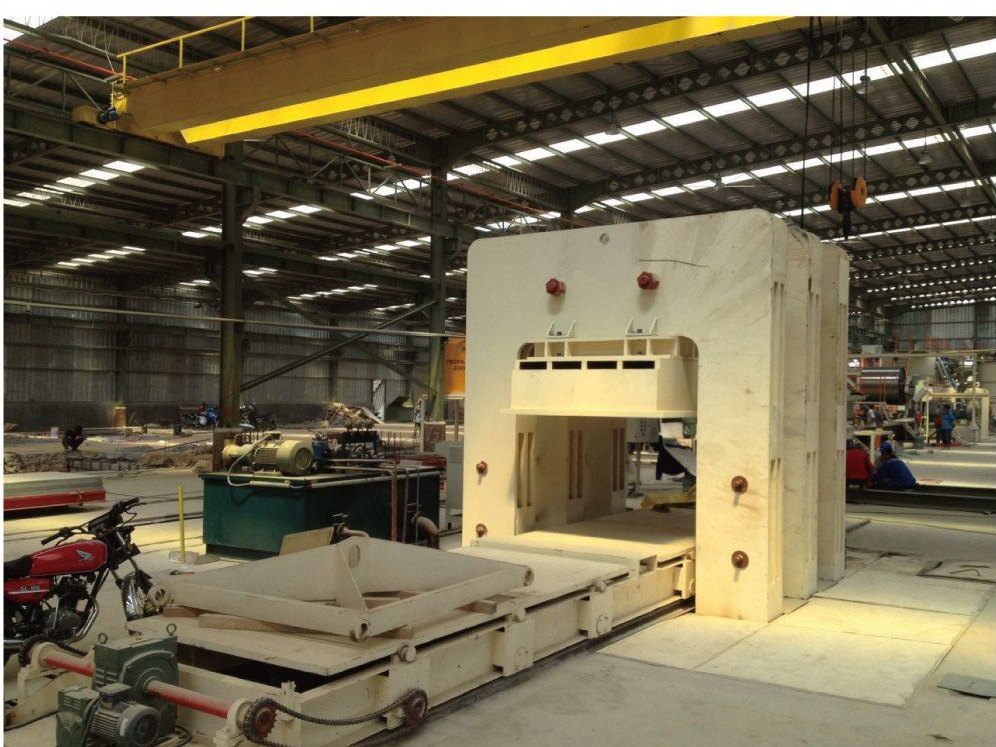
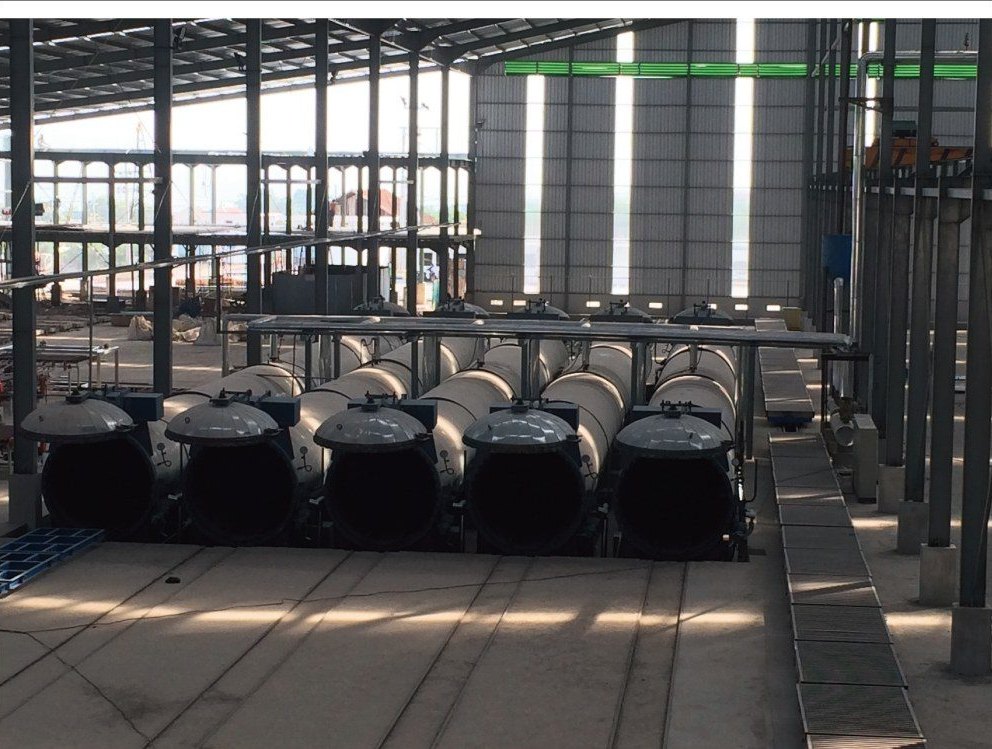
A flat sheet and corrugated slate are formed the same way: the Hatschek machine builds the wrap from thin films on the format drum, and the wrap is cut and taken off. Then the paths diverge. A corrugated sheet goes to the corrugator. A flat one goes either straight onto pallets and into the curing chamber (unpressed), or into a pack with flat steel separators and under the press (pressed). A flat sheet hardens in air or in an autoclave, which depends on the slurry recipe. After curing a flat sheet has more operations: accurate edge trimming, sometimes sanding or calibrating, primer and coating of the face. The requirements for flatness are tighter for a flat sheet: the interstate GOST 18124-2012 sets limits on deviation from flatness, and the face must not carry felt marks.
What the owner needs to decide
- What the sheet is for. Flat sheet goes into wall cladding, partitions, soffits and roofing. For facades and interior finishing, Europe has a separate standard, EN 12467, for fibre-cement flat sheets; a sheet for painting or for a facade has higher surface requirements than a "grey" sheet.
- Whether a press is needed. A pressed sheet is denser, stronger, flatter and more frost-resistant: GOST 18124 sets higher requirements for it than for an unpressed one. A pressed class cannot be produced without a press.
- Autoclave or air. It is decided by the recipe: with ground sand, an autoclave; with PVA fibre, air curing. This has a separate article.
- Cutting to size. A flat sheet is more often cut to an exact format, sometimes to a complex shape. This is where waterjet cutting appears as an alternative to knives.
Slate and flat sheet: where the technologies diverge
| Stage | Corrugated slate | Flat sheet |
|---|---|---|
| Forming | Hatschek machine | the same |
| After the drum | corrugating | laying on flat pallets or into a pack with steel separators |
| Pressing | usually none | often: the pressed class is obtained only this way |
| Pre-curing | on corrugated spacers or in profiled carts | on flat pallets or in the press pack |
| Final curing | warehouse, warm water or autoclave | the same; for boards with sand, an autoclave |
| Processing | edge trimming | accurate trimming, sometimes sanding of the face, chamfer, drilling |
| Finish | grey or painted | grey, painted, textured; sometimes an anti-sticking layer on the back |
| What is checked more strictly | wave height | flatness, face surface, squareness |
Where a flat sheet has more defects
Warping
A building materials technology textbook names warping as the most common defect of flat sheets. The cause is uneven density through the thickness: the side next to the format drum is denser; the vacuum draws cement out of the surface layers; the slurry concentration fluctuates. When wetted, such a sheet swells unevenly and bows. Helpful measures are more intensive agitation in the vat, greater press force, sand cement with an autoclave, and hydrophobization. The causes and checks are covered in detail in the article on why a flat sheet warps.
The face surface
On a corrugated sheet a small felt or spacer mark is almost invisible. On a flat sheet for painting it is seen at once. GOST 18124 does not allow felt marks on the face; on the back they are permitted. The cleanliness and oiling of the press separator plates and the pallets are directly reflected in the face of the sheet.
Sticking in the stack
Painted sheets are often stacked while still warm, and a soft coating can glue the sheets together. To prevent this, a coating with the required resistance to sticking is chosen, or an anti-sticking layer is applied to the back.
Edge and squareness
A flat sheet is installed butt-jointed or with an even joint, so a crooked edge and deviation from a right angle are more noticeable than on lapped slate.
Can flat sheet be made on a slate line
It can: the forming part is shared. But you will need flat pallets, a press section if a pressed class is wanted, and more accurate trimming. The details are in the article on flat sheet on a corrugated line.
How we do it
- From a number, drawing or photo of the unit, we look for the item at the manufacturing plant. What we find, with the price, photos and specifications, we send before the order.
- The press, the autoclave and waterjet cutting are in the catalog; a unit can be requested separately or as part of a line.
- We check the batch at the plant before shipment: article number, dimensions, batch, packaging.
What this article relies on
Below are the documents and materials we refer to, so that you can check what is said for yourself.
Standards and documents
- GOST 18124-2012 "Flat chrysotile-cement sheets. Specifications" (Листы хризотилцементные плоские. Технические условия): pressed and unpressed sheets, flatness, felt marks on the face and backtext ↗
- EN 12467:2012+A2:2018 "Fibre-cement flat sheets. Product specification and test methods": standard card (scope: cladding of walls and ceilings, inside and outside)text ↗
Reference materials
- "Technology of Production of Building Materials, Products and Structures" (Технология производства строительных материалов, изделий и конструкций), clause 5.4.2 (bibliotekar.ru): unpressed boards go after edge trimming into stacks and chambers, pressed ones in stacks with metal separators; warping as the main defect and measures against itbibliotekar.ru ↗
- Patent US 11773023 "Methods for producing air-cured fiber cement products": pressing raw flat sheets with metal separators, removing separators after pre-curing, air curingpatents.google.com ↗
- Patent US 8754151 "Multistage polymer dispersions...": flat and corrugated fibre-cement sheets, curing in a humidified heat chamber or an autoclave, sticking of painted sheets in a warm stackpatents.google.com ↗
- Environmental declaration for corrugated fibre-cement sheets (heinze.de): anti-sticking treatment of the back, return of waste to productionheinze.de ↗
- taminota.com catalog: fibre-cement and asbestos-cement sheet line, press, autoclave, waterjet cutting: manufacturing plant descriptions.
EN 12467 was not opened in full, only the standard card. Pressing and curing settings for your line are set by the process regulations.