Packing and storing slate at the plant to avoid breakage
Breakage in the finished goods yard most often has three causes: the sheet was handled before it gained strength, the pack stands on an uneven or weak base, or sheets are dropped and knocked when moved. GOST 30340-2012 sets what to pack the sheets in, the maximum size and mass of a pack, how many tiers to stack and how to store coloured sheet. Storage at the manufacturer follows the plant's process regulations.
In short
5minutes to read
5sections
3sources
4catalog items
In this article
- 01What the owner and the section head need to decide
- 02What GOST 30340-2012 requires
- 03Where breakage comes from and what to do about it
- 04Engineering layer: what happens to the sheet after the chamber
- 05How we do it
Slate breaks at the plant not on the line but after it: when moved, in the stack and in the pack in the yard. There are three causes. The sheet was handled before it gained strength. The pack was put on an uneven or soft base, and the sheet in it works in bending. The sheet was dropped, or hit with a gripper or a sling. GOST 30340-2012 describes what to pack the sheets in, what maximum dimensions and mass a pack may have, how many tiers are allowed and how to store a coloured sheet. For storage at the manufacturer the standard refers to the plant's process regulations, which means the plant writes its own yard procedure.
What the owner and the section head need to decide
- Where the sheet gains strength. If the sheet cures in air, after the chambers it needs time in the yard before it can be loaded. That time and the conditions are in the process regulations. If the sheet goes through an autoclave, no extra holding in storage is needed.
- What to ship in. A strapped pack on a pallet or on bearers is the main option. Crates, cassettes and unstrapped stacks are by agreement with the buyer and depending on the mode of transport.
- Where to put it. A level horizontal yard with a hard surface; for coloured sheet, a roof.
- Who answers for breakage. Write down in a log where a broken sheet was found: in the stack after the chamber, during packing, in the yard, during loading. Without this the cause cannot be found.
What GOST 30340-2012 requires
How to pack
The standard allows sheets to be transported:
- in wooden slatted crates;
- in transport packs on wooden bearers or pallets, strapped with wire, steel tape or other means;
- in specialised cassettes;
- by other means of packing, by agreement with the consumer.
The pack size is limited: no more than 1950 mm long, 1350 mm wide and 1880 mm high, and the mass no more than 5000 kg. The number and section of the straps are set by the plant's own documentation.
How to mark the pack
The pack is marked with transport marking under GOST 14192: main, additional and information inscriptions directly on the pack or on a securely fixed tag. The sheet itself carries its own marking on the overlapped part; see the article on marking for details.
How to store
- At the manufacturer: per the plant's process regulations.
- At the consumer: on horizontal yards, in packs or stacks on pallets and bearers.
- Packs and stacks on pallets are put on top of each other no more than two tiers high. The total height of a stack of packs is up to 3.5 m, of a stack of loose stacks up to 2.5 m.
- Coloured sheet is stored on level yards protected from precipitation and direct sun, and packs of it are not put on top of each other.
- Impacts on the sheets and dropping from any height are not allowed.
Where breakage comes from and what to do about it
| Where it breaks | Cause | What to check |
|---|---|---|
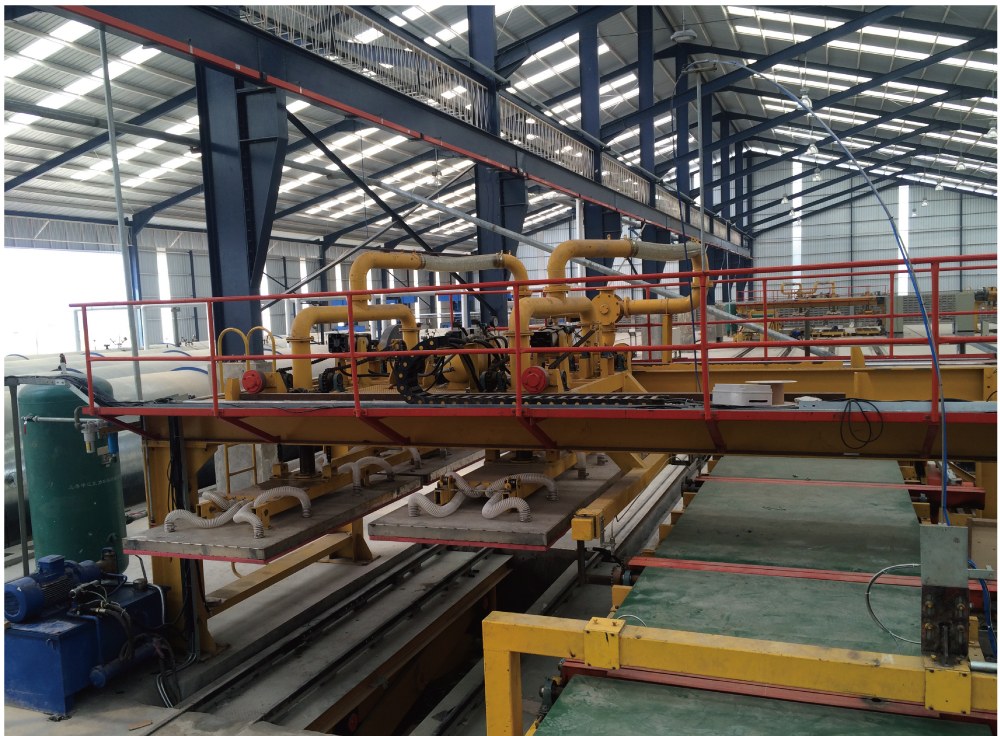
| At demoulding and moving | the sheet has not gained strength after the chambers, a gripper or suction cup hits the edge | time in the chamber per the regulations, setup of the demoulding machine |
| In the stack | uneven pallets and interlayers, a stack out of true | pallet geometry, stacking wave in wave |
| In the pack in the yard | an uneven or settled base, bearers not under the waves, a third tier | yard surface, bearer positions, stack height |
| At loading | chain slings, forklift tines on the sheet, dropping | textile slings with a spreader, a lifting beam, training of riggers |
| In winter | the sheet got wet and froze in the pack | protecting packs from water, keeping fresh sheet in the warm |
Engineering layer: what happens to the sheet after the chamber
- Gaining strength. After preliminary curing the sheet is strong enough only to be demoulded and moved. An air-cured sheet gains the rest of its strength in stacks in a heated yard. How long and at what temperature follows the regulations of your line; textbooks speak of days for this, not hours.
- Water. On some lines the stacks are moistened after demoulding so that the cement gains strength more evenly. Dry wind and sun on a fresh sheet give shrinkage cracks, frost on a wet sheet gives delamination.
- Autoclaved sheet comes out of the autoclave at full strength and needs no holding in storage. But breakage from impacts and an uneven base is the same for it.
- Flat sheet is more sensitive than corrugated to uneven stacking: it warps if the stack lies on uneven bearers.
How we do it
- From the photo, dimensions and the passport of the unit, we look for the item at the manufacturing plant. What we find, with the price, photos and specifications, we send before the order.
- We inspect the lot at the plant before shipment: part number, dimensions, lot, packaging.
What this article relies on
Below are the documents and materials we refer to, so that you can check what is said for yourself.
Standards and documents
- GOST 30340-2012 "Chrysotile-cement corrugated sheets. Specifications", section 9: means of packing, pack dimensions and mass, pack marking under GOST 14192, storage at the manufacturer and the consumer, tiers and stack height, storage of coloured sheets, ban on impacts and droppingtext ↗
Reference materials
- Rybyev I. A. "Building Materials Science" (Строительное материаловедение), section "Fundamentals of asbestos-cement product manufacturing": curing in chambers, then ripening in a heated warehouse; an autoclave removes the need for holding in storagestudme.org ↗
- "Technology of production of building materials, products and structures" (Технология производства строительных материалов, изделий и конструкций), clause 5.4.2 (bibliotekar.ru): stacking sheets onto trolleys, moistening the stacks after demoulding, final curing in a heated warehouse, no holding needed for autoclaved products, warping of flat sheetsbibliotekar.ru ↗
Holding time in the yard and temperature follow the process regulations of your line; they are not given in the article.