Standalone machineXinhuibo
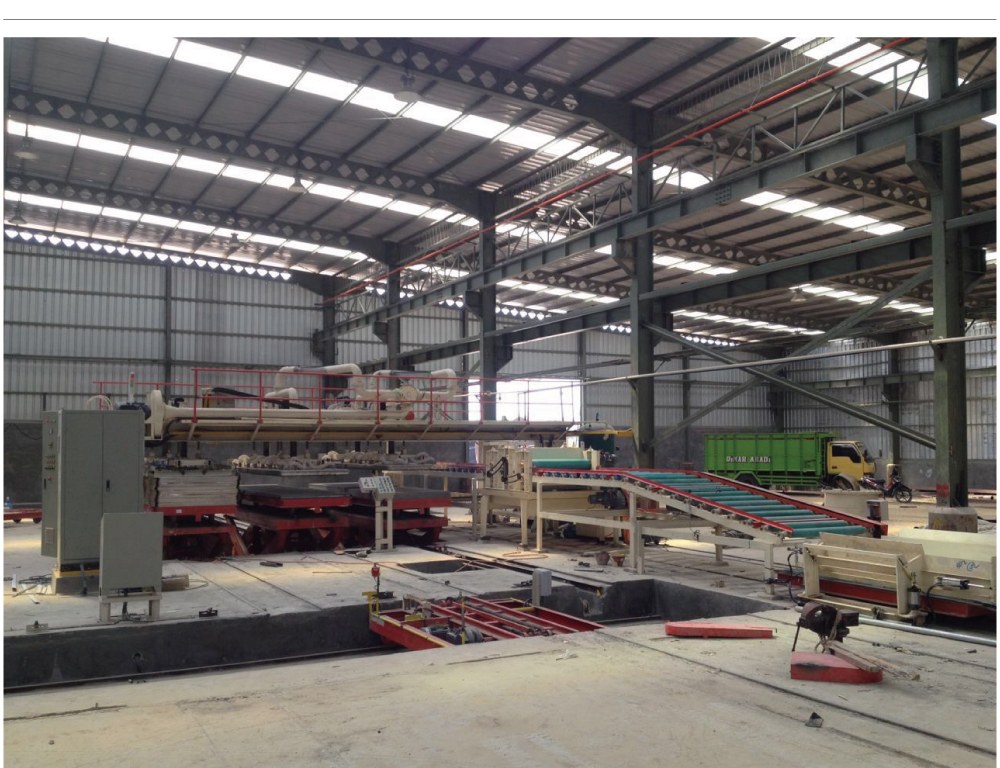
Four-station demolding machine with pallet lubrication unit
Pre-curing4–5h · 40–60 °C
- TAMINOTA part number
- TMN-XHB-06
- Servo motor
- 5.5–15 kW
- Rotation speed
- 2000–3000 rpm
Separates the sheet and the pallet after pre-curing. The trolley with the stack is rolled under the machine, the pallet is separated from the sheet, and the sheet moves on to the next stage. A sucker transfers the pallet to the roller table of the lubrication unit, where it is washed and greased; the cleaned pallets are stacked and returned to the stacker. Pre-curing before demolding takes 4–5 hours at a chamber temperature of 40–60 °C.
- Brand
- Xinhuibo
- Category
- Standalone machine
- Industry
- Asbestos and fiber cement
- Availability
- Project supply
What to send for selection
- 01Part number or the number on the nameplate
- 02Photos of the unit and its nameplate
- 03Model of the machine the unit is fitted to
- 04Quantity
Specifications
TMN-XHB-06
- Gearbox
- QJ-L200-16
- Fan
- 11–18.5 kW · 2900 rpm
- Sucker height
- 1300–1500 mm
- Sucker stroke
- 2000 mm
How to get this item
- 01You send the part number or a nameplate photo
- 02You get the plant’s invoice and a lead time
- 03Inspection at the plant, delivery, documents
Related articles
- Slate line machines and which parts wear out firstA fibre-cement sheet line is a chain of stages: raw material preparation, milling, fibre opening, the forming machine, press, curing, demolding, autoclave, cutting. What wears out first is whatever rubs against the slurry and the sheet: forming felts, screens, knives, shaft bearings and slurry pumps.
- Steel templates and pallets: when to repair, when to replaceA template or pallet is repaired as long as it can be cleaned, straightened and again gives a sheet within tolerance. It is replaced when the metal has warped so that straightening does not hold, when corrosion has eaten the surface or the edges, or when the buildup can no longer be removed. A crooked template gives a crooked wave and edge, which shows in the edge waves of the sheet.
- Demolding machine: what wears and why it breaks sheetsIn a demolding machine the suction cups, the vacuum part (valves, hoses, seals, pump or ejector), the pneumatic cylinders, the position sensors and the travel drive wear. Sheets are most often broken for three reasons: the sheet was demolded before it gained strength; it stuck to a dirty or poorly lubricated pallet; the vacuum or the synchronization failed.
- Why a slate sheet delaminates and how to find the causeA sheet delaminates when the layers built up on the format drum did not bond to each other. Look for the cause along the path of the sheet: slurry, screen, felt, vacuum, drum pressure and press, curing, demolding. Most often the culprits are a film that is too wet or too dry, a clogged felt and weak compaction.
- Where cracks in slate sheets come from: demolding, stack, roofFirst tie the crack to a time: did it appear right after demolding, in the stack in the finished goods warehouse, or already on the roof. That decides where to look for the cause: forming and curing, drying of the stack, or installation and frost.
- White deposit on slate sheets: a defect or notThe white deposit is efflorescence: soluble calcium salts come out to the surface with water and turn into calcium carbonate there. It usually does not affect the strength of the sheet and is a defect of appearance only. But for a painted sheet the GOST does not allow efflorescence, and under the paint it spoils the coating.
- Crooked wave and uneven edge: which deviations are allowedFor a corrugated sheet the GOST measures length, width, thickness, wave height, deviation from squareness and straightness of the edges. The wave pitch is given for reference and is not a rejection criterion. A crooked wave usually comes from the templates and the corrugating machine, a skewed sheet and a ragged edge come from cutting.
- Flat sheet warps and bends: moisture and curingA flat sheet warps when one side dries or gets wet differently from the other: the wet side is longer, the dry side shorter, and the sheet bows. The causes are uneven moisture through the thickness, uneven laying in the stack and drying from one side. GOST 18124-2012 limits warping, and the allowance is larger for unpressed sheets.
- Curing chambers: temperature, humidity and where rejects come fromIn the curing chamber the green sheet gains the strength to be taken off the pallet without breaking. Three things cause rejects here: heat applied before the cement began to set; temperature raised too fast or unevenly; the sheet losing water to dry air and drafts.
- An old line: repair, modernize or replaceThe decision starts not with a catalog of new lines but with a survey of the old one: what is worn and whether a unit can be replaced. If the frame, beds, shafts and format drum are alive and the problems are in the drive, automation, press or individual machines, it usually pays to modernize unit by unit. Replacing the whole line makes sense when the technology itself is out of date or the line cannot give the needed product and volume however much it is repaired.
- Pre-curing: when a sheet can be taken off its templateAfter forming, a raw sheet is soft, like wet cardboard. While it lies on its template or pallet in the chamber, the cement sets and the sheet gains demolding strength: enough to be taken off, turned over, trimmed and stacked without cracks. Time and temperature are not guessed: they are set by the regulations, and readiness is checked on a control sheet. A sheet taken off too early cracks and breaks later, in the warehouse and on the roof.
- How slate gets its wave and why the profile comes out unevenThe wave is given to the raw flat sheet right after the wrap is cut, while it is still soft. The corrugator (rod, chain or vacuum type) bends the sheet to the profile, then the sheet is laid on a corrugated spacer or in a profiled cart and held in that shape until it hardens. An uneven wave almost always comes from three places: sheet moisture and thickness, wear of the corrugator, and the condition of the templates and carts.
- Felt, screen, format drum: a glossary of the slate plantShort explanations of the words heard on the floor of a slate plant: from the vat and the cylinder screen to demolding, the autoclave and trimmings. The glossary is for the buyer who writes the request and for a new person on the line. Each word says what it is and which article to read next.
- Chinese names of slate line units: felt, screen, autoclaveAt a Chinese plant the felt is 毛毯, the drying mesh is 螺旋干网, the autoclave is 养护釜 or 高压釜, the demolding machine is 脱模机. One unit often goes by two or three names: one word in the catalog, another in a patent or in correspondence. So the Chinese name in a request helps, but the photo, dimensions and nameplate decide.
- Heat: fast setting, over-dried sheet and overheated motorsIn hot weather cement sets faster, water leaves the green sheet faster, and motors and control cabinets run hotter. Hence three summer problems: slurry thickens in the vats and pipes, sheet dries out in the yard and cracks, motors and frequency drives trip on overheating. The answer: control of water and slurry temperature, shelter and moistening of the sheet, ventilation of motors and cabinets.
- Compressed air on the line: compressor, dryer and leaksA slate plant needs compressed air for demolding and the stacker, for the line's pneumatic cylinders and valves, for blowing filters and for aeration of cement silos. The air must be dry and clean, otherwise water and oil ruin the pneumatics, and in a silo damp air cakes the cement. Hence three concerns: the compressor, the dryer with filters, and finding leaks.
- Accepting a line at a plant in China: what to check at the trial runAt the manufacturing plant you can check completeness, assembly, no-load running of the machines, automation and documents. Output and sheet quality on your raw materials are checked only at your site after start-up. Whatever is found before shipment is corrected there and recorded in the protocol: after shipment it is harder to correct.
- Corrugated sheet types: profiles, wave count, useA corrugated sheet is told apart by its profile, meaning wave height and pitch, and by its number of waves. The current interstate standard GOST 30340-2012 knows two profiles: 40/150 with symmetric edges and 51/177 with asymmetric edges. The old designations (54/200, the "unified" and the "reinforced" profile) come from withdrawn standards, but they still turn up in orders and designs.
- Slate sheet sizes under GOST: length, width, thickness, tolerancesGOST 30340-2012 sets for a corrugated sheet the length, the width by wave count, several thicknesses, the wave height and the edge width, each with a tolerance. The most common sheet, 40/150, is 1750 mm long and 980 mm wide with seven waves or 1130 mm with eight. Sizes are checked on every lot, and on the line they are held by the templates, the cutting and the format drum.
- Coloured slate: what you need to start productionColoured slate is made in two ways: pigment in the mass, so the colour runs through the whole thickness, or a coating on the surface of the sheet. To start production you need a decision on the method and the palette, a section for coating or pigment dosing, colour standards, an abrasion test of the coating to GOST, separate packing and storage under a roof. Start with a trial coloured batch and a talk with dealers, not with buying a line.
- Packing and storing slate at the plant to avoid breakageBreakage in the finished goods yard most often has three causes: the sheet was handled before it gained strength, the pack stands on an uneven or weak base, or sheets are dropped and knocked when moved. GOST 30340-2012 sets what to pack the sheets in, the maximum size and mass of a pack, how many tiers to stack and how to store coloured sheet. Storage at the manufacturer follows the plant's process regulations.
Request
Send a part number or a photo — we will find the factory
Items from the catalog · 1
- TMN-XHB-06 · Four-station demolding machine with pallet lubrication unit