How slate gets its wave and why the profile comes out uneven
The wave is given to the raw flat sheet right after the wrap is cut, while it is still soft. The corrugator (rod, chain or vacuum type) bends the sheet to the profile, then the sheet is laid on a corrugated spacer or in a profiled cart and held in that shape until it hardens. An uneven wave almost always comes from three places: sheet moisture and thickness, wear of the corrugator, and the condition of the templates and carts.
In short
5minutes to read
5sections
5sources
3catalog items
In this article
- 01What the owner and the process engineer need to decide
- 02What does the corrugating
- 03Why the wave comes out uneven
- 04What to record for a defect analysis
- 05How we do it
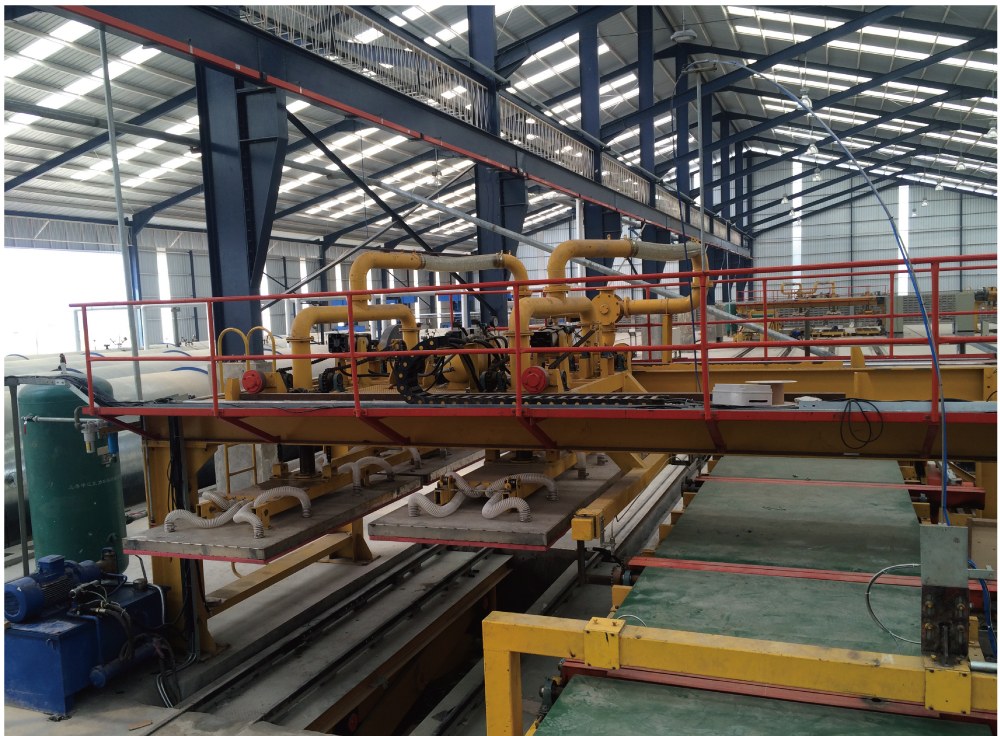
Corrugated slate is formed flat: the Hatschek machine produces an even raw wrap, it is cut into blanks, and only then does the corrugator give the blank its wave. This is done at once, while the sheet is soft and bends without cracks. After that the sheet must hold the profile until it hardens. There are two ways to do this. In the spacer method the sheet is laid on an oiled corrugated metal spacer, and a stack of spacers with sheets is taken to the chamber. In the spacerless method a vacuum stacker lays the sheet directly into a cart with a corrugated bottom, sheet on sheet. If the wave comes out uneven, the cause is looked for in three places: the sheet itself (moisture, thickness), the corrugator (wear, setting) and what the sheet hardens on (templates, carts).
What the owner and the process engineer need to decide
- Which method your line uses and what follows from it. The spacer method needs a fleet of corrugated spacers, their cleaning and oiling. The spacerless one needs profiled carts and an accurate stacker. The consumables and spares of these lines differ.
- The profile is set by the standard. The interstate GOST 30340-2012 sets the profiles of corrugated sheets by wave height and pitch, and the tolerances on wave height. The wave pitch there is a reference value, and the height is a rejection criterion. What exactly applies in your country is checked in the national register of standards.
- Templates are a consumable. A bent or clogged spacer repeats its defect on every sheet. The fleet of spacers is checked and straightened on a schedule.
What does the corrugating
| Corrugator type | How it works |
|---|---|
| Rod | rods press the sheet in turn into a corrugated form; there are types with rods above and below |
| Chain | the sheet passes between rows of endless profiled chains; the chains converge, the points of the future crests come closer, and the spans between sag under their own weight into the troughs |
| Vacuum | the sheet with a flexible belt is drawn by suction into a corrugated form or into converging vacuum boxes |
In the description of a domestic equipment complex for corrugated sheets, the chain corrugator is built so that the sheet is hardly stretched across: the wave comes from the crests coming closer, not from stretching the material. After the profiling section comes a calibrating one, where the profile is finished with weighted overlays, and the longitudinal edges are trimmed with disc knives. The design and wear of a vacuum corrugator are covered in detail in a separate article.
There are also machines that form the sheet corrugated at once, with no separate corrugating step (the Magnani process): the slurry is laid on a felt lying on a corrugated chain of vacuum boxes. This rules out damage during corrugating, but such machines are rarer.
Why the wave comes out uneven
| What is seen | Where to look |
|---|---|
| Wave height differs across the width of the sheet | different sheet thickness across (slurry, screen, felt); wear or skew of the chains, rods, vacuum boxes |
| Outer waves lower or higher | wear of the outer elements of the corrugator; uneven edge trimming; sheet shifted when laid |
| The wave "floated" after laying | sheet too wet; demolding too early; the sheet sat down in the stack |
| Cracks on the crest or in the trough | sheet over-dried before corrugating or too thick; sharp bend; sheet slipping over the form |
| The profile repeats a defect on every sheet | a bent spacer or a deformed cart bottom |
| Sheet skewed, waves not parallel to the edge | skewed feed of the sheet into the corrugator, uneven chain operation |
Moisture and thickness are the first things to check
A sheet that is too wet corrugates easily but does not hold the profile: the wave sags while the sheet is taken to curing. An over-dried sheet holds its shape but cracks at the bend. This is exactly why the vacuum under the felt and the slurry concentration also affect the wave. A sheet of uneven thickness bends unevenly: thin places sag deeper.
Templates and carts
The sheet repeats the shape of what it hardens on. Spacers with dents, stuck-on cement or poor oiling give an uneven profile, marks and sticking. Carts with deformed supports give the same defect over the whole stack.
What to record for a defect analysis
- A photo of the sheet from the side along the end: the profile of all the waves is visible.
- A measurement of the height of each wave at several places along the length.
- The sheet thickness across the width.
- The number of the spacer or cart the sheet was on.
- The time from cutting the wrap to laying.
How we do it
- From a number, drawing or photo of the unit, we look for the item at the manufacturing plant. What we find, with the price, photos and specifications, we send before the order.
- A unit can be requested separately or as part of a line from the catalog.
- We check the batch at the plant before shipment: article number, dimensions, batch, packaging.
What this article relies on
Below are the documents and materials we refer to, so that you can check what is said for yourself.
Standards and documents
- GOST 30340-2012 "Corrugated chrysotile-cement sheets. Specifications" (Листы хризотилцементные волнистые. Технические условия): profiles by wave height and pitch, tolerances on wave height, wave pitch is a reference valuetext ↗
Reference materials
- "Technology of Production of Building Materials, Products and Structures" (Технология производства строительных материалов, изделий и конструкций), clause 5.4.2 "Production of sheet products" (bibliotekar.ru): spacer and spacerless methods, oiled spacers, carts with a profiled bottom, rod, chain and vacuum corrugators, the Magnani processbibliotekar.ru ↗
- "SM-1155 equipment complex for making corrugated asbestos-cement sheets" (stroy-technics.ru): chain corrugator, crests come closer without transverse stretching, calibrating section, edge trimming with disc knivesstroy-technics.ru ↗
- "Building Materials and Products" (Строительные материалы и изделия), § 8.14 (bibliotekar.ru): sheets for corrugating are laid into forms on corrugated metal spacersbibliotekar.ru ↗
- Patent US 3764252 "Apparatus for the manufacture of contoured asbestos sheet": cracks from uneven bending and from the sheet slipping during corrugatingpatents.google.com ↗
The "what is seen, where to look" table is a conclusion from the design of the corrugator and the sources named.