GOST 18124-2012: requirements for flat sheets
GOST 18124-2012 is the interstate standard for flat chrysotile-cement sheets. It divides sheets into pressed (LPP) and unpressed (LPN) and sets dimensions, flatness, bending strength, density, impact toughness and frost resistance. Amendment No. 1, in force from 1 January 2019, requires every sheet to be marked or to carry a label.
In short
4minutes to read
5sections
4sources
4catalog items
In this article
GOST 18124-2012 "Chrysotile-cement flat sheets. Specifications" is the standard for flat sheet used for cladding, ventilated facades, partitions, window sills, permanent formwork and roofing. Sheets are pressed (LPP) and unpressed (LPN), painted and unpainted, with a smooth or textured surface. The standard sets dimensions, squareness and flatness, four physical and mechanical indicators, appearance, marking, acceptance and storage. Since 2013 it has replaced GOST 18124-95 and the parts of GOST 8747-88 and GOST 30301-95 that deal with flat sheets. Since 1 January 2019 Amendment No. 1 has been in force: the marking is applied to every sheet or to a glued-on label.
What the owner and the buyer need to decide
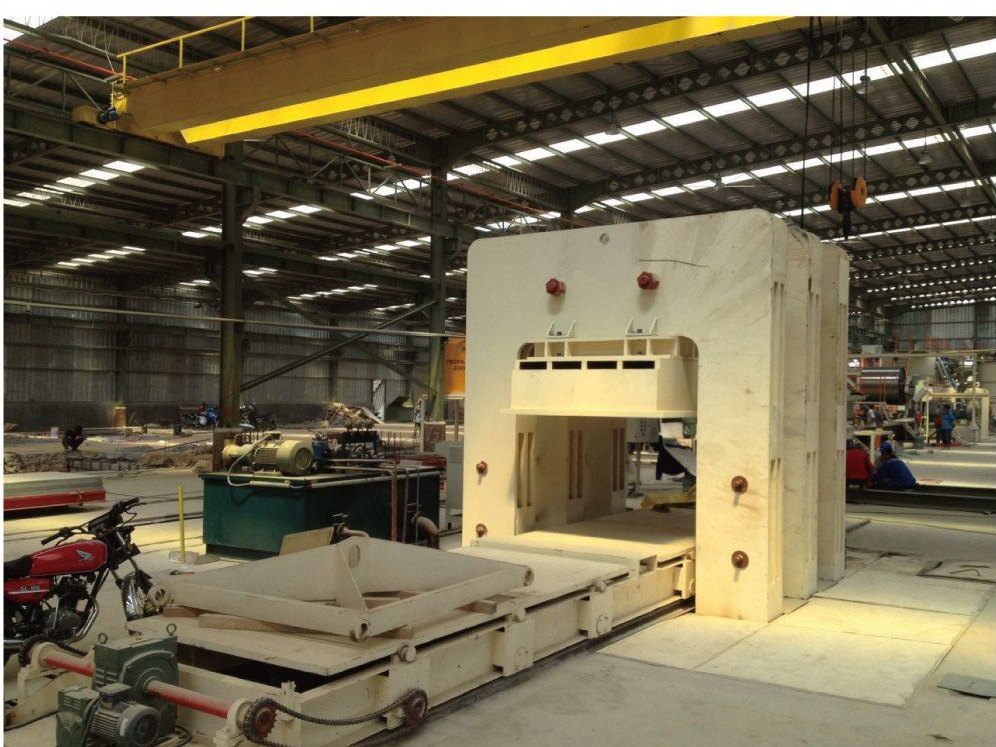
The first question is which sheet the plant makes and is able to make. A pressed sheet is denser and stronger, but it needs a press, and often an autoclave and edge finishing as well. If the line is a corrugated one and there is no press, making LPP to this standard will not work; this is covered in detail in the article on a flat sheet on a corrugated line.
The second question is marking. After Amendment No. 1 every sheet must carry a marking or a label. For the packing area that is a separate operation and a separate consumable.
The third is testing. A flat sheet is checked for bending on every lot, and for impact toughness and frost resistance periodically. The laboratory needs a bending press, a pendulum impact tester, a drying oven, scales and a freezer.
What is inside the standard
Types of sheet
- LPP: pressed. After forming, the sheet is compacted by a press.
- LPN: unpressed. The sheet goes to curing right after forming and cutting.
Each type has its own indicator values. That is why the type must be written in the sheet designation, together with the dimensions and the number of the standard.
Dimensions and shape
The standard sets length, width, thickness and their deviations, squareness, straightness of the edges and flatness. Flatness is critical for a flat sheet: warping is a frequent complaint from facade contractors. The causes of warping are covered in a separate article.
Physical and mechanical indicators
- Bending strength.
- Density.
- Impact toughness.
- Frost resistance: the number of cycles and the residual strength after them.
Water tightness and water absorption are placed in the annexes as recommended methods, not mandatory requirements. The values of the indicators are in the tables of the standard, separately for LPP and LPN.
Appearance and coating
Scrapes, delamination, chipped pieces and through cracks are not allowed. Minor irregularities are allowed within the standard. A painted sheet is checked against a color reference. There must be no efflorescence or stains, and the coating is checked for abrasion with sand.
Acceptance and storage
A lot is the shift output of the line. On every lot the appearance, dimensions, bending strength, density and coating abrasion are checked. Impact toughness is checked about once a month, frost resistance once a quarter. Sheets for testing are taken from different stacks, leaving out the outer sheets of a stack. Sheets are stored on level sites, and the stack height is limited. Painted sheets are covered from precipitation and sun.
Amendment No. 1
The amendment was adopted within the Interstate Council for Standardization; in Russia it was introduced by Rosstandart order No. 200-st of 17.04.2018 and has been in force since 1 January 2019. It corrected the scope and the clause on marking. The current wording is: the marking is applied to the face or the back of every sheet, or to a glued-on label. In the original edition, the marking was applied to at least 1% of the sheets in a lot, or to a label. In the discussion of the draft the amendment was explained as protection against counterfeits and against sheets with no information about the manufacturer.
If the plant holds a printout of the 2012 standard without the amendment, marking can no longer be done by it.
How 2012 differs from 95
GOST 18124-95 was called "Asbestos-cement flat sheets". Asked whether the new standard can be cited in place of the old one, an expert on normacs.info answered no. The argument: the two standards cover different objects, and the new one is written for sheets made with chrysotile. For a plant the conclusion is practical: in quality documents, cite the current GOST 18124-2012 and check that your sheet conforms to it.
How we do it
- From the photo, dimensions and the passport of the unit, we look for the item at the manufacturing plant. What we find, with the price, photos and specifications, we send before the order.
- We inspect the lot at the plant before shipment: part number, dimensions, lot, packaging.
What this article relies on
Below are the documents and materials we refer to, so that you can check what is said for yourself.
Standards and documents
- GOST 18124-2012 "Chrysotile-cement flat sheets. Specifications": types of sheet, indicators, appearance, acceptance, methods, storagetext ↗
- Record card of GOST 18124-2012 on meganorm.ru: Amendment No. 1 (introduced by Rosstandart order of 17.04.2018 No. 200-st from 01.01.2019), the current wording on marking, the voting tabletext ↗
Reference materials
- normacs.info, discussion of the draft Amendment No. 1 to GOST 18124-2012 (marking of every sheet)normacs.info ↗
- normacs.info, an expert's answer on replacing GOST 18124-95 with GOST 18124-2012normacs.info ↗
The values of the indicators for LPP and LPN are in the tables of the standard; this is a retelling without figures.