Standalone machineXinhuibo
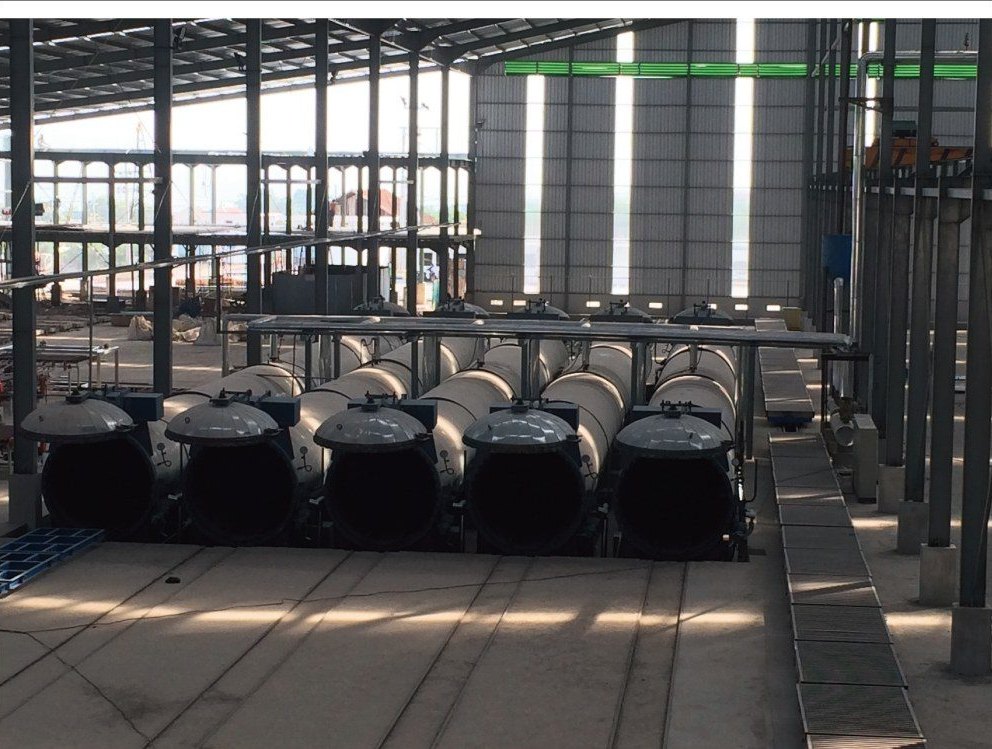
Autoclave for fiber-cement sheet
Holding time12–20h
- TAMINOTA part number
- TMN-XHB-03
- Pressure
- 0.8–1.1 MPa
- Temperature
- 180 °C
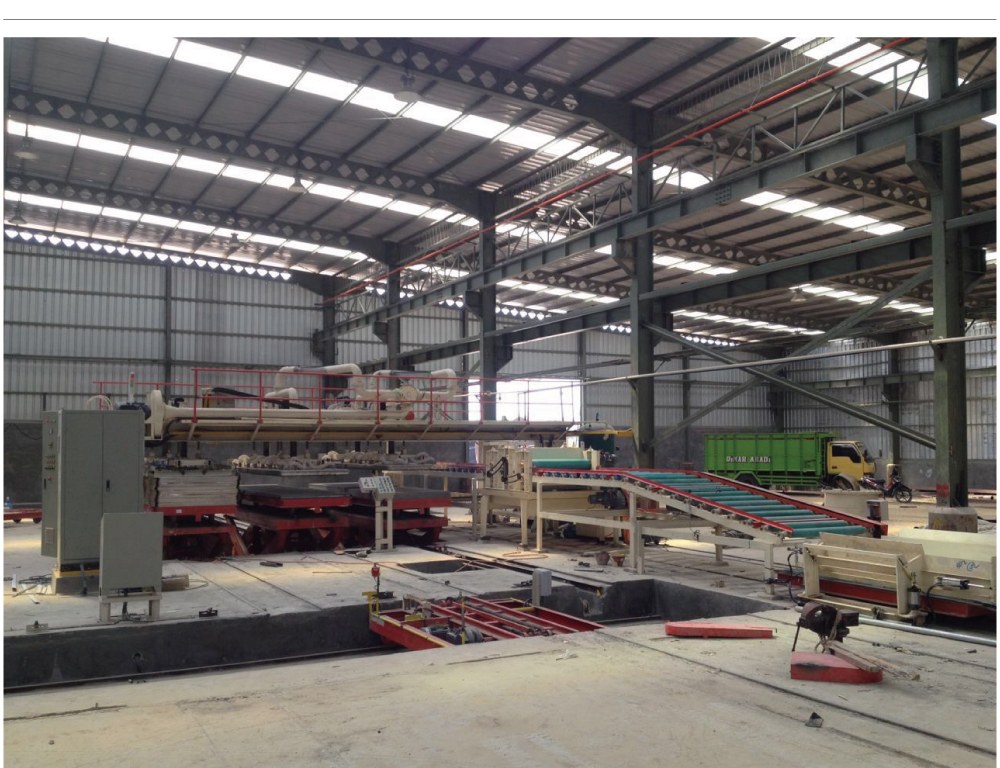
Autoclave curing of the stack after demolding. The cycle has three stages: pressure rise, holding, release. The key stage is holding. During the treatment silica reacts with calcium hydroxide and water to form tobermorite; the hydration products bind the unreacted quartz flour and the reinforcing fiber, and the sheet gains its strength this way. The stacks are loaded by winch on autoclave trolleys with stainless steel pallets.
- Brand
- Xinhuibo
- Category
- Standalone machine
- Industry
- Asbestos and fiber cement
- Availability
- Project supply
What to send for selection
- 01Part number or the number on the nameplate
- 02Photos of the unit and its nameplate
- 03Model of the machine the unit is fitted to
- 04Quantity
Specifications
TMN-XHB-03
- Load
- Лебёдка · тележки
How to get this item
- 01You send the part number or a nameplate photo
- 02You get the plant’s invoice and a lead time
- 03Inspection at the plant, delivery, documents
Related articles
- Slate line machines and which parts wear out firstA fibre-cement sheet line is a chain of stages: raw material preparation, milling, fibre opening, the forming machine, press, curing, demolding, autoclave, cutting. What wears out first is whatever rubs against the slurry and the sheet: forming felts, screens, knives, shaft bearings and slurry pumps.
- Where cracks in slate sheets come from: demolding, stack, roofFirst tie the crack to a time: did it appear right after demolding, in the stack in the finished goods warehouse, or already on the roof. That decides where to look for the cause: forming and curing, drying of the stack, or installation and frost.
- Sheet breaks on impact and laying: why the strength is lowFour things set the bending and impact strength of a sheet: the fibre (how much there is and how it was opened or refined), the cement, the compaction of the layers and the curing. To find out which of them failed, compare the density and strength of the sheet with the norm and look at the fracture: a loose fracture means slurry and compaction, a dense but brittle one means fibre and curing mode.
- White deposit on slate sheets: a defect or notThe white deposit is efflorescence: soluble calcium salts come out to the surface with water and turn into calcium carbonate there. It usually does not affect the strength of the sheet and is a defect of appearance only. But for a painted sheet the GOST does not allow efflorescence, and under the paint it spoils the coating.
- Slate lets water through: watertightness and water absorptionWatertightness is whether water passes through the sheet: under the GOST a column of water is placed on the sheet and after a day the underside is checked for drops. Water absorption is how much water the sheet soaks up; the GOST does not set a limit for it but gives a method. A porous sheet that soaks up a lot of water and lets it through most often has too little cement, weak compaction or early curing.
- Slate crumbles after winter: what frost resistance meansFrost resistance is the number of freeze-thaw cycles in the wet state that a sheet withstands without delamination and without a large loss of strength. A sheet that takes up a lot of water crumbles after winter: the water in the pores freezes, expands and tears the stone. So in production frost resistance is above all density and low water absorption.
- Flat sheet warps and bends: moisture and curingA flat sheet warps when one side dries or gets wet differently from the other: the wet side is longer, the dry side shorter, and the sheet bows. The causes are uneven moisture through the thickness, uneven laying in the stack and drying from one side. GOST 18124-2012 limits warping, and the allowance is larger for unpressed sheets.
- Autoclave at a slate plant: what it is for and what gets servicedAn autoclave is needed where the mix contains ground quartz sand: under saturated steam pressure the sand reacts with the lime from the cement, and the sheet gains strength in a single cycle. What wears out in it: the seal of the quick-opening lid and its mechanism, steam traps and drainage, valves and safety valves, rails and cars. In Uzbekistan the autoclave is pressure equipment and falls under technical regulation CMR No. 493.
- Where a slate plant needs steam and how not to lose it on the wayAt a slate plant steam goes to the autoclave, to the curing chambers and, in winter, to heating water and buildings. It is lost on the way in three places: bare pipes and valves without insulation, faulty steam traps, and condensate drained into a ditch instead of returned to the boiler house.
- Autoclave or air curing: which to choose for the sheetThe choice between an autoclave and curing in air is a choice of mix composition, not only of equipment. The autoclave gives fast strength gain and lets ground sand replace part of the cement, but it needs steam, a boiler and a pressure vessel. A mix with PVA fibre does not survive the autoclave; it is cured in air.
- Can flat sheet be made on a corrugated slate lineIt can: flat and corrugated sheet are formed in the same way, on the same Hatschek machine. A corrugated sheet is made from a flat blank on a corrugator, and a flat sheet bypasses it. But a marketable flat sheet usually needs sections that a corrugated line lacks or has only weak ones: a press, flat pallets, and for facade boards an autoclave, drying, sanding and painting.
- Flat fibre-cement sheet: how the technology differs from slateA flat sheet is formed the same way as slate, on a Hatschek machine. The differences start after the format drum: no corrugating, but often a press; the sheet hardens on flat pallets or in an autoclave; the requirements for flatness, the face and the edge are stricter. The main defects of a flat sheet are warping and marks on the face, which are almost unnoticeable on a corrugated sheet.
- GOST 18124-2012: requirements for flat sheetsGOST 18124-2012 is the interstate standard for flat chrysotile-cement sheets. It divides sheets into pressed (LPP) and unpressed (LPN) and sets dimensions, flatness, bending strength, density, impact toughness and frost resistance. Amendment No. 1, in force from 1 January 2019, requires every sheet to be marked or to carry a label.
- How slate is tested: bending, density, water absorption, frostSlate is checked for bending strength and strength under load, for density, impact toughness, water tightness, water absorption and frost resistance. The methods for corrugated sheets are now in GOST 30340-2012, for flat sheets in GOST 18124-2012; before that they were in GOST 8747-88. Each test answers its own question about the sheet, and each has its own specimen preparation.
- Chinese names of slate line units: felt, screen, autoclaveAt a Chinese plant the felt is 毛毯, the drying mesh is 螺旋干网, the autoclave is 养护釜 or 高压釜, the demolding machine is 脱模机. One unit often goes by two or three names: one word in the catalog, another in a patent or in correspondence. So the Chinese name in a request helps, but the photo, dimensions and nameplate decide.
- Winter at a slate plant: water, curing, heatingIn winter a slate plant loses on three things: recirculated water and pipes freeze, the sheet cures more slowly and may freeze while still green, and fresh sheet on an open yard takes up moisture and freezes. Preparation starts in autumn: insulating and heating pipes and tanks, warming the water and slurry, heat in the curing chambers and the shop, a place to store sheet.
- Gas for steam and heat: where a slate plant loses the mostA slate plant's gas burns in the boiler and is lost on the way in three places: in the boiler itself (excess air in the furnace, hot flue gas, scale and soot, blowdown without heat recovery), in the steam network (bare pipes, failed steam traps, dumped condensate) and at the consumer (chambers and autoclave with open doors and no insulation). The cheapest check is a flue gas analysis and burner tuning.
- Press and autoclave: what is checked for safetyOn a press, what is checked is what keeps a person from ending up under the platen: guards, interlocks, emergency stop, holding of the platen and isolation of energy before repair, including pressure in the hydraulics. On an autoclave, it is what keeps the lid from being opened under pressure: the quick-opening lid interlock, safety valves, pressure gauges, passport and inspection. In Uzbekistan the autoclave falls under the technical regulation of Cabinet Resolution No. 493.
- New slate line: what to decide before talking to a plantBefore you ask a manufacturing plant for a line quotation, decide seven things: which sheet you will make, from what raw materials, how many sheets per shift the market needs, how the sheet will cure, where the line will stand, where steam, water and electricity will come from, and who will run it. Without these answers, quotations from different plants cannot be compared.
- Workshop for a slate line: what to prepare before equipment arrivesBy the time the line arrives, the workshop must be ready to receive it: foundations and pits poured to the manufacturing plant's drawings and cured to strength, water, drainage, electricity, steam and compressed air brought to the connection points, the overhead crane working, access routes clear. The buyer does all this under the brief that the plant issues with the workshop plan.
- Buying a used slate line: what to check before payingBefore paying for a used line, it is inspected on site while it is still assembled and, best of all, running: year of manufacture and hours of operation, condition of the shafts, vats, screens, format drum and press, electrics and controller programs, autoclave and boiler documents, completeness against the inventory. Separately, decide who will dismantle, transport and reassemble it, and how.
- Technical specification for a slate line: what to write to the plantA technical specification is your requirements for the line on paper: which sheet and to which standard, from what raw materials, how much per shift, how it cures, what is in the supply, what automation, in what language the documents are, which spare parts and training, how you will accept it. It is attached to the contract, and the line is later accepted against it.
- Whom to train and in what when starting a slate lineWhen a line is started, five groups are trained: operators of the forming machine and adjacent stages, the technologist, the mechanic, the electrician and the laboratory technician. Each needs its own training, on the line and on paper. Training is written into the contract with the manufacturer: whom, in what, when, in what language, and how it is checked that people have learned.
- Fibre cement facade boards: can a slate plant make themA facade board can be formed on the same Hatschek machine as slate. But a facade board is a different product: it needs a press, curing to the board's own recipe, precise cutting, often sanding, primer and a coating on the face, and to be sold under European requirements it needs EN 12467 tests for strength and resistance to water, frost and temperature swings. It is not "slate without the wave" but a separate process stage and a separate market.
- Oversize equipment (press, autoclave): how it is shippedOversize cargo is cargo that does not fit an ordinary container or the road clearance in width, height, length or weight. It travels on platforms and in open containers, with transit permits and a planned route. The main decisions are made before packing: what the plant will dismantle, what packages that leaves and how each one will be lifted.
- Quartz sand for autoclaved fibre cement: its role and the dust hazardGround quartz sand works in the sheet as a reagent during autoclave treatment: under steam pressure the silica reacts with the lime of the cement and gives calcium silicate hydrates. That is why the sand is ground to a fineness close to that of cement, and the fineness is monitored with a sieve and by specific surface. The dust of ground quartz is respirable crystalline silica: it causes silicosis and is classed as a Group 1 carcinogen.
- How much steam a slate plant needs: estimating the boilerBoiler capacity is worked out not from the floor area of the shop and not from a salesman's advice, but from the steam consumers: how much heat goes into warming the autoclave, the cars and the sheets, how much is lost through the walls and the steam line, and how often the cycles overlap. The main consumer is the heat-up: the peak rests on it. Then the boiler figure is converted from the nominal one to the actual one: it depends on the pressure and on the feedwater temperature.
- Verifying scales and instruments at a slate plant: law and GOSTA sheet test result is worth as much as the instrument it was obtained with. GOST 30340-2012 sets the accuracy of the scales, the caliper and the bending testing machine. The Uzbek law "On Metrology" names the areas where measurements are under state control: accounting of material assets, industrial safety, quality of certified products, conformity assessment. Instruments for such measurements are, as a general rule, verified; where the law allows calibration instead of verification, check with the metrology service.
Request
Send a part number or a photo — we will find the factory
Items from the catalog · 1
- TMN-XHB-03 · Autoclave for fiber-cement sheet