Flat sheet warps and bends: moisture and curing
A flat sheet warps when one side dries or gets wet differently from the other: the wet side is longer, the dry side shorter, and the sheet bows. The causes are uneven moisture through the thickness, uneven laying in the stack and drying from one side. GOST 18124-2012 limits warping, and the allowance is larger for unpressed sheets.
In short
5minutes to read
5sections
6sources
4catalog items
In this article
A flat sheet warps when its sides behave differently. Cement stone lengthens slightly when it gets wet and shortens when it dries. If one side is wetter than the other, it is longer, and the sheet bows with the dry side inward. So warping is almost always tied to moisture: the sheet dried unevenly through its thickness, in the stack one side was open and the other pressed down, the sheet lay unevenly while it cured. GOST 18124-2012 limits warping, and in it the allowance for unpressed sheets is larger than for pressed ones.
What the standard requires
GOST 18124-2012 for flat sheets sets the deviation from flatness. It is measured like this: a metre ruler is placed on edge on the face side along the diagonals, and the largest gap is recorded. For pressed sheets the allowance is smaller, for unpressed ones larger. Take the exact values from the current edition of the standard with Amendment No. 1.
The same standard describes storage at the consumer: on a flat horizontal area, in packs or stacks on pallets, with a limit on the height of the pile. Coated sheets are protected from precipitation and direct sun, and packs are not placed on top of each other.
Why the sheet bows
Moisture through the thickness
In a thesis on asbestos-cement sheets (University of Surrey, 1986) the sheets were tested for wetting and drying, and the warping stresses caused by uneven moisture in the sheet were calculated. The sharper the difference between the sides, the stronger the bow.
From this comes a practical rule: a sheet must not dry from one side. Typical cases:
- the top sheet in the stack is open to sun and wind, while the underside is pressed against its neighbor;
- the pack stands by a wall or on a wet floor, and one side draws moisture;
- a coated sheet: the painted side gives up water more slowly than the unpainted one.
Drying in the stack
A study of air-cured corrugated sheets showed the same at the edges of the stacks. The edges of the stack give up water faster than the middle, hence stresses and cracks. On a flat sheet the same difference over the area gives warping and a wave along the edge.
Laying during curing
The green sheet is plastic. If it cures on an uneven pallet, with a spacer in the wrong place or under uneven load, it remembers that shape. The causes:
- bent or dirty pallets;
- skew when laying on the pallet in the stacker;
- a pack pressed unevenly.
Pressing
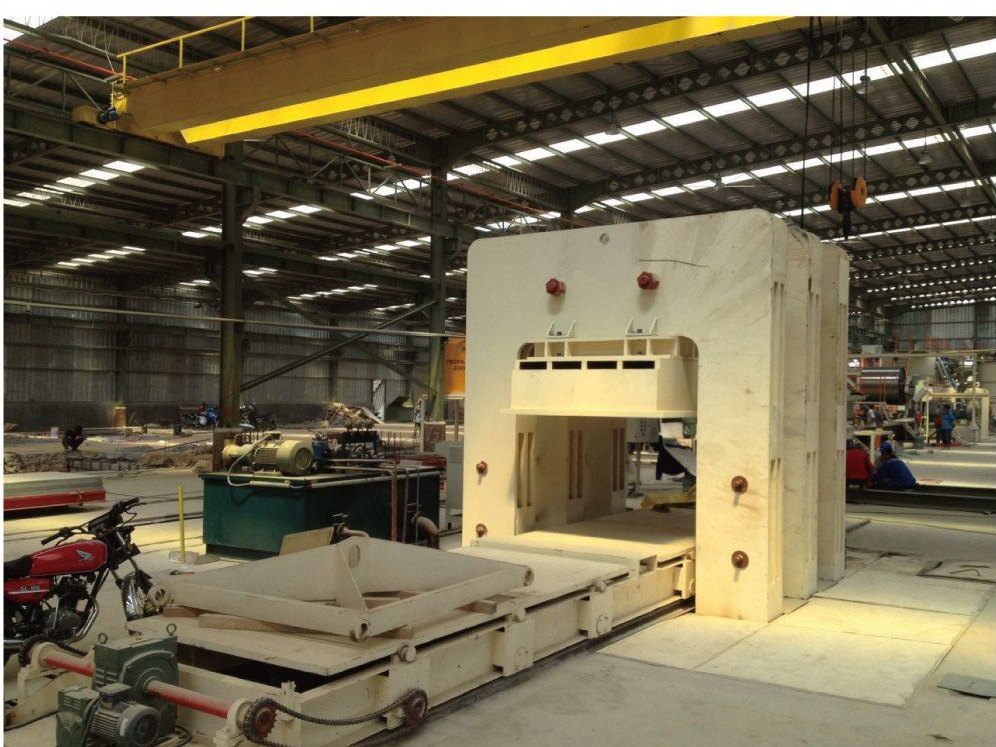
A pressed sheet is denser and, by the standard's requirements, must be flatter. Uneven pressure over the area of the press, a skewed platen or a different height of the stack gives a sheet of different density over its area. Such a sheet dries and warps unevenly.
Autoclave or air curing
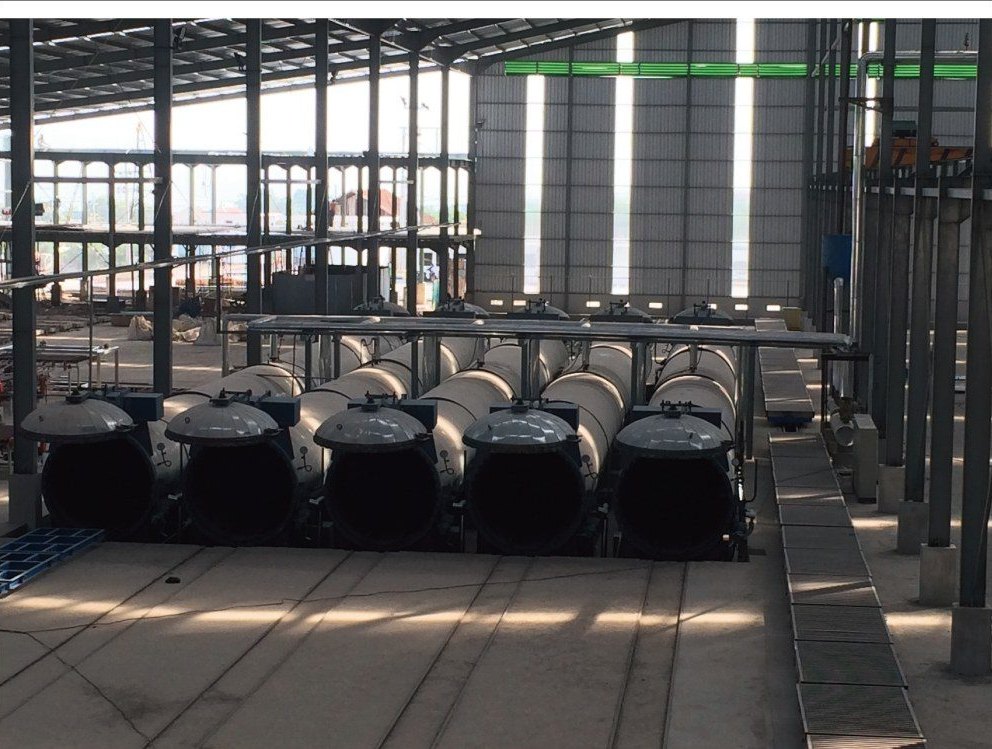
Textbooks on asbestos cement describe two routes. Air curing: steam curing chambers, then conditioning in the finished goods warehouse. Autoclave: steam under pressure, after which no conditioning is needed. On an autoclave line the cycle itself matters. A patent on fibre-cement products notes that the speed of pressure rise and release in the autoclave affects damage to the sheets. A sharp pressure release means sharp evaporation, and the stack dries unevenly.
With air curing the sheet gives up water for longer. Until it comes into equilibrium with the air, its shape can change.
How to look for the cause
- Where the sheets warp. Only the top ones in the pack: drying from one side. All alike: press, pallets or mode. Sheets from the same position in the pack: laying.
- Which way the bow goes. Bowed toward the face side or the back side shows which side was drier.
- When it appeared. Right after demolding: pallets and laying. After days in the finished goods warehouse: drying. At the buyer's: storage and installation.
- Moisture. Compare the moisture of the sheet at the edge and in the middle, at the face and the back side.
- Press. Check the pressure on the gauge and the flatness of the platens.
What to do
- keep packs on flat pallets, under a canopy, without one-sided sun and wind;
- do not leave the top sheet open; cover the pack;
- check pallets for flatness and cleanliness, and take crooked ones out of use;
- for pressed sheets, watch the evenness of the pressure;
- give the buyer the storage requirements: a flat area, cover, coated sheets not to be wetted. Manufacturers of fibre-cement boards require them to be stored under cover and not installed wet.
How we do it
- From the number, drawing or photo of the unit, we look for the item at the manufacturing plant. What we find, with the price, photos and specifications, we send before the order.
- We inspect the lot at the plant before shipment: part number, dimensions, lot, packaging.
What this article relies on
Below are the documents and materials we refer to, so that you can check what is said for yourself.
Standards and documents
- GOST 18124-2012 "Chrysotile-cement flat sheets. Specifications": deviation from flatness, measurement method, storage and transporttext ↗
Reference materials
- Baroonian A. "Theoretical and experimental investigation of fibre cement corrugated sheeting under load", doctoral thesis, University of Surrey, 1986: warping stresses in asbestos-cement sheets from different moisture through the thicknessopenresearch.surrey.ac.uk ↗
- Fiorelli J. et al. "Durability of fibre-cement roofing corrugated sheets", CIB DC33112: difference in moisture between the edge and the middle of the stack, drying shrinkageirbnet.de ↗
- Rybyev I. A. "Building Materials Science" (Строительное материаловедение), section "Fundamentals of asbestos-cement product manufacturing": steam curing chambers and autoclave, pressing of flat productsstudme.org ↗
- Patent US 6346146 "Building products": speed of pressure rise and release in the autoclavepatents.google.com ↗
- Nichiha, "AWP Troubleshooting Guide": store under cover, do not install wetnichiha.com ↗
The European standard for flat fibre-cement sheets, EN 12467, was not opened in preparing this article, and its requirements are not retold here. The curing and autoclave modes follow the process regulations of your line.