Slate lets water through: watertightness and water absorption
Watertightness is whether water passes through the sheet: under the GOST a column of water is placed on the sheet and after a day the underside is checked for drops. Water absorption is how much water the sheet soaks up; the GOST does not set a limit for it but gives a method. A porous sheet that soaks up a lot of water and lets it through most often has too little cement, weak compaction or early curing.
In short
4minutes to read
7sections
7sources
4catalog items
In this article
Contents
These are two different indicators. Watertightness answers the question of whether water passes through the sheet. Under the GOST a column of water is placed on the sheet, and after a day the back side is examined: there must be no drops. Water absorption shows how much water the sheet soaks up, as a percentage of its mass. The GOST does not set a limit for it but gives a method. High water absorption is a sign of a porous sheet. Such a sheet holds water worse and withstands frost worse. In production, porosity usually comes from a shortage of cement or fines in the slurry, weak compaction and over-dried or early curing. If the sheet itself passes the test and the roof still leaks, the cause is in the installation.
What the standard requires
Corrugated sheets. GOST 30340-2012 requires the sheet to withstand a column of water for a set time without drops on the back side. This is checked periodically, at least as often as the standard sets, together with frost resistance. The standard does not set a limit for water absorption but gives the method for determining it in a recommended appendix.
Flat sheets. In GOST 18124-2012 watertightness is moved to a recommended appendix. It is checked when the consumer asks for it; it matters for sheets that go on a roof.
EN 494. In Europe the watertightness of profiled sheets is a mandatory item of the declaration. Manufacturers write: traces of moisture may show on the lower surface, but drops must not form.
How watertightness is tested
The essence of the method under the GOST:
- A tube is placed on the face side of the sheet in a wave trough, or a frame over several waves. The joints are sealed.
- Water is poured in to the set height.
- After a day the back side is examined.
- No drops means the sheet is watertight. A dark damp patch without drops is not counted as a defect.
Take the height of the column, the dimensions of the tube and the time from the current edition of the standard.
How water absorption is tested
Specimens are dried in a drying oven at 105–110 °C for at least 24 hours, weighed, kept in water and weighed again. The difference, related to the dry mass, is the water absorption. European manufacturers state their own water absorption limit in the technical data of the sheet. That is their own indicator, not a requirement of the standard.
For a plant, water absorption is a convenient control: it changes before the sheet starts to leak or crumble.
What makes a sheet porous in production
- Too little cement or fines in the slurry. The cement fills the pores between the fibres. If there is not enough of it, channels remain.
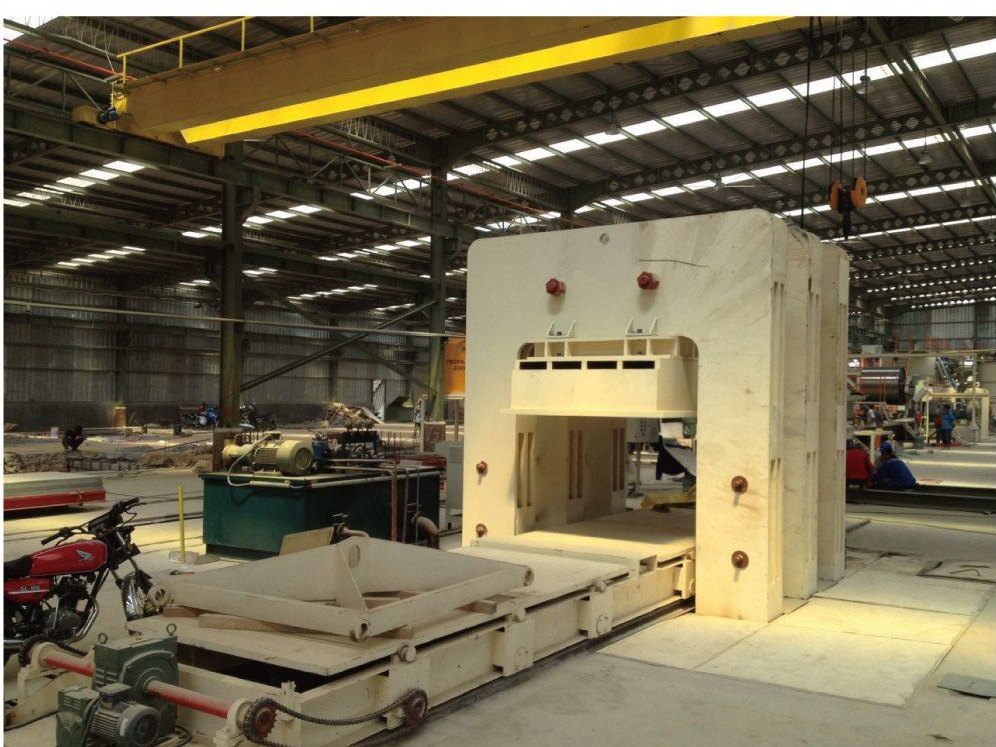
- Weak compaction. A pressed sheet is denser than an unpressed one; this is seen also in the GOST density requirements. A press that does not hold pressure gives a porous sheet.
- Delamination. Water runs between poorly bonded layers as through a crack.
- Curing. If the green sheet dried out before the cement gained strength, the stone comes out porous. In a study of air-cured corrugated sheets, specimens that went through accelerated carbonation (their pores are denser) absorbed and released less water and shrank less.
- Fibre. Clumps of poorly opened fibre leave loose areas.
If the roof leaks but the sheet is normal
Often the water goes not through the sheet but through the joints and fasteners.
- Overlaps. The codes of practice for roofs require the cross overlaps to be directed against the prevailing wind and roll waterproofing to be laid under the sheets.
- Fasteners. The sealing washer is tightened so that it presses down but is not crushed. An under-tightened and an over-tightened fastener let water through alike.
- Cracks from installation at holes and in corners where sheets meet.
- Slope below what is allowed for the profile.
To tell the cases apart, ask the buyer where it leaks: over the whole area of the sheet or at joints and fasteners.
What the plant should do
- Check the log of periodic watertightness tests.
- Introduce water absorption control by shift, if there is none. A sharp rise is a signal before defects appear.
- If water absorption rises, check cement dosing, density, press pressure, curing mode.
- Check frost resistance separately: it is directly linked to water absorption.
How we do it
- From the photo, dimensions and the passport of the unit, we look for the item at the manufacturing plant. What we find, with the price, photos and specifications, we send before the order.
- We inspect the lot at the plant before shipment: part number, dimensions, lot, packaging.
What this article relies on
Below are the documents and materials we refer to, so that you can check what is said for yourself.
Standards and documents
- GOST 30340-2012 "Chrysotile-cement corrugated sheets. Specifications": requirement and test method for watertightness, water absorption method, frequency of teststext ↗
- GOST 18124-2012 "Chrysotile-cement flat sheets. Specifications": watertightness and water absorption in recommended appendices, density of pressed and unpressed sheetstext ↗
- SP 31-101-97 "Design and construction of roofs": overlaps of corrugated sheets, underlay layertext ↗
Reference materials
- Declaration and technical data of profiled sheets to EN 494 (Eternit Baltic): watertightness, with traces of moisture allowed but no drops; own water absorption limittaloon.com ↗
- Declaration of performance of Swisspearl W177 to EN 494: watertightness "no drops"swisspearl.com ↗
- Fiorelli J. et al. "Durability of fibre-cement roofing corrugated sheets", CIB DC33112: uptake and release of water, link between pores and shrinkageirbnet.de ↗
- Cladco, "Installation Guide: Fibre Cement Sheets": tightening fasteners with a sealing washercladco.co.uk ↗