White deposit on slate sheets: a defect or not
The white deposit is efflorescence: soluble calcium salts come out to the surface with water and turn into calcium carbonate there. It usually does not affect the strength of the sheet and is a defect of appearance only. But for a painted sheet the GOST does not allow efflorescence, and under the paint it spoils the coating.
In short
4minutes to read
6sections
5sources
2catalog items
In this article
Contents
The white deposit on slate sheets is efflorescence. The cement stone contains soluble compounds, above all calcium hydroxide. Water carries them to the surface and evaporates, and the salt stays behind. In air it reacts with carbon dioxide and turns into white calcium carbonate. On an unpainted sheet this is a defect of appearance. It usually does not affect strength or watertightness, and over time it is often washed off by rain. On a painted sheet the deposit is already a defect: the GOST requires paint without efflorescence, and salt under the paint can make it peel.
When the deposit appears
Efflorescence needs three conditions at once:
- the material contains soluble salts;
- there is water that dissolves them;
- there is a path by which the solution reaches the surface: pores and capillaries.
Remove any one of the three and there will be no efflorescence. So it is linked not to a single cause but to a chain: slurry composition, curing, storage, conditions on the roof.
Efflorescence on asbestos-cement sheets has been known for a long time. As early as the 1940s the journal of the American Concrete Institute described experiments in which sheets were treated with carbon dioxide to bind the free lime in advance and reduce the deposit. Fibre-cement manufacturers write the same today: the deposit is a natural phenomenon for all cement-based materials, including brick, mortar and concrete.
Defect or not
Unpainted corrugated sheet. GOST 30340-2012 does not specifically regulate efflorescence on unpainted sheets. The deposit does not reduce strength and usually goes away with time. A buyer who sees the deposit on a new roof is told what it is. If the deposit is heavy and in patches, that is a reason to check production: it means the sheet takes up and gives off a lot of water.
Painted sheet. Here it is stricter. Under the GOST the coating must be even, without efflorescence and without patches visible from a distance. European patents on painted fibre cement name efflorescence directly as a defect of appearance that shows up months after manufacture. Mechanical properties do not suffer. For a plant that paints the sheet, efflorescence is a frequent cause of claims.
Flat sheet for cladding. The buyer looks at the face side, and the deposit is visible. The requirements are usually set out in the contract.
What in production affects efflorescence
- Excess water in the sheet. The more pores and capillaries in the stone, the easier it is for the solution to get out. A porous sheet comes from weak compaction, loose slurry, lack of cement.
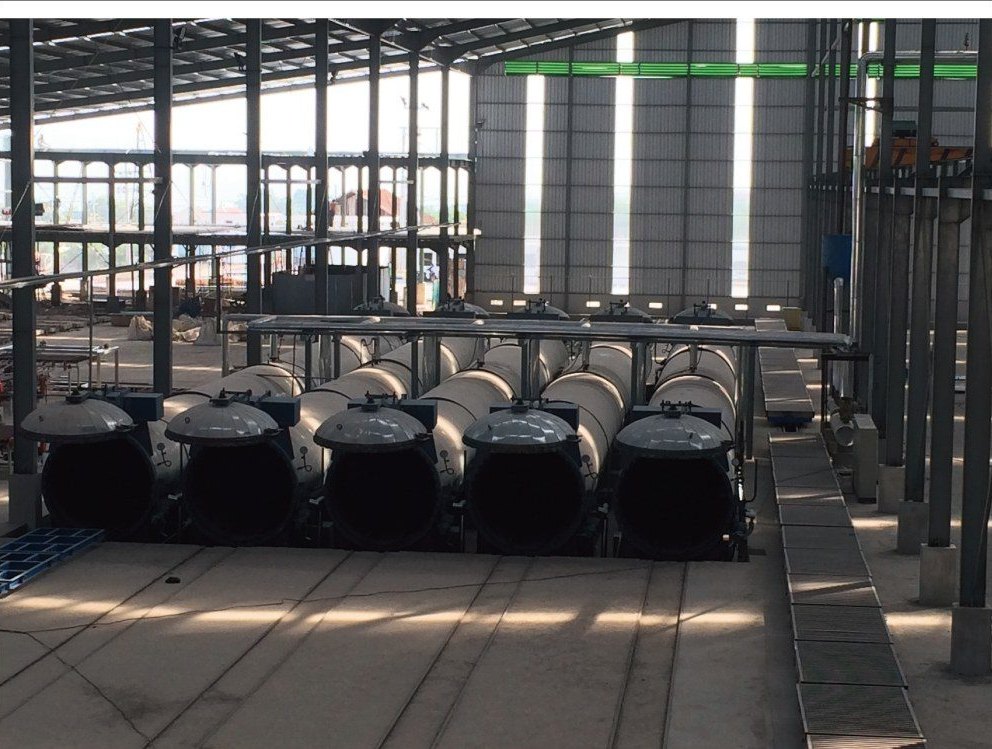
- Curing. Lime bound in the hardened stone does not come to the surface. The curing and autoclave mode affects how much free lime remains. On an autoclave line, the silica from ground quartz binds calcium hydroxide into new compounds.
- Storage of fresh stacks. A stack that gets wet in the rain and then dries in the sun drives water through the sheet. Fibre-cement manufacturers require sheets to be stored under cover and not installed wet.
- Painting a green sheet. If you paint a sheet that still holds a lot of water, the salt will come out under the paint.
Which measures suit your line is decided by the process engineer. There are no mode figures here on purpose: they depend on the cement, the recipe and the equipment.
How to remove the deposit
Manufacturers of fibre-cement sheets suggest:
- waiting: on an unpainted sheet the deposit often washes off by itself;
- a soft brush or cloth with water or a mild household detergent; do not use high-pressure washers;
- a weak solution of table vinegar or a special efflorescence cleaner, first on a small inconspicuous area;
- not rubbing a painted surface hard, so as not to damage the paint.
For old slate, the procedure for working on the surface is set by the sanitary rules in force in your country. We do not retell them in this article.
How to answer a buyer's claim
- Determine whether the sheet is painted or not.
- Check the lot number and the date of manufacture from the marking.
- Ask for photos: whether the deposit is even or in patches, under the paint or on top of it.
- For a painted sheet, check the paint requirement in the GOST and test the coating.
- Explain to the buyer the nature of the deposit and the cleaning method, if the sheet is unpainted and otherwise normal.
How we do it
- From the photo, dimensions and the passport of the unit, we look for the item at the manufacturing plant. What we find, with the price, photos and specifications, we send before the order.
- We inspect the lot at the plant before shipment: part number, dimensions, lot, packaging.
What this article relies on
Below are the documents and materials we refer to, so that you can check what is said for yourself.
Standards and documents
- GOST 30340-2012 "Chrysotile-cement corrugated sheets. Specifications": requirements for painted sheets, without efflorescence and patchestext ↗
Reference materials
- Hutchcroft C. R., Anderson H. R. "The Use of Carbon Dioxide to Reduce Efflorescence on Asbestos-Cement Shingles", ACI Journal Proceedings, vol. 37, 1941concrete.org ↗
- Nichiha, "AWP Troubleshooting Guide", section "Efflorescence": three conditions for efflorescence, storage under cover, cleaningnichiha.com ↗
- European patent EP 3313804 (painted fibre cement): efflorescence as a defect of appearance, appears after months, does not affect mechanicsdata.epo.org ↗
- taminota.com catalog: TMN-XHB-03, binding of calcium hydroxide by silica in the autoclave.