Quartz sand for autoclaved fibre cement: its role and the dust hazard
Ground quartz sand works in the sheet as a reagent during autoclave treatment: under steam pressure the silica reacts with the lime of the cement and gives calcium silicate hydrates. That is why the sand is ground to a fineness close to that of cement, and the fineness is monitored with a sieve and by specific surface. The dust of ground quartz is respirable crystalline silica: it causes silicosis and is classed as a Group 1 carcinogen.
In short
8minutes to read
7sections
9sources
2catalog items
In this article
- 01What the owner needs to decide
- 02Why sand is in the sheet
- 03How much sand is in the slurry
- 04What fineness of grinding is needed
- 05What to ask the quarry and what to check in a batch
Contents
Ground quartz sand is put into the slurry first of all when the sheet is cured in an autoclave. Under the pressure of saturated steam, the silica of the sand reacts with the lime released as the cement hardens and forms calcium silicate hydrates. The hardening of an autoclaved sheet rests on this reaction. So that the reaction has time to complete within the cycle, the sand is ground to a fineness close to that of Portland cement. That is why a plant with an autoclave has a ball mill, grinding control and a separate concern: the dust of ground quartz. It is respirable crystalline silica: it causes silicosis and is classed by the International Agency for Research on Cancer as carcinogenic to humans.
What the owner needs to decide
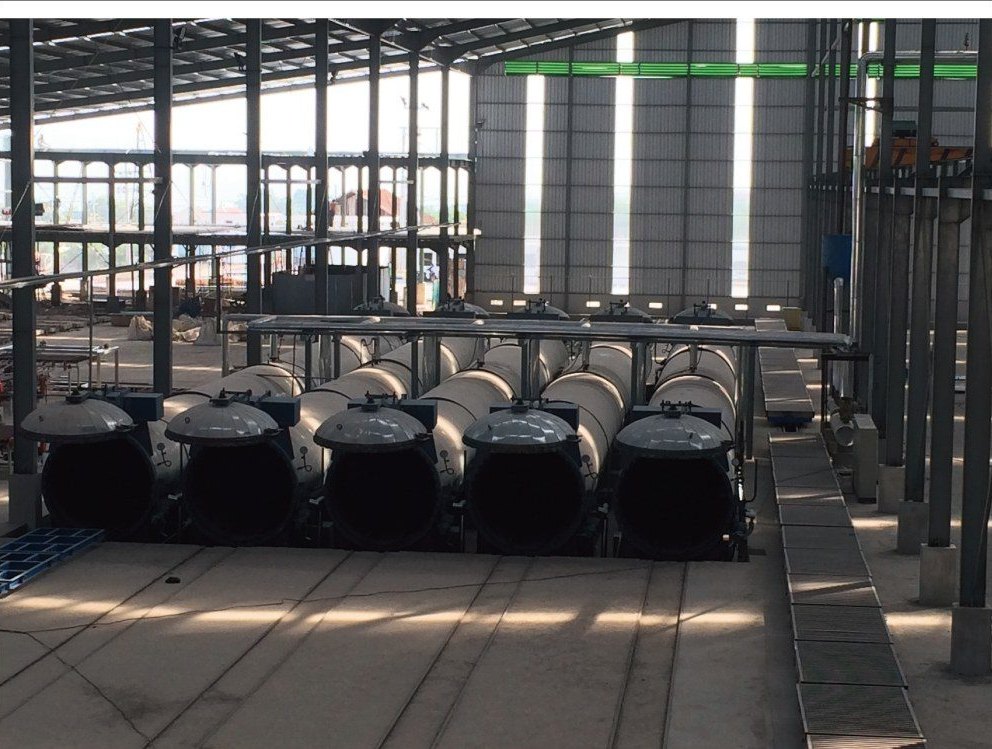
- Whether there is an autoclave. The sand in the slurry is designed for the autoclave. According to Rybyev's textbook, it is hardening in the autoclave that allows sandy cement to be used in asbestos cement and the product not to be held in a warehouse.
- Whether there is stable sand. One quarry with a constant composition is needed. Sand "whatever was delivered" changes the grinding and the strength of the sheet.
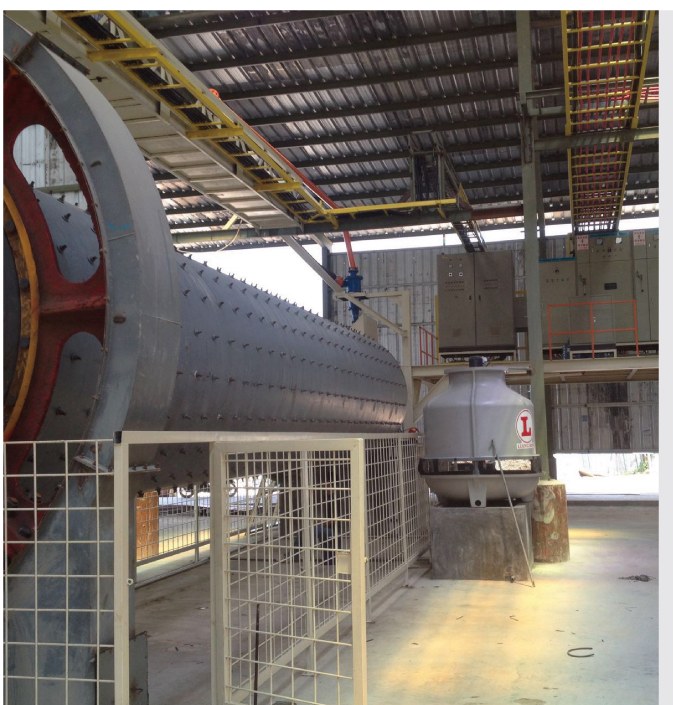
- Whether there is grinding and control. A ball mill, a sieve and an instrument for specific surface, a lab technician who measures every shift.
- Whether you are ready to protect people from dust. This is not an add-on but part of the process stage. On protection, see below.
Why sand is in the sheet
| Curing method | Sand in the slurry | What happens |
|---|---|---|
| Steaming and holding in a warehouse | As a rule, none | The sheet cures on cement. Per Rybyev: steaming at 50–60 °C and 90–95% humidity for 10–14 h, then 5–7 days in an insulated warehouse |
| Autoclave | Yes, ground | Silica reacts with the lime of the cement, calcium silicate hydrates form. In Rybyev: steam at a pressure of 0.8 MPa |
The autoclave shortens curing: in patent US 9388076 air curing is called a process of usually 28 days and autoclave curing usually less than 3 days, at a temperature of up to 175 °C, preferably 160 °C. In the patent of the Danish manufacturer Dansk Eternit, autoclave treatment is carried out at 100–240 °C, preferably 130–190 °C; in the laboratory example the cycle is 2.5 h of pressure rise, 16 h of holding and 2.5 h of release, with the samples treated at 160 °C. The regime of your autoclave is set by the process regulations and the vessel passport, not by these examples.
How much sand is in the slurry
The figures are from open patents. They are other people's recipes, not a norm.
| Product | Composition per patent |
|---|---|
| Autoclaved asbestos-cement sheet (known recipe, pressed) | 15% asbestos, 51% Portland cement, 34% ground sand |
| Autoclaved fibre cement, general range | 30–50% cement, 40–60% silica |
| Autoclaved sheet on unbleached cellulose, Australia and the USA | about 35% cement, about 55% finely ground silica |
The ratio of sand to cement is chosen by the technologist. According to open patents, with an excess of silica it stays unreacted, and with an excess of lime (too little silica) the sheet comes out brittle. For details, see the article "Autoclave or air curing".
What fineness of grinding is needed
The benchmark is the fineness of Portland cement. This is stated in the European application of Dansk Eternit: ground quartz, quartz sand and other siliceous components are taken with a fineness corresponding to Portland cement.
| Material in the patent | Specific surface |
|---|---|
| Portland cement in the Dansk Eternit example | 2300 cm²/g (by Blaine) |
| Ground SiO₂ in the same example | about 4500 cm²/g, mean particle size about 20 µm |
| Ground silica in the previously known solution | 3000–5000 cm²/g |
| Ground siliceous sand (aggregate) in patent US 6676744 | 300–450 m²/kg (this is 3000–4500 cm²/g); cement in the same patent: 250–400 m²/kg |
The required value for your line is taken from the regulations. If there are no regulations, they are requested from the line manufacturer and tested on trial sheets.
How to control grinding
For cement, methods of controlling fineness are described by EN 196-6. The standard itself is written for cements, but the same techniques, sieving and the Blaine instrument, are applied to ground sand too; the procedure for sand is set by the laboratory regulations.
- Residue on the sieve. Shows whether there are coarse particles. Suitable for shift-by-shift control of the mill.
- Specific surface by Blaine (air permeability). Shows how finely the powder is ground. Under EN 196-6 this method checks, above all, the constancy of grinding at one plant.
If the residue on the sieve rises or the specific surface falls at the same feed, look at the mill: balls, lining, diaphragm, and also whether different sand has arrived. On mill wear, see the article "Ball mill for sand".
What to ask the quarry and what to check in a batch
- Chemical composition: SiO₂ content and the main impurities by laboratory analysis, with a date.
- Particle size distribution of the raw sand: the work of the mill depends on it.
- Consistency: one section of the quarry, the same composition from batch to batch.
- In every batch at the plant: a sample for grinding in the usual mill regime, residue on the sieve and specific surface. A strong deviation is a reason to stop the batch and show it to the technologist.
- A new quarry only through trial sheets: strength, water absorption, appearance after the autoclave.
The permissible content of silica and impurities is set by the regulations of your line. We do not give a single figure for all lines.
Dust of ground quartz: safety of people
Crystalline silica in the form of quartz or cristobalite is classed by the International Agency for Research on Cancer in Group 1, carcinogenic to humans (volumes 68 and 100C). Breathing in its particles causes silicosis, an irreversible fibrotic lung disease. It is the fine, respirable dust that is dangerous. And it is exactly this that dry grinding, transfer, sieving and cleaning produce.
An example of a norm is the American standard OSHA 29 CFR 1910.1053 for industry (text checked on 30.10.2026):
- the permissible limit of respirable crystalline silica is 50 µg/m³, averaged over an 8-hour shift;
- the level at which mandatory measures begin is 25 µg/m³;
- first of all engineering controls and work practices, a respirator where they are not enough;
- medical surveillance with a chest X-ray for those who work 30 or more days a year at a concentration at or above the action level;
- dry sweeping and brushing are not allowed where they add dust to the air, if wet cleaning, a vacuum with a HEPA filter or another method that reduces dust is possible; clothing and surfaces are not blown off with compressed air, except where ventilation captures the dust cloud or there is no other way.
A plant in Uzbekistan and neighbouring countries is subject to its own sanitary norms. Check the limit values and the procedure for medical examinations against them and with the sanitary supervision authority of your country.
What is done in practice:
- Sand and ground powder transfer points are enclosed, and extraction is installed at the mill, hoppers and screw conveyors.
- Dust levels in the air of the working zone at the mill and transfer points are measured.
- Dust is removed by wet cleaning or with a vacuum cleaner, not with a broom or compressed air.
- Where enclosure and extraction are not enough, and when cleaning units, respirators are issued and it is checked that they are worn.
- Cleaning and repair of the mill are done only with the drive stopped and locked out.
How we do it
- We select the ball mill for quartz sand and the autoclave at the manufacturing plant to suit the line capacity. What we find, with specifications, we send before the order.
- From a number, drawing or photo we select spare parts for the mill: lining, grates, balls, bearings.
- We work under a contract with the manufacturing plant. We check the batch at the plant before shipment. A defect confirmed by an inspection report is replaced by the manufacturing plant; we go after the replacement.
What this article relies on
Below are the documents and materials we refer to, so that you can check what is said for yourself.
Standards and documents
- OSHA 29 CFR 1910.1053 "Respirable crystalline silica": definition, limit of 50 µg/m³ over 8 h, action level of 25 µg/m³, engineering controls, respirators, restriction of dry cleaning and blowing with compressed air with exceptions (h)(1), (h)(2), medical surveillance with an X-ray at the action level for 30 or more days a yeartext ↗
- OSHA 29 CFR 1910.147 "The control of hazardous energy (lockout/tagout)": lockout of energy sources when servicing machinestext ↗
- EN 196-6:2018 "Methods of testing cement — Part 6: Determination of fineness": sieving (only the presence of coarse particles), air-jet sieving, air permeability by Blaine (above all the constancy of grinding at one plant); scope: cements per EN 197text ↗
- IARC Monographs, volume 100C "Arsenic, Metals, Fibres, and Dusts" (2012), section "Silica Dust, Crystalline, in the form of Quartz or Cristobalite"text ↗
Reference materials
- European application EP 0263723 A2, Dansk Eternit-Fabrik A/S, 1988: siliceous components react with lime in the autoclave to form calcium silicate hydrates, fineness as for Portland cement, specific surface of cement and ground SiO₂, composition of an asbestos slurry with ground sand, autoclave temperature and cycledata.epo.org ↗
- Patent US 6676744 B2, "Background" section and description: 30–50% cement and 40–60% silica in autoclaved products; about 35% cement and 55% ground silica; specific surface of the binder 250–400 m²/kg and of the aggregate (preferably ground siliceous sand) 300–450 m²/kgpatents.google.com ↗
- Patent US 9388076 B2: air curing usually 28 days, autoclave curing usually less than 3 days, autoclave up to 175 °C, preferably 160 °Cpatents.google.com ↗
- Rybyev I. A. "Building Materials Science" (Строительное материаловедение), section "Fundamentals of the production of asbestos-cement products": steaming and holding regime, autoclave with steam at 0.8 MPa and sandy cementstudme.org ↗
- CAREX Canada, profile "Silica (crystalline)": IARC Group 1 (volumes 68 and 100C), silicosis as an irreversible fibrotic lung disease, link with lung cancercarexcanada.ca ↗