Standalone machineXinhuibo
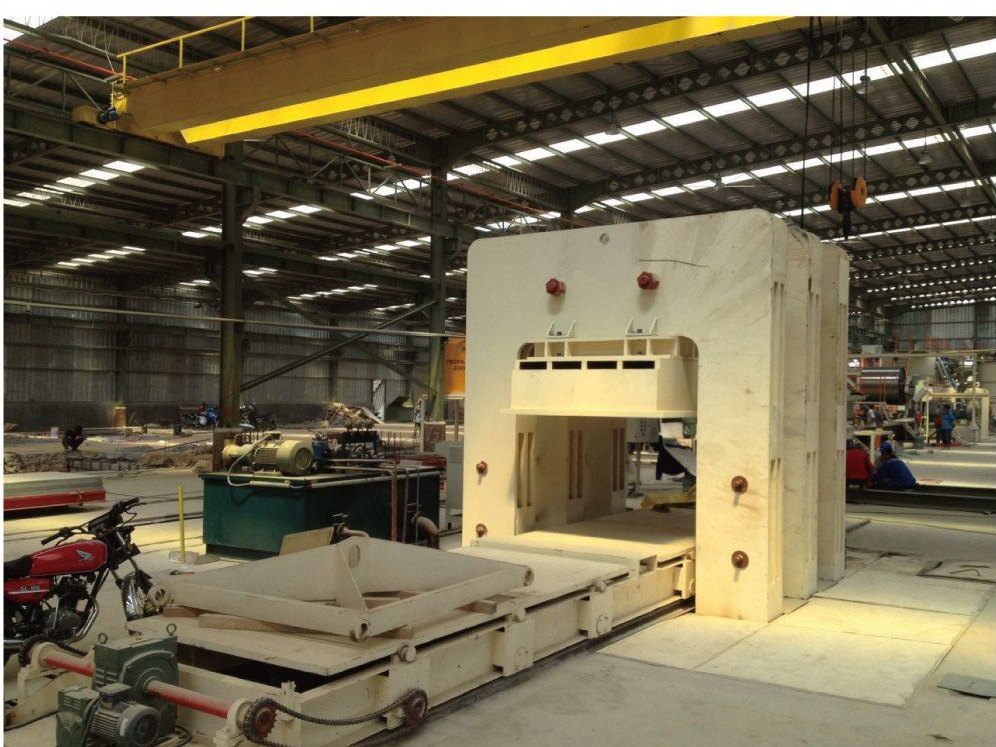
Hydraulic press 3000–15000 t
Force3000–15000т
- TAMINOTA part number
- TMN-XHB-02
- Lifting motor
- 22–45 kW
- Pressing motor
- 4–18.5 kW
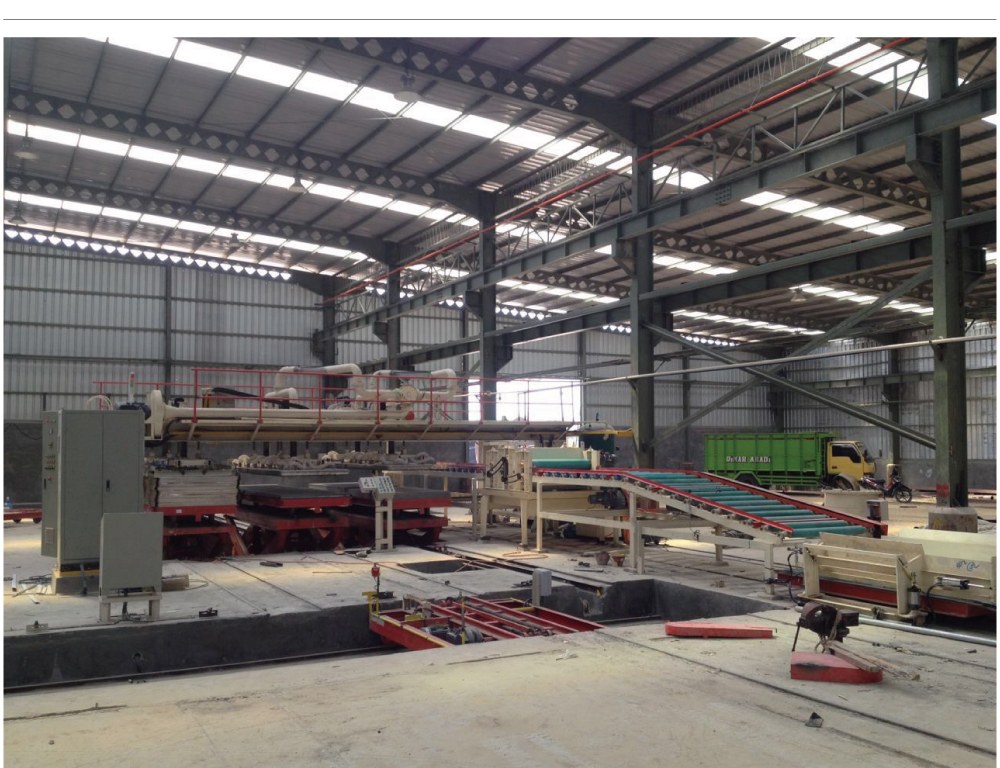
A press that compacts the stack of sheets after forming. Versions apply the force from above or from below; the upper arrangement is the more common one. Design: six pressing and two lifting cylinders, with a filling valve controlling rapid release and oil make-up in the main cylinders. The hydraulic unit and the electrical system run the pressing and lifting cycle, and a pressure sensor shows the load and the balance between cylinders. The PLC allows several modes, stages, holding times and strokes to be set. O-type frame; the press stroke is designed to suit the stack height.
- Brand
- Xinhuibo
- Category
- Standalone machine
- Industry
- Asbestos and fiber cement
- Availability
- Project supply
What to send for selection
- 01Part number or the number on the nameplate
- 02Photos of the unit and its nameplate
- 03Model of the machine the unit is fitted to
- 04Quantity
Specifications
TMN-XHB-02
- Rotation speed
- 1430 rpm
- Pressing cylinder
- Ø600–800 mm
- Lifting cylinder
- Ø150–280 mm
- Cylinder stroke
- 400–600 mm
- Frame
- O-образная
How to get this item
- 01You send the part number or a nameplate photo
- 02You get the plant’s invoice and a lead time
- 03Inspection at the plant, delivery, documents
Related articles
- Hydraulic sheet press: seals, oil and pumpIn a hydraulic sheet press the seals of the main and lifting cylinders, the pump, the valves (relief, prefill, directional), the filters and the hoses wear. Oil is a consumable just like them: dirty or overheated oil speeds up the wear of everything else. Pressure most often drops because of internal leakage: past the piston seals, a worn valve or the pump.
- Why a slate sheet delaminates and how to find the causeA sheet delaminates when the layers built up on the format drum did not bond to each other. Look for the cause along the path of the sheet: slurry, screen, felt, vacuum, drum pressure and press, curing, demolding. Most often the culprits are a film that is too wet or too dry, a clogged felt and weak compaction.
- Sheet breaks on impact and laying: why the strength is lowFour things set the bending and impact strength of a sheet: the fibre (how much there is and how it was opened or refined), the cement, the compaction of the layers and the curing. To find out which of them failed, compare the density and strength of the sheet with the norm and look at the fracture: a loose fracture means slurry and compaction, a dense but brittle one means fibre and curing mode.
- Slate lets water through: watertightness and water absorptionWatertightness is whether water passes through the sheet: under the GOST a column of water is placed on the sheet and after a day the underside is checked for drops. Water absorption is how much water the sheet soaks up; the GOST does not set a limit for it but gives a method. A porous sheet that soaks up a lot of water and lets it through most often has too little cement, weak compaction or early curing.
- Slate crumbles after winter: what frost resistance meansFrost resistance is the number of freeze-thaw cycles in the wet state that a sheet withstands without delamination and without a large loss of strength. A sheet that takes up a lot of water crumbles after winter: the water in the pores freezes, expands and tears the stone. So in production frost resistance is above all density and low water absorption.
- Flat sheet warps and bends: moisture and curingA flat sheet warps when one side dries or gets wet differently from the other: the wet side is longer, the dry side shorter, and the sheet bows. The causes are uneven moisture through the thickness, uneven laying in the stack and drying from one side. GOST 18124-2012 limits warping, and the allowance is larger for unpressed sheets.
- Can flat sheet be made on a corrugated slate lineIt can: flat and corrugated sheet are formed in the same way, on the same Hatschek machine. A corrugated sheet is made from a flat blank on a corrugator, and a flat sheet bypasses it. But a marketable flat sheet usually needs sections that a corrugated line lacks or has only weak ones: a press, flat pallets, and for facade boards an autoclave, drying, sanding and painting.
- An old line: repair, modernize or replaceThe decision starts not with a catalog of new lines but with a survey of the old one: what is worn and whether a unit can be replaced. If the frame, beds, shafts and format drum are alive and the problems are in the drive, automation, press or individual machines, it usually pays to modernize unit by unit. Replacing the whole line makes sense when the technology itself is out of date or the line cannot give the needed product and volume however much it is repaired.
- Why slate is pressed and how the press affects strengthThe press squeezes the raw sheet further after forming: it forces out water, brings the layers and fibres closer and removes some of the pores. A pressed sheet is denser, stronger, holds frost and water better and is flatter. That is why the interstate standard for flat sheets divides them into pressed and unpressed ones with different requirements. Corrugated slate is usually not pressed; the press is needed first of all for flat sheet and higher-grade products.
- Flat fibre-cement sheet: how the technology differs from slateA flat sheet is formed the same way as slate, on a Hatschek machine. The differences start after the format drum: no corrugating, but often a press; the sheet hardens on flat pallets or in an autoclave; the requirements for flatness, the face and the edge are stricter. The main defects of a flat sheet are warping and marks on the face, which are almost unnoticeable on a corrugated sheet.
- GOST 18124-2012: requirements for flat sheetsGOST 18124-2012 is the interstate standard for flat chrysotile-cement sheets. It divides sheets into pressed (LPP) and unpressed (LPN) and sets dimensions, flatness, bending strength, density, impact toughness and frost resistance. Amendment No. 1, in force from 1 January 2019, requires every sheet to be marked or to carry a label.
- How slate is tested: bending, density, water absorption, frostSlate is checked for bending strength and strength under load, for density, impact toughness, water tightness, water absorption and frost resistance. The methods for corrugated sheets are now in GOST 30340-2012, for flat sheets in GOST 18124-2012; before that they were in GOST 8747-88. Each test answers its own question about the sheet, and each has its own specimen preparation.
- How a lot of slate is accepted: sampling and retestingA lot of slate is the shift output of one line. Every lot goes through acceptance tests: appearance, dimensions, load or bending, density. The other indicators are checked periodically. Sheets for checking are taken from different stacks, leaving out the outer ones. If the defects fall between the acceptance number and the rejection number, a second sample is taken. If a periodic test fails, control is switched to every lot.
- Is a certificate needed to sell slate in UzbekistanThe answer depends on the current list of objects subject to mandatory conformity confirmation (Cabinet of Ministers Resolution No. 43 of 30.01.2021) and on the HS code under which the sheet clears. The old 2011 list, which had products of cement and asbestos cement, lost force on 1 May 2021. Since 2026 a reform of technical regulation has been under way and the lists are changing. Check for your own sheet and for the current date.
- Selling slate in Kazakhstan and Kyrgyzstan: which documents are neededIn Kazakhstan slate falls under the national technical regulation on the safety of building materials (order No. 435 of 09.06.2023, in force since 19.12.2023). Asbestos-free corrugated sheets are in its mandatory certification list. There is no general EAEU regulation for building materials yet; it is being drafted. In Kyrgyzstan the 2010 national building materials regulation lost force in 2015; what is required now must be asked of the country's authority.
- A buyer complains about slate: how to work through the claimA claim is worked through in order: lot number and quality document, photos and the place of the defect, how the sheet was stored, transported and fastened, then sampling and testing to GOST. Under GOST 30340-2012 the manufacturer is responsible for the sheet conforming to the standard if the buyer observed the rules of transport, storage and use. The aim of the review is to tell a production defect from an installation error and to find the cause in both cases.
- Press cylinder seals: how to record the size and materialA sheet press cylinder works with a wiper, a rod seal, guide rings, a piston seal and static rings in the heads. Record the size of each from the groove, not from the old seal. The material is chosen by conditions: polyurethane holds pressure and wear but dislikes hot water, NBR is universal for oil, PTFE is for low friction. For large cylinders seals are machined to size.
- Press and autoclave: what is checked for safetyOn a press, what is checked is what keeps a person from ending up under the platen: guards, interlocks, emergency stop, holding of the platen and isolation of energy before repair, including pressure in the hydraulics. On an autoclave, it is what keeps the lid from being opened under pressure: the quick-opening lid interlock, safety valves, pressure gauges, passport and inspection. In Uzbekistan the autoclave falls under the technical regulation of Cabinet Resolution No. 493.
- New slate line: what to decide before talking to a plantBefore you ask a manufacturing plant for a line quotation, decide seven things: which sheet you will make, from what raw materials, how many sheets per shift the market needs, how the sheet will cure, where the line will stand, where steam, water and electricity will come from, and who will run it. Without these answers, quotations from different plants cannot be compared.
- Workshop for a slate line: what to prepare before equipment arrivesBy the time the line arrives, the workshop must be ready to receive it: foundations and pits poured to the manufacturing plant's drawings and cured to strength, water, drainage, electricity, steam and compressed air brought to the connection points, the overhead crane working, access routes clear. The buyer does all this under the brief that the plant issues with the workshop plan.
- Buying a used slate line: what to check before payingBefore paying for a used line, it is inspected on site while it is still assembled and, best of all, running: year of manufacture and hours of operation, condition of the shafts, vats, screens, format drum and press, electrics and controller programs, autoclave and boiler documents, completeness against the inventory. Separately, decide who will dismantle, transport and reassemble it, and how.
- Technical specification for a slate line: what to write to the plantA technical specification is your requirements for the line on paper: which sheet and to which standard, from what raw materials, how much per shift, how it cures, what is in the supply, what automation, in what language the documents are, which spare parts and training, how you will accept it. It is attached to the contract, and the line is later accepted against it.
- Accepting a line at a plant in China: what to check at the trial runAt the manufacturing plant you can check completeness, assembly, no-load running of the machines, automation and documents. Output and sheet quality on your raw materials are checked only at your site after start-up. Whatever is found before shipment is corrected there and recorded in the protocol: after shipment it is harder to correct.
- Whom to train and in what when starting a slate lineWhen a line is started, five groups are trained: operators of the forming machine and adjacent stages, the technologist, the mechanic, the electrician and the laboratory technician. Each needs its own training, on the line and on paper. Training is written into the contract with the manufacturer: whom, in what, when, in what language, and how it is checked that people have learned.
- Fibre cement facade boards: can a slate plant make themA facade board can be formed on the same Hatschek machine as slate. But a facade board is a different product: it needs a press, curing to the board's own recipe, precise cutting, often sanding, primer and a coating on the face, and to be sold under European requirements it needs EN 12467 tests for strength and resistance to water, frost and temperature swings. It is not "slate without the wave" but a separate process stage and a separate market.
- Oversize equipment (press, autoclave): how it is shippedOversize cargo is cargo that does not fit an ordinary container or the road clearance in width, height, length or weight. It travels on platforms and in open containers, with transit permits and a planned route. The main decisions are made before packing: what the plant will dismantle, what packages that leaves and how each one will be lifted.
- Importing equipment from China to Kazakhstan: step by stepKazakhstan is a member of the EAEU, so equipment from China is imported under the Customs Code of the union. The declarant is the Kazakh party to the deal. Before filing the declaration you need to know the EAEU HS code and check whether the goods require a declaration or an EAEU certificate of conformity. After release the goods become goods of the union.
- TR CU 010/2011: is a declaration of conformity needed for equipmentTR CU 010/2011 is the EAEU technical regulation on the safety of machinery and equipment. For some machines it requires a certificate, for most a declaration of conformity. Equipment for the building materials industry and pumps go by declaration in the current list. Spare parts for repair and used equipment are not subject to confirmation.
- Importing equipment from China to Kyrgyzstan: Torugart, IrkeshtamKyrgyzstan is an EAEU member, so equipment from China is imported under the Customs Code of the union and the Kyrgyz law on customs regulation. There is no railway from China: cargo goes by truck over the Torugart or Irkeshtam passes. The declarant is the Kyrgyz party to the deal, and an EAEU conformity document is needed before the declaration is filed.
Request
Send a part number or a photo — we will find the factory
Items from the catalog · 1
- TMN-XHB-02 · Hydraulic press 3000–15000 t