Why a slate sheet delaminates and how to find the cause
A sheet delaminates when the layers built up on the format drum did not bond to each other. Look for the cause along the path of the sheet: slurry, screen, felt, vacuum, drum pressure and press, curing, demolding. Most often the culprits are a film that is too wet or too dry, a clogged felt and weak compaction.
In short
7minutes to read
6sections
6sources
4catalog items
In this article
- 01What the buyer and the owner need to decide
- 02Why the layers hold to each other at all
- 03Order of checking along the machine
- 04How to tell the cause from the look of the defect
- 05What to do before ordering spare parts
Contents
A slate sheet made by the Hatschek process is built up from dozens of thin layers. Delamination means the layers did not bond properly. The cause is usually in one of three places: the layer reached the format drum too wet or too dry, the felt clogged and no longer gives up water well, or the layers were pressed too little on the drum and in the press. Less often the sheet is delaminated by demolding or by drying too fast. It is easier to look for the cause along the path of the sheet, from the vat to the stack. Then replacing the felt or repairing the press is a decision based on the cause you found, not a guess.
What the buyer and the owner need to decide
Delamination is not a defect you can ship a lot with. GOST 30340-2012 for corrugated sheets and GOST 18124-2012 for flat sheets do not allow delamination, either in appearance or after the frost resistance test. So the question is: which unit of the line is at fault.
What most often has to be ordered after the diagnosis:
- forming felt, if the old one is clogged or stretched;
- cylinder screens;
- seals and parts of the vacuum system;
- seals and the pump of the hydraulic press, if the press does not hold pressure.
Before ordering, the process engineer should show at which point the sheet loses the bond between layers. Below is how to find it.
Why the layers hold to each other at all
Each wire-mesh cylinder picks up a thin film of fibre and cement from the vat. The felt takes the films off one by one and carries them over the vacuum boxes, where part of the water leaves the slurry. Then the format drum winds the film on turn after turn, and the pressure rolls compact it. The layers bond while they are wet and while the cement has not yet begun to set. The fibres of one layer enter the neighboring one, and the cement paste fills the pores between them.
This gives two conditions for a good bond. The layer must reach the drum at the right moisture: not as a liquid mush and not as a dried crust. And it must be pressed at once, while it can still fuse with its neighbor.
The textbook literature on asbestos cement describes the same scheme. The sheet passes the vacuum box, is wound onto the format drum and squeezed between rolls. After the squeezing the moisture of the green sheet drops noticeably. The exact pressures and moisture values differ for each line, so see your plant's process regulations.
Order of checking along the machine
1. Slurry in the vats
- The slurry concentration jumps: in some turns the film is thicker and wetter, in others thinner.
- The slurry has too few fines and too little cement and too much coarse fibre. The film comes out loose.
- The fibre is poorly opened. In asbestos cement, the quality of opening on the edge runners and in the Hollander beater directly affects the sheet. In fibre cement, the degree of cellulose refining matters just as much.
What to look at: the concentration log by shift, the work of the save-all, the degree of refining.
2. Cylinder screens
A clogged or torn screen picks up an uneven film. In some places the layer is thin and wet, in others there is none. If the delamination runs as a stripe along the length of the sheet, the first suspect is the screen, or the section of felt opposite that stripe.
3. Felt
The felt must take the film off the cylinder and let the water pass through. A clogged felt gives up water poorly, and a layer that is too wet reaches the drum. It can be pressed, but the water between the turns prevents bonding. Signs of a clogged felt: the blank is wetter than usual, the vacuum has to be raised, washing does not bring the fabric back to normal.
Patents on felts for fibre cement say that some felts deliberately leave a light relief on the layer. It helps the next layer to key in. When the felt becomes greasy and clogged, the relief is lost; this is one more reason to look at the felt when there is delamination.
4. Vacuum boxes
Weak vacuum means a wet layer. Vacuum that is too strong or uneven across the width dries the layer out in places, and the next turn does not stick to it. A US patent on fibre-cement products analyzes both cases: a heavy wet sheet comes apart into layers when lifted by a vacuum suction cup, while an over-dried one holds its layers poorly because of the weak wet bond.
What to look at: vacuum readings by box, wear of the box covers, air leaks, the work of the vacuum pump.
5. Pressing on the format drum and in the press
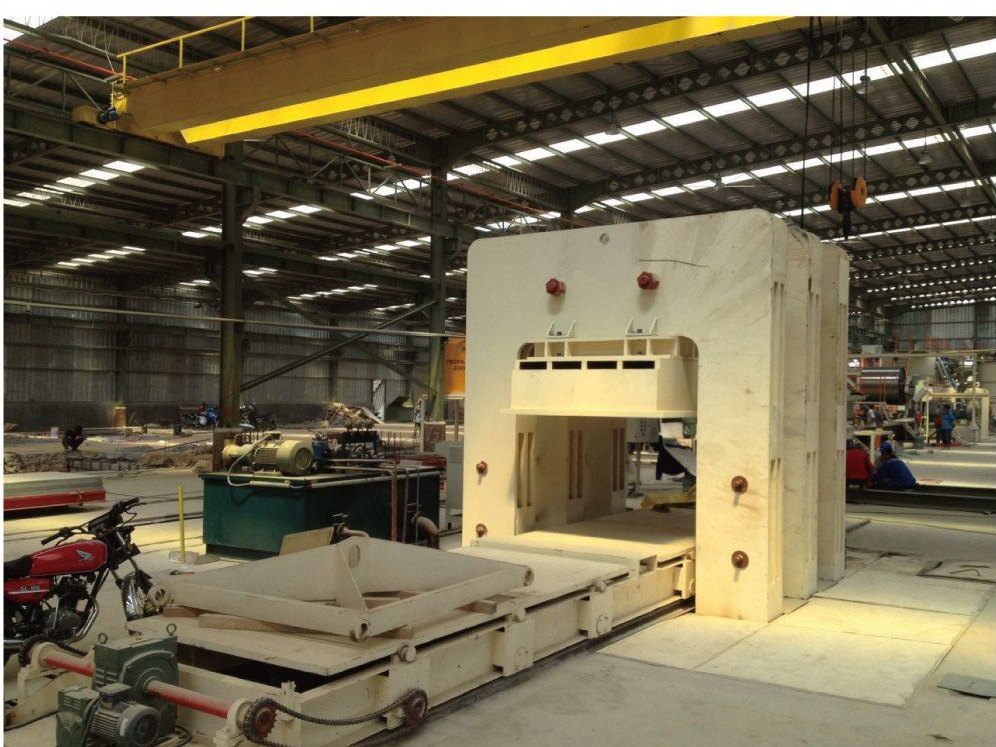
If the pressure rolls do not give the required force, the turns stay loose. If the hydraulic press does not hold pressure because of worn seals or a worn pump, the flat pressed sheet comes out porous and its layers are weakly bonded.
6. Curing and demolding
The green sheet is still weak. If it is taken off the pallet too early, or the demolding machine tears it with a suction cup, the layers can come apart at the edge. The same patent lists, among the measures against delamination, a longer precuring, a change in the rates of pressure rise and release in the autoclave, and an additive that strengthens the bond between layers.
How to tell the cause from the look of the defect
| What you see | Where to look first |
|---|---|
| Delamination over the whole area of the sheet | slurry, felt, vacuum, pressing on the drum |
| In a stripe along the length of the sheet | the section of screen or felt, the cover of the vacuum box |
| Only along the edge | cutting, demolding, drying out of the edge in the stack |
| After the autoclave | pressure rise and release mode, moisture of the stack before the autoclave |
| After winter, on the roof | water absorption and frost resistance; see the article on frost resistance |
This is a scheme for searching, not a diagnosis. One sign can come from two causes at once.
What to do before ordering spare parts
- Pick out several delaminated sheets and mark where exactly on the sheet the defect is.
- Write down which felt is installed, how long it has run, and what the vacuum is by box.
- Check the slurry concentration in the log for the shift when the defects started.
- Check the press pressure on the gauge.
- For periodic control, the plant tests sheets for bending strength and frost resistance according to GOST. Delamination after freezing is the same defect that showed up later.
How we do it
- From the photo, dimensions and the passport of the felt or unit, we look for the item at the manufacturing plant. What we find, with the price, photos and specifications, we send before the order.
- We inspect the lot at the plant before shipment: part number, dimensions, lot, packaging.
What this article relies on
Below are the documents and materials we refer to, so that you can check what is said for yourself.
Standards and documents
Reference materials
- Rybyev I. A. "Building Materials Science" (Строительное материаловедение), section "Fundamentals of asbestos-cement product manufacturing": opening, forming, vacuum box, squeezing on the format drumstudme.org ↗
- Patent US 6346146 "Building products": delamination of the green sheet when lifted by a suction cup, a sheet that is too wet or too dry, measures against delaminationpatents.google.com ↗
- Patent US 9415564 "Felt for forming fiber cement articles": relief from the felt and the bond between layers, vacuum boxes under the feltpatents.google.com ↗
- Fiorelli J. et al. "Durability of fibre-cement roofing corrugated sheets", XIII CIB Conference on Durability of Building Materials (CIB DC33112): edge cracks and delamination of air-cured sheetsirbnet.de ↗
The order of checking along the machine is drawn up from the design of the Hatschek machine; the settings of your line follow the process regulations.