Steel templates and pallets: when to repair, when to replace
A template or pallet is repaired as long as it can be cleaned, straightened and again gives a sheet within tolerance. It is replaced when the metal has warped so that straightening does not hold, when corrosion has eaten the surface or the edges, or when the buildup can no longer be removed. A crooked template gives a crooked wave and edge, which shows in the edge waves of the sheet.
In short
5minutes to read
7sections
5sources
2catalog items
In this article
- 01What they are and where they stand
- 02How templates and pallets wear
- 03How a crooked template spoils the sheet
- 04Lubrication and cleaning
- 05Repair or replace
Contents
A steel template (a corrugated spacer) and a pallet hold the raw sheet while it hardens. They are worth repairing as long as, after cleaning and straightening, they again give a sheet within tolerance. They are replaced when the metal has warped so that straightening does not hold; when corrosion has eaten the surface or the edges; when the cement buildup can no longer be removed without damaging the metal. A sign that templates have become the cause of defects is an uneven wave and "wandering" edge waves with a sound corrugating machine. To order new ones you need the wave profile, the dimensions, the metal thickness and a drawing.
What they are and where they stand
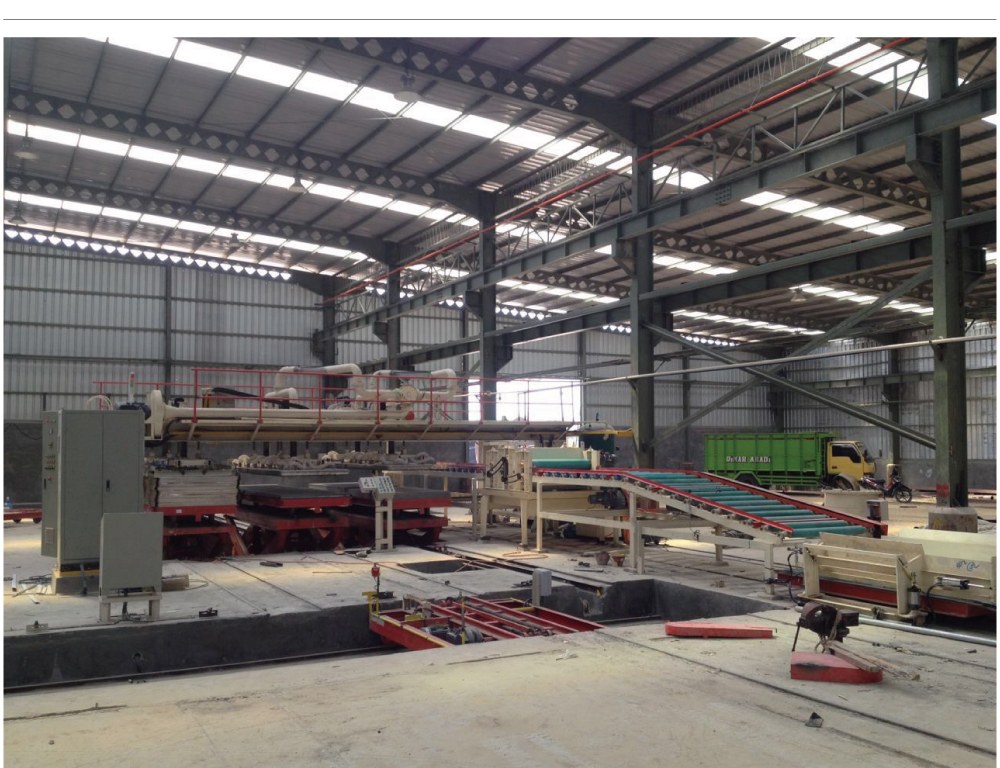
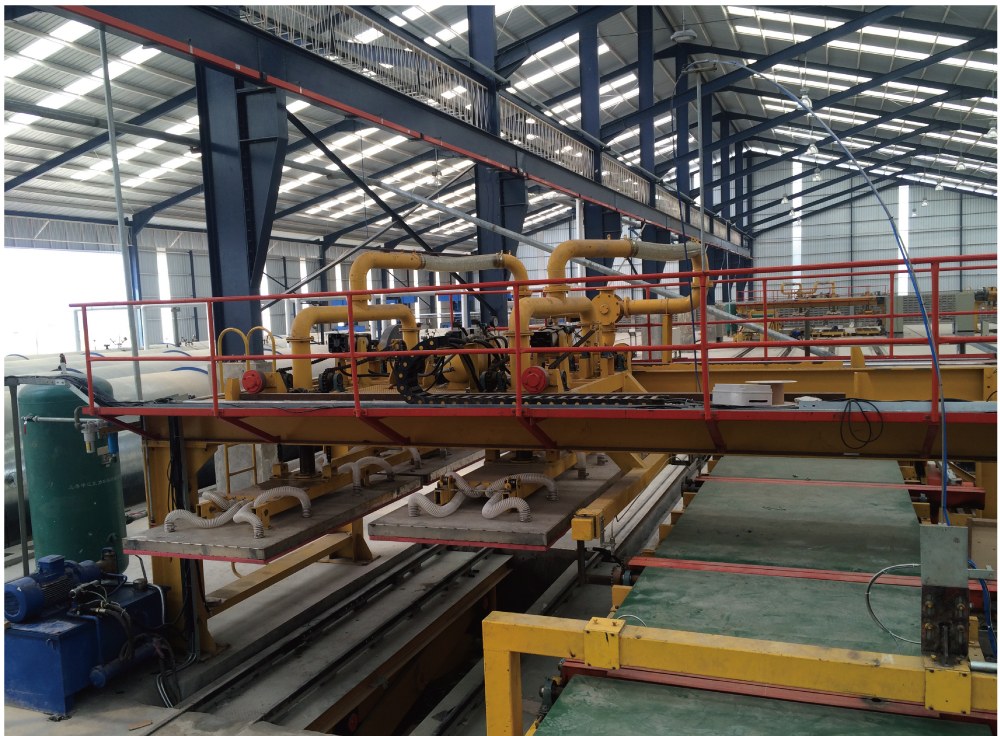
After the forming machine and cutting, the raw sheet does not yet hold its shape. It is laid in a stack, and each sheet lies on its own steel base. For a corrugated sheet this is a corrugated template, for a flat one a flat pallet. The stack goes for pre-curing. Once the sheet has set, the demolding machine takes it off the base, and the base is cleaned, lubricated and returned to the stacker in a loop.
How many bases are in circulation depends on the capacity of the line and the curing time. There are hundreds or thousands of them on a line, so even a small percentage of crooked templates produces a steady flow of rejects.
How templates and pallets wear
- Deformation. Impacts during demolding and stacking, uneven support in the stack and skewing during transport bend the metal. The template wave loses height or pitch, the edges curl, and a flat pallet twists like a propeller.
- Buildup. If there is too little release agent, or it is uneven, the cement laitance sets onto the metal. The layer grows from cycle to cycle, and the template stops giving a smooth surface and an accurate wave.
- Corrosion. Moisture, the heat of the chambers and the alkaline environment of cement eat away unprotected metal, especially at the edges and where the coating has worn off. Rust passes to the sheet as stains.
- Mechanical damage. Nicks, dents, cracks at the edges and at the gripping points.
How a crooked template spoils the sheet
The raw sheet takes the shape of what it lies on. So a defect of the template is repeated on every sheet that hardened on it:
- Uneven wave. A wave of different height across the width of the sheet or at one edge.
- Edge waves out of size. The standard for corrugated sheets (the interstate GOST 30340-2012) specifies the height of the standard and edge waves, the overlapping and the overlapped. The edge waves are the first to go out of tolerance with a bent template, and on the roof the sheets then lie badly overlapped.
- Crooked edge and a sheet that is not square. The standard specifies the straightness of the longitudinal edges and the squareness of the sheet.
- Marks on the surface: imprints of buildup, pits, rust.
- Sticking and breakage during demolding. The sheet sticks to a dirty template, and the machine breaks it.
How to tell the template's fault from the corrugating machine's: if the defect repeats on the same templates (it is useful to mark them with numbers), the template is to blame. If the defect comes one after another on all of them, look at the corrugating machine, the vacuum and the sheet thickness.
Lubrication and cleaning
Before every cycle the base is cleaned and lubricated with a compound that keeps the sheet from sticking. On automatic lines there is a washing and lubricating unit after the demolding machine for this: the pallet moves along a roller conveyor, is washed, lubricated and stacked for return. Which compound and how much to apply is set by the regulations of your line and the recommendations of the lubricant supplier. Too little means buildup; too much means stains and poor paint adhesion, if the sheet is painted afterward.
Repair or replace
| Condition | What to do |
|---|---|
| Thin film, light marks | Cleaning, check the lubrication |
| Thick buildup | Mechanical cleaning without damaging the metal; if the metal under it is affected, replace |
| Bent edge, slight bend | Straightening with a check against a control template or sheet |
| The bend returns after straightening, the metal has warped over the whole area | Replace |
| Corrosion with loss of thickness, cracks | Replace |
After straightening the template is checked: a sheet is laid on it and the wave height and edge straightness are measured, as in the acceptance of the product. Templates that give defects again after straightening are taken out of circulation, otherwise they will keep wandering around the line.
What to state when ordering
- The wave profile of the sheet: the designation (wave height and pitch) or the drawing of the sheet.
- The dimensions of the template or pallet: length, width, metal thickness.
- The drawing of the template, if there is one, or a sample: an old straight template of good quality.
- Material and coating: steel, stainless steel, galvanized or other.
- Requirements for the edges and gripping points: for the suction cups of the demolding machine, for the stacker.
- Quantity, taking into account the whole circulation on the line.
Before a large lot it is sensible to order a few templates and test them on your own line: how the sheet lies, how the suction cups work, how demolding goes.
How we do it
- From the drawing or sample, we look for the manufacturer of templates and pallets. What we find, with the price, photos and specifications, we send before the order.
- A demolding machine with a pallet lubrication unit and a stacker are in the catalog.
- We inspect the lot at the plant before shipment: dimensions, profile, lot, packaging.
What this article relies on
Below are the documents and materials we refer to, so that you can check what is said for yourself.
Reference materials
- GOST 30340-2012 "Corrugated chrysotile-cement sheets. Specifications" (meganorm.ru, in Russian), sections 4 and 5: height of standard and edge waves, squareness, straightness of edgesmeganorm.ru ↗
- "Stroitelnye materialy i izdeliya" (Building Materials and Products, in Russian), section on asbestos-cement production (bibliotekar.ru): sheets for corrugating are laid on metal corrugated spacersbibliotekar.ru ↗
- European application EP2687346, background: a stack of raw sheets on carts with flat or corrugated steel sheets between them, release agent for the formworkdata.epo.org ↗
- European application EP4056342: an agent against sheets sticking together in the stack before the autoclavedata.epo.org ↗
- taminota.com catalog, demolding machine with a pallet lubrication unit: washing, lubrication and return of pallets to the stacker as described by the manufacturing plant.