Standalone machineXinhuibo
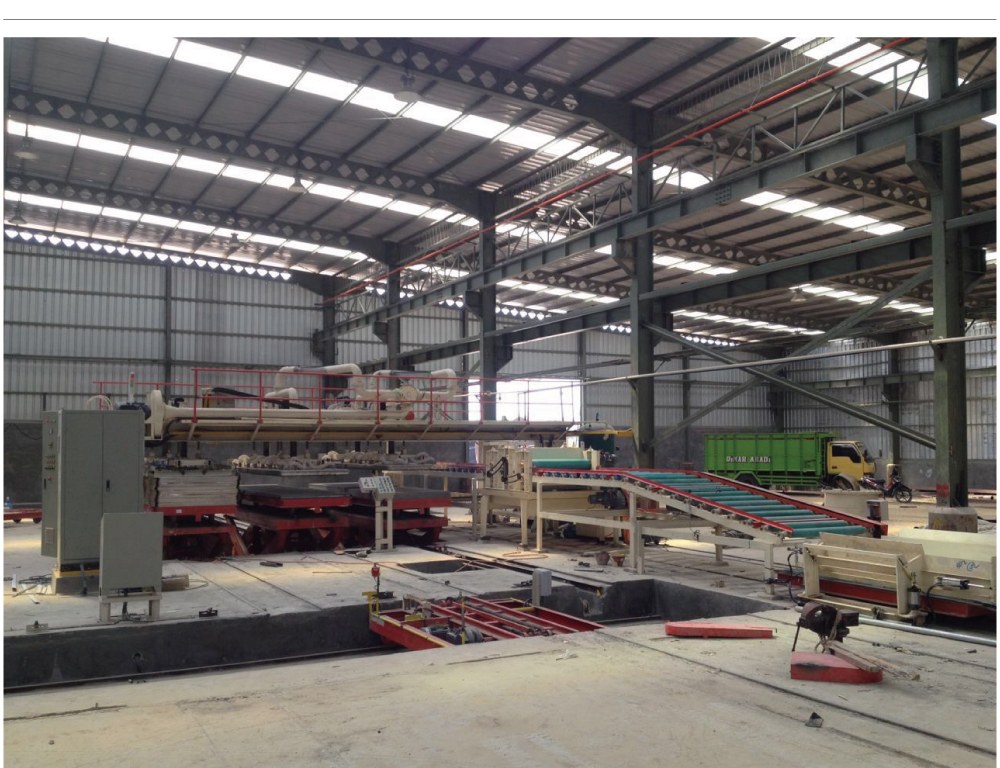
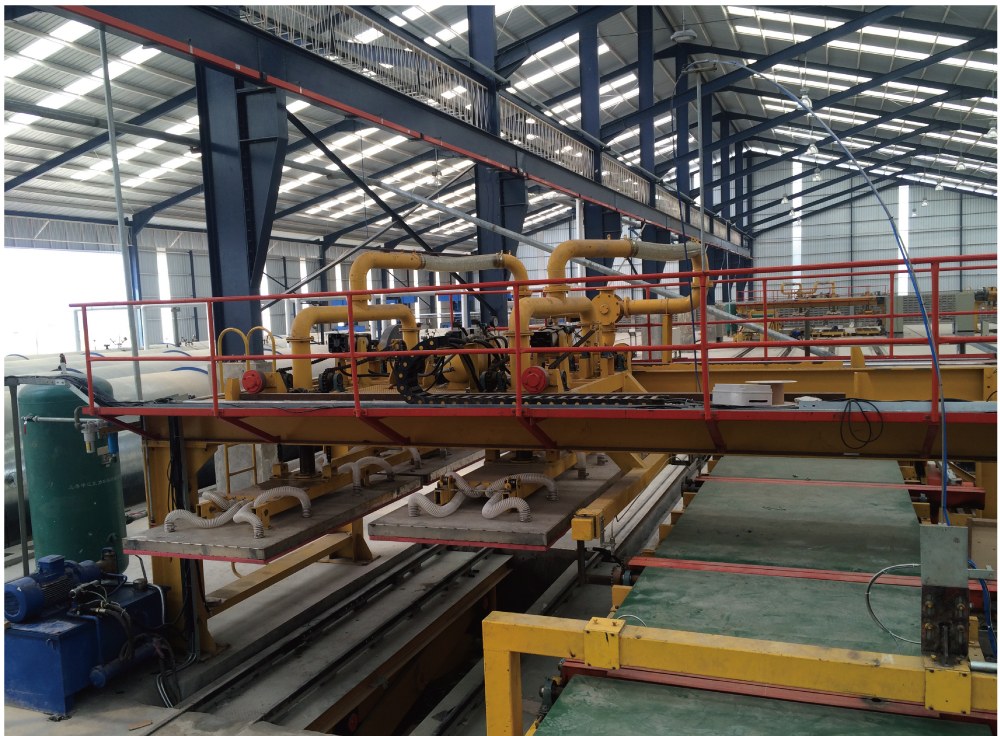
Three-station pneumatic stacker
Sheet format2440×1220mm
- TAMINOTA part number
- TMN-XHB-05
- Sheets per cycle
- 2
- Cycle time
- 12–15 с
Builds the stack of sheets and pallets after longitudinal and cross cutting. The blank is fed by belt conveyor to the cross-cutting position; after the cut a vacuum sucker places the pallet at the set position, then the sheet sucker lays the sheet onto the pallet — the alternation repeats through the cycle. Forming, take-off, transport, cutting and stacking are run by a programmable controller.
- Brand
- Xinhuibo
- Category
- Standalone machine
- Industry
- Asbestos and fiber cement
- Availability
- Project supply
What to send for selection
- 01Part number or the number on the nameplate
- 02Photos of the unit and its nameplate
- 03Model of the machine the unit is fitted to
- 04Quantity
Specifications
TMN-XHB-05
- Servo motor
- 5.5–15 kW
- Rotation speed
- 2000–3000 rpm
- Gearbox
- QJ-L200-16
- Fan
- 11–18.5 kW · 2900 rpm
- Sucker stroke
- 2000 mm
How to get this item
- 01You send the part number or a nameplate photo
- 02You get the plant’s invoice and a lead time
- 03Inspection at the plant, delivery, documents
Related articles
- Steel templates and pallets: when to repair, when to replaceA template or pallet is repaired as long as it can be cleaned, straightened and again gives a sheet within tolerance. It is replaced when the metal has warped so that straightening does not hold, when corrosion has eaten the surface or the edges, or when the buildup can no longer be removed. A crooked template gives a crooked wave and edge, which shows in the edge waves of the sheet.
- Stacker, conveyors, roller tables: what gets replaced most oftenOn the stacker, belt conveyors and roller tables of a slate line, the things replaced most often are belts and conveyor belting, drive chains and sprockets, rollers and their bearings, suction cups, pneumatic cylinder seals and position sensors. All of these are standard parts: they can be recorded by marking and dimensions and kept in stock without waiting for a failure.
- Where cracks in slate sheets come from: demolding, stack, roofFirst tie the crack to a time: did it appear right after demolding, in the stack in the finished goods warehouse, or already on the roof. That decides where to look for the cause: forming and curing, drying of the stack, or installation and frost.
- Crooked wave and uneven edge: which deviations are allowedFor a corrugated sheet the GOST measures length, width, thickness, wave height, deviation from squareness and straightness of the edges. The wave pitch is given for reference and is not a rejection criterion. A crooked wave usually comes from the templates and the corrugating machine, a skewed sheet and a ragged edge come from cutting.
- Flat sheet warps and bends: moisture and curingA flat sheet warps when one side dries or gets wet differently from the other: the wet side is longer, the dry side shorter, and the sheet bows. The causes are uneven moisture through the thickness, uneven laying in the stack and drying from one side. GOST 18124-2012 limits warping, and the allowance is larger for unpressed sheets.
- Curing chambers: temperature, humidity and where rejects come fromIn the curing chamber the green sheet gains the strength to be taken off the pallet without breaking. Three things cause rejects here: heat applied before the cement began to set; temperature raised too fast or unevenly; the sheet losing water to dry air and drafts.
- An old line: repair, modernize or replaceThe decision starts not with a catalog of new lines but with a survey of the old one: what is worn and whether a unit can be replaced. If the frame, beds, shafts and format drum are alive and the problems are in the drive, automation, press or individual machines, it usually pays to modernize unit by unit. Replacing the whole line makes sense when the technology itself is out of date or the line cannot give the needed product and volume however much it is repaired.
- Why slate is pressed and how the press affects strengthThe press squeezes the raw sheet further after forming: it forces out water, brings the layers and fibres closer and removes some of the pores. A pressed sheet is denser, stronger, holds frost and water better and is flatter. That is why the interstate standard for flat sheets divides them into pressed and unpressed ones with different requirements. Corrugated slate is usually not pressed; the press is needed first of all for flat sheet and higher-grade products.
- Pre-curing: when a sheet can be taken off its templateAfter forming, a raw sheet is soft, like wet cardboard. While it lies on its template or pallet in the chamber, the cement sets and the sheet gains demolding strength: enough to be taken off, turned over, trimmed and stacked without cracks. Time and temperature are not guessed: they are set by the regulations, and readiness is checked on a control sheet. A sheet taken off too early cracks and breaks later, in the warehouse and on the roof.
- How slate gets its wave and why the profile comes out unevenThe wave is given to the raw flat sheet right after the wrap is cut, while it is still soft. The corrugator (rod, chain or vacuum type) bends the sheet to the profile, then the sheet is laid on a corrugated spacer or in a profiled cart and held in that shape until it hardens. An uneven wave almost always comes from three places: sheet moisture and thickness, wear of the corrugator, and the condition of the templates and carts.
- Marking slate and lots: what to write on the sheet and in the documentA corrugated sheet to GOST 30340-2012 is marked with the manufacturer (trademark or name), profile, thickness and lot number, on the face of the overlapped part. The OTK quality control stamp goes on at least 1 % of the sheets in a lot. A flat sheet to GOST 18124-2012, after Amendment No. 1, is marked on every sheet or carries a label. Every delivery is accompanied by a quality document with the test results of the lot.
- How a lot of slate is accepted: sampling and retestingA lot of slate is the shift output of one line. Every lot goes through acceptance tests: appearance, dimensions, load or bending, density. The other indicators are checked periodically. Sheets for checking are taken from different stacks, leaving out the outer ones. If the defects fall between the acceptance number and the rejection number, a second sample is taken. If a periodic test fails, control is switched to every lot.
- A buyer complains about slate: how to work through the claimA claim is worked through in order: lot number and quality document, photos and the place of the defect, how the sheet was stored, transported and fastened, then sampling and testing to GOST. Under GOST 30340-2012 the manufacturer is responsible for the sheet conforming to the standard if the buyer observed the rules of transport, storage and use. The aim of the review is to tell a production defect from an installation error and to find the cause in both cases.
- Felt, screen, format drum: a glossary of the slate plantShort explanations of the words heard on the floor of a slate plant: from the vat and the cylinder screen to demolding, the autoclave and trimmings. The glossary is for the buyer who writes the request and for a new person on the line. Each word says what it is and which article to read next.
- Compressed air on the line: compressor, dryer and leaksA slate plant needs compressed air for demolding and the stacker, for the line's pneumatic cylinders and valves, for blowing filters and for aeration of cement silos. The air must be dry and clean, otherwise water and oil ruin the pneumatics, and in a silo damp air cakes the cement. Hence three concerns: the compressor, the dryer with filters, and finding leaks.
- Slate line capacity: why sellers quote different figuresDifferent sellers state line capacity in different units: tonnes per hour, square metres, sheets per shift, conventional sheets. And they calculate it differently: at the machine's top speed, with no stoppages and no rejects. To compare quotations, ask each seller to convert output into your sheets and your shifts and to state what is built into the calculation.
- Accepting a line at a plant in China: what to check at the trial runAt the manufacturing plant you can check completeness, assembly, no-load running of the machines, automation and documents. Output and sheet quality on your raw materials are checked only at your site after start-up. Whatever is found before shipment is corrected there and recorded in the protocol: after shipment it is harder to correct.
- Corrugated sheet types: profiles, wave count, useA corrugated sheet is told apart by its profile, meaning wave height and pitch, and by its number of waves. The current interstate standard GOST 30340-2012 knows two profiles: 40/150 with symmetric edges and 51/177 with asymmetric edges. The old designations (54/200, the "unified" and the "reinforced" profile) come from withdrawn standards, but they still turn up in orders and designs.
- Slate sheet sizes under GOST: length, width, thickness, tolerancesGOST 30340-2012 sets for a corrugated sheet the length, the width by wave count, several thicknesses, the wave height and the edge width, each with a tolerance. The most common sheet, 40/150, is 1750 mm long and 980 mm wide with seven waves or 1130 mm with eight. Sizes are checked on every lot, and on the line they are held by the templates, the cutting and the format drum.
- Coloured slate: what you need to start productionColoured slate is made in two ways: pigment in the mass, so the colour runs through the whole thickness, or a coating on the surface of the sheet. To start production you need a decision on the method and the palette, a section for coating or pigment dosing, colour standards, an abrasion test of the coating to GOST, separate packing and storage under a roof. Start with a trial coloured batch and a talk with dealers, not with buying a line.
- Packing and storing slate at the plant to avoid breakageBreakage in the finished goods yard most often has three causes: the sheet was handled before it gained strength, the pack stands on an uneven or weak base, or sheets are dropped and knocked when moved. GOST 30340-2012 sets what to pack the sheets in, the maximum size and mass of a pack, how many tiers to stack and how to store coloured sheet. Storage at the manufacturer follows the plant's process regulations.
- How to load and haul slate so it arrives in one pieceSlate arrives whole if it has already gained strength, is packed in strapped packs on pallets, the packs stand tight and are secured against shifting, and they are loaded with textile slings and a spreader or a lifting beam, with no impacts or dropping. GOST 30340-2012 allows any mode of transport but leaves placing and securing to the rules of that mode: for railcars the technical conditions for placing and securing cargo, for containers the rules for packing cargo units.
Request
Send a part number or a photo — we will find the factory
Items from the catalog · 1
- TMN-XHB-05 · Three-station pneumatic stacker