Knives
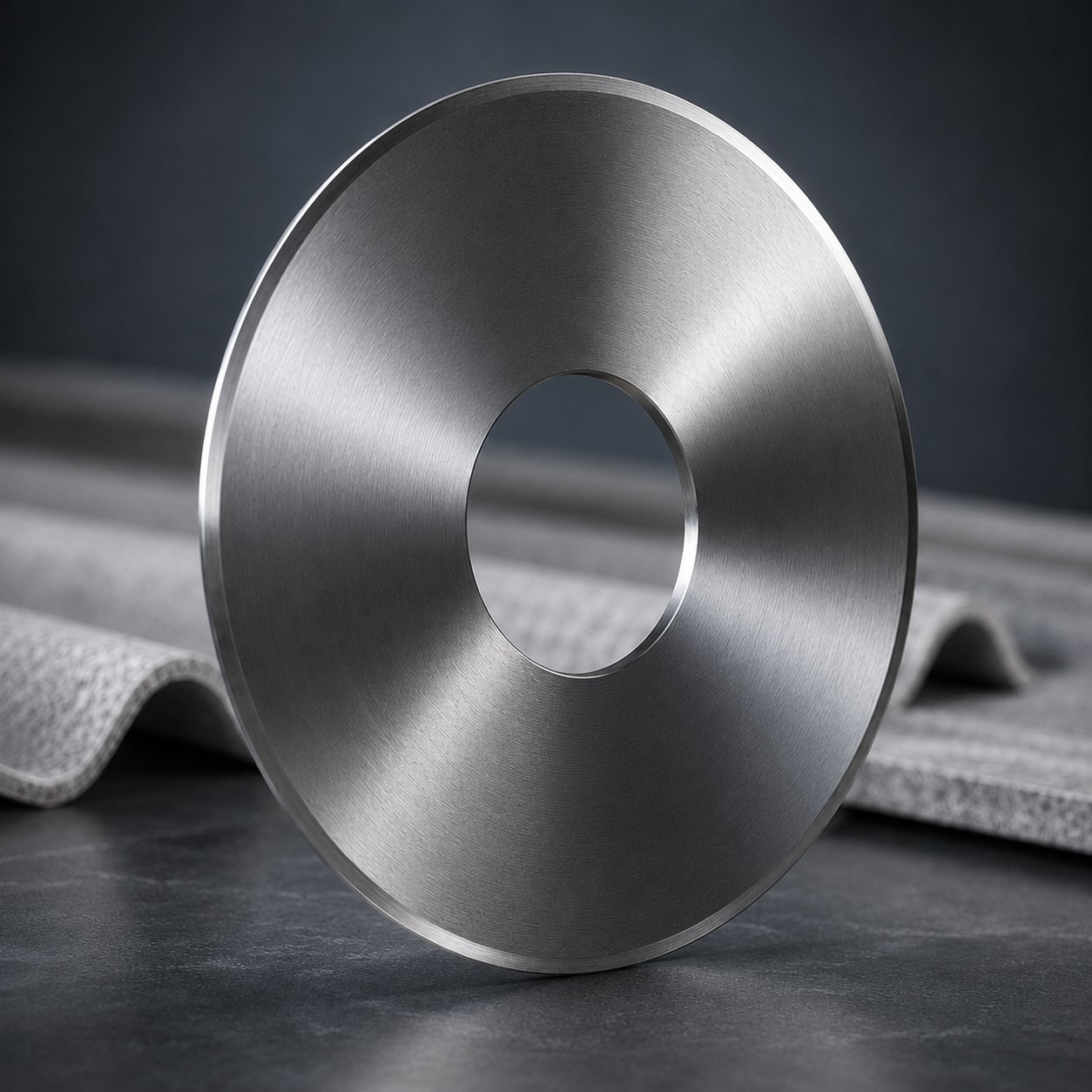
Circular knife for trimming asbestos-cement sheet
Outer diameter280mm
- TAMINOTA part number
- TMN-280-1303
- Seat diameter
- 130 mm
- Thickness
- 3.38 mm
A tungsten carbide disc blade for trimming the side edges of asbestos-cement sheets on production lines. Outer diameter 280 mm, seat diameter 130 mm, thickness 3.38 mm. Hardness ≥ 89 HRA, bending strength ≥ 2800 MPa.
- Category
- Knives
- Industry
- Asbestos and fiber cement
- Availability
- Made to order
What to send for selection
- 01Part number or the number on the nameplate
- 02Photos of the unit and its nameplate
- 03Model of the machine the unit is fitted to
- 04Quantity
Specifications
TMN-280-1303
- Product type
- Disc blade
- Material
- Carbide (tungsten carbide)
- Hardness
- ≥ 89 HRA
- Bending strength
- ≥ 2800 MPa
How to get this item
- 01You send the part number or a nameplate photo
- 02You get the plant’s invoice and a lead time
- 03Inspection at the plant, delivery, documents
Nearby in this category
001
Related articles
- When to order a sample before the lot, and when you don't need oneA sample is needed when quality cannot be described by a number: forming fabrics, screens, knives, rubber products, parts made to a drawing, a new plant. It is not needed for a standard unit with a catalog number, such as a bearing or a motor. An approved sample becomes the reference against which the whole lot is checked.
- Which spare parts to keep in stock so the line does not stopKeep in stock what fails suddenly, stops the whole line and cannot be found in Uzbekistan: bearings for critical units, controllers and modules, sensors, forming fabrics, knives, seals. What is sold locally or has a standby on the line can be ordered as needed.
- Slate line machines and which parts wear out firstA fibre-cement sheet line is a chain of stages: raw material preparation, milling, fibre opening, the forming machine, press, curing, demolding, autoclave, cutting. What wears out first is whatever rubs against the slurry and the sheet: forming felts, screens, knives, shaft bearings and slurry pumps.
- Knives and discs for cutting sheets: carbide or waterjetOn the line a green sheet is cut with disc knives or a waterjet, and a hardened one with carbide-tipped or diamond saws. A carbide disc is cheaper to set up and simple; a jet does not blunt and makes less dust, but needs a high-pressure pump and clean water. An enquiry for a knife needs the dimensions, the carbide grade or hardness and the place on the line.
- Forming machine spare parts to keep in stock for a yearFor a Hatschek machine keep in stock what is made to your machine's size and what stops it when missing: felts, cylinder screens, vacuum box strips, knives, coverings and roll bearings, pump impellers and liners, spray nozzles. Work out the quantity from your own replacement log, not from someone else's norm.
- Spare parts for an old Soviet line: where to get them with no plantSpare parts for a line whose manufacturer has closed fall into three groups. Standard units — bearings, motors, gearboxes, belts — are converted to current designations and ordered from any maker. Original parts — shafts, knives, gears, bushings — are made to a drawing or from measurements. A unit that cannot be repeated is replaced whole with a modern one with the same connecting dimensions.
- A part with no catalog: how to order from a drawing or sampleThe plant needs a drawing or sketch with all dimensions, tolerances on the mating seats, material, heat treatment and hardness, coating, quantity and a photo of the part on the machine. If there is no drawing, send a sample or take measurements. Before a lot, order one part and put it on the machine.
- When to order spare parts so you do not stand in the seasonCount from the date the part must be in your hands: the start of the repair shutdown or the start of the sales season. From it subtract the production time, transport, customs and a reserve for the unexpected — that gives the last order day for each item. Felts, screens, parts to drawing and large bearings are ordered first; off-the-shelf consumables last.
- How to draw up a slate plant's annual request for parts and feltsAn annual request is one table by lines and units: item, marking or size, consumption per year, stock, how much to order, urgency, who approved. Consumption is taken from the replacement log, not from memory. Items are divided into long (felts, screens, parts to drawing) and quick, and the long ones are sent as one package in advance.
- Where cracks in slate sheets come from: demolding, stack, roofFirst tie the crack to a time: did it appear right after demolding, in the stack in the finished goods warehouse, or already on the roof. That decides where to look for the cause: forming and curing, drying of the stack, or installation and frost.
- Crooked wave and uneven edge: which deviations are allowedFor a corrugated sheet the GOST measures length, width, thickness, wave height, deviation from squareness and straightness of the edges. The wave pitch is given for reference and is not a rejection criterion. A crooked wave usually comes from the templates and the corrugating machine, a skewed sheet and a ragged edge come from cutting.
- Trimming and cutting slate to size: wet, dry and offcutsSlate is cut twice. The raw wrap is cut into blanks and the edges trimmed while the sheet is soft: with shears, disc knives or a water jet. The hardened sheet is cut when an exact size or a clean edge is needed: with a saw or abrasive waterjet, and then dust appears. Raw offcuts go straight back into the slurry through the agitator. Hardened offcuts cannot be returned to ordinary slurry: they are either ground to powder as a filler or taken away under the rules of the country.
- GOST 30340-2012: what it requires of a corrugated sheetGOST 30340-2012 is the interstate standard for corrugated chrysotile-cement sheets and their fittings. It sets two profiles, dimensions and tolerances, strength, density, impact toughness, water tightness and frost resistance, and requirements for appearance, marking, acceptance and storage. It replaced GOST 30340-95 and, for corrugated sheets, GOST 8747-88 and GOST 30301-95.
- GOST 18124-2012: requirements for flat sheetsGOST 18124-2012 is the interstate standard for flat chrysotile-cement sheets. It divides sheets into pressed (LPP) and unpressed (LPN) and sets dimensions, flatness, bending strength, density, impact toughness and frost resistance. Amendment No. 1, in force from 1 January 2019, requires every sheet to be marked or to carry a label.
- Chinese names of slate line units: felt, screen, autoclaveAt a Chinese plant the felt is 毛毯, the drying mesh is 螺旋干网, the autoclave is 养护釜 or 高压釜, the demolding machine is 脱模机. One unit often goes by two or three names: one word in the catalog, another in a patent or in correspondence. So the Chinese name in a request helps, but the photo, dimensions and nameplate decide.
- Carbide grades on knives: what YG and VK (ВК) meanVK (ВК) and YG are one family of cemented carbides: tungsten carbide bonded with cobalt. The number after the letters is the cobalt share in percent: ВК8 and YG8 contain about 8% cobalt. Less cobalt means harder and more resistant to abrasion, more means tougher against impact and chipping. For a knife cutting an abrasive sheet a balance is sought, so a request states the grade, the HRA hardness and the bending strength.
- Failure log: how to tell what breaks most often on the lineA failure log is one line for every stop of the line: when it stopped, which unit, what happened, why, which part was replaced, how long it stood. After a month or two these lines show a few units that give most of the downtime. That is where spare parts stock and planned repairs are concentrated.
- Planned maintenance of a slate line: what to do at each stopPlanned maintenance of a slate line has three levels: an inspection every shift, a short planned stop and a major seasonal overhaul. Each level has its own list of work and its own list of spare parts. The major overhaul is set for the time when slate sales are lower, and the parts for it are ordered in advance.
- Sludge and offcuts: return to the slurry or haul awayRaw offcuts and raw rejects go back into the slurry at once: they are broken down in the agitator and fed back to the bucket agitator. Sludge from the recuperator is returned too, but in a limited share: the cement in it has already begun to set. Hardened waste does not go into the slurry as is: it is either ground to a fine powder and added as filler, or hauled away under the rules of your country.
- Corrugated sheet types: profiles, wave count, useA corrugated sheet is told apart by its profile, meaning wave height and pitch, and by its number of waves. The current interstate standard GOST 30340-2012 knows two profiles: 40/150 with symmetric edges and 51/177 with asymmetric edges. The old designations (54/200, the "unified" and the "reinforced" profile) come from withdrawn standards, but they still turn up in orders and designs.
- Slate sheet sizes under GOST: length, width, thickness, tolerancesGOST 30340-2012 sets for a corrugated sheet the length, the width by wave count, several thicknesses, the wave height and the edge width, each with a tolerance. The most common sheet, 40/150, is 1750 mm long and 980 mm wide with seven waves or 1130 mm with eight. Sizes are checked on every lot, and on the line they are held by the templates, the cutting and the format drum.
Request
Send a part number or a photo — we will find the factory
Items from the catalog · 1
- TMN-280-1303 · Circular knife for trimming asbestos-cement sheet