Trimming and cutting slate to size: wet, dry and offcuts
Slate is cut twice. The raw wrap is cut into blanks and the edges trimmed while the sheet is soft: with shears, disc knives or a water jet. The hardened sheet is cut when an exact size or a clean edge is needed: with a saw or abrasive waterjet, and then dust appears. Raw offcuts go straight back into the slurry through the agitator. Hardened offcuts cannot be returned to ordinary slurry: they are either ground to powder as a filler or taken away under the rules of the country.
In short
5minutes to read
5sections
9sources
4catalog items
In this article
- 01What the owner needs to decide
- 02Where and with what the cutting is done
- 03What to do with offcuts
- 04What to attach to a request for knives and cutting units
- 05How we do it
A slate line is cut in two places. The first is on the raw sheet: the wrap taken off the format drum is cut into blanks of the required length, and after corrugating the longitudinal edges are trimmed. A raw sheet is soft, cuts easily and without dust, and the offcuts go straight into the agitator and back into the slurry. The second is on the hardened sheet: when an exact size, a straight edge on a flat sheet or a made-to-order sheet is needed. Here saws or a water jet are used, and dry cutting makes dust. Hardened offcuts cannot be returned to the slurry as raw ones can: the cement in them has already reacted. They are either ground to powder and added to the slurry as a filler (some fibre-cement plants do this), or taken away as waste under the rules of your country.
What the owner needs to decide
- Where to cut: on the raw or on the hardened sheet. Cutting raw is cheaper: no dust, and the offcuts go back into the slurry. But accuracy is lower: a raw sheet is still soft and after cutting may settle or shift. For flat sheet of an exact format, cutting is often done after curing.
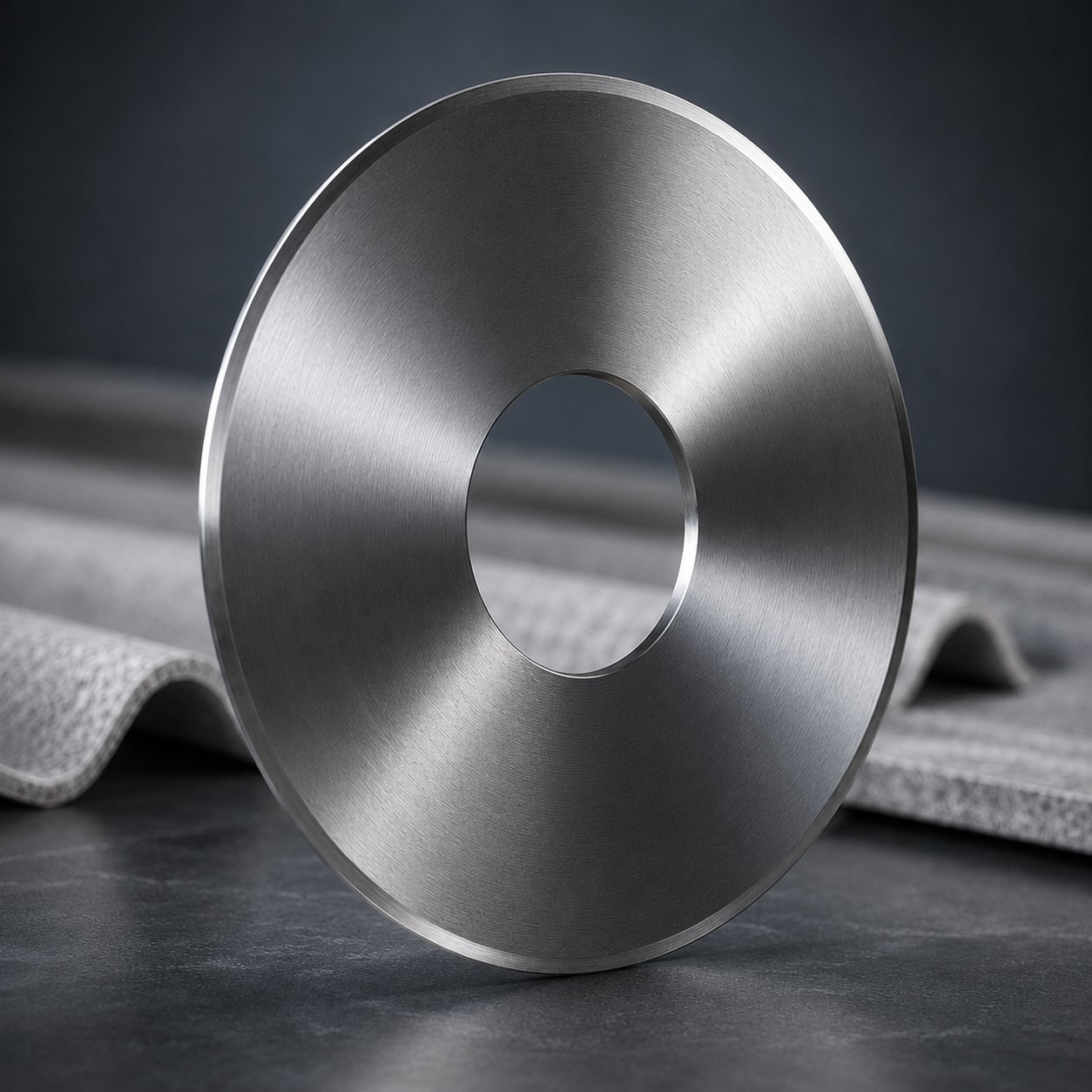
- What to cut with. Knives and disc knives are consumables: they are sharpened and replaced on a schedule. Waterjet cutting does not dull, but needs a high-pressure pump, water filtration and nozzle maintenance.
- Where to put hardened scrap and offcuts. It is not only a question of a waste yard: removal, processing and accounting are regulated by the rules of the country. If the line has no grinding unit, hardened offcuts pile up.
Where and with what the cutting is done
| Place | What is cut | With what |
|---|---|---|
| After the format drum | the wrap along the generatrix of the drum | wrap cutter (wire, comb, knife) |
| On the conveyor after the machine | the wrap into blanks by length | rotary shears, water jet |
| In the corrugator or after it | longitudinal edges of the raw sheet | disc knives |
| After curing | the sheet to exact size, the edge of a flat sheet | circular saws, abrasive waterjet |
Cutting the raw sheet
In the description of a domestic equipment complex for corrugated sheets, the wrap is cut with rotary shears with two knives on a shaft, and the cut pitch is changed by changing gears and cams. The longitudinal edges after the corrugator are cut off with disc knives perpendicular to the sheet surface, and the offcuts fall onto belt conveyors. Patent descriptions of foreign lines also mention trimming the raw sheet with a high-pressure water jet.
What matters for cutting raw:
- A sharp knife. A dull knife crushes the soft edge, tears it and causes delamination at the edge. Knives and discs have a separate article.
- The right moment. A sheet that is too wet drags after the knife, one that is over-dried crumbles.
- Even feed. A sheet skewed under the knife gives a slanted edge, which is most noticeable on flat sheet.
Cutting the hardened sheet
A hardened sheet is hard and abrasive. It is cut with saws with carbide or diamond discs, or with a water jet with abrasive. Dry cutting with a saw gives fine dust. Fibre-cement dust contains respirable crystalline silica, and asbestos-cement sheet dust also contains chrysotile fibres: WHO classes all forms of asbestos, including chrysotile, as carcinogenic to humans. So a hardened sheet is cut only with dust extraction and respiratory protection. Occupational safety recommendations for cutting fibre-cement board (for example, OSHA in the USA) provide for a saw with dust extraction and filtration; what is mandatory for you is set by the occupational safety rules of your country. A water jet gives almost no dust, but gives slurry: water with cement fines, which has to be settled.
What to do with offcuts
| Offcut | What is done with it |
|---|---|
| Raw (wrap offcuts, edges, rejected raw sheet) | straight into the agitator: broken down in water and returned to the slurry; a textbook describes this as the usual path of offcuts and rejected raw sheets |
| Slurry from settling tanks and from waterjet cutting | returned to the slurry in the share set by the regulations, or taken away |
| Hardened offcuts and scrap | do not go into ordinary slurry "as is"; ground to a fine powder and added as a filler, or taken away |
Raw offcuts are returned to the slurry in measured amounts: if too many offcuts get into the agitator, the composition and concentration of the slurry change, and this shows on the sheet.
The return of hardened waste is described in the patents of a fibre-cement manufacturer: hardened waste is crushed and ground in a pendulum mill to a fineness close to cement or ground limestone, and this powder replaces part of the solids in the slurry. The same patents note that with a large share of powder the sheet density falls, and pressing helps recover the properties. The share returned and the testing of the sheet are the job of the process engineer and the laboratory.
What to attach to a request for knives and cutting units
- A photo of the knife or disc with dimensions: outer and bore diameter, thickness.
- The material of the cutting edge, if known.
- What you cut: the raw wrap or the hardened sheet, and the sheet thickness.
- For waterjet cutting: the nameplate of the high-pressure pump and the nozzle type.
How we do it
- From a number, drawing or photo of the unit, we look for the item at the manufacturing plant. What we find, with the price, photos and specifications, we send before the order.
- A disc knife for trimming slate and an abrasive waterjet cutting system are in the catalog.
- We check the batch at the plant before shipment: article number, dimensions, batch, packaging.
What this article relies on
Below are the documents and materials we refer to, so that you can check what is said for yourself.
Reference materials
- "Technology of Production of Building Materials, Products and Structures" (Технология производства строительных материалов, изделий и конструкций), clause 5.4.2 (bibliotekar.ru): the wrap is cut with a comb cutter and rotary shears, offcuts and rejected sheets are returned to the bucket agitatorbibliotekar.ru ↗
- "SM-1155 equipment complex for making corrugated asbestos-cement sheets" (stroy-technics.ru): rotary wrap shears, trimming of longitudinal edges with disc knives in the corrugator, offcuts dropped onto conveyorsstroy-technics.ru ↗
- "Equipment for the production of asbestos-cement products" (Оборудование для производства асбестоцементных изделий) (stroy-technics.ru): offcuts from the shears and the corrugator go to the agitator and return to the cycle as a suspensionstroy-technics.ru ↗
- Patent US 6824715: trimming the raw sheet with a high-pressure water jet, offcuts are broken down and reusedpatents.google.com ↗
- Patent US 10144150: raw sheet offcuts are returned to the slurrypatents.google.com ↗
- Patents US 11554987 and US 11773023 "Methods for producing fiber cement products with fiber cement waste" / "...air-cured fiber cement products": grinding hardened waste to powder and replacing part of the solids in the slurry with itpatents.google.com ↗patents.google.com ↗
- OSHA, fact sheet "Control of Silica Dust in Construction: Handheld Power Saws Used to Cut Fiber-Cement Board": cutting generates respirable crystalline silica dust; dust extraction, filtrationosha.gov ↗
- WHO, fact sheet "Asbestos: elimination of asbestos-related diseases": all forms of asbestos, including chrysotile, are carcinogenic to humanswho.int ↗
- taminota.com catalog: disc knife for trimming asbestos-cement slate, abrasive waterjet cutting system: item descriptions.
The cutting procedure, the share of offcuts returned and the dust extraction requirements for your line are set by the process regulations and the occupational safety rules of the country.