Carbide grades on knives: what YG and VK (ВК) mean
VK (ВК) and YG are one family of cemented carbides: tungsten carbide bonded with cobalt. The number after the letters is the cobalt share in percent: ВК8 and YG8 contain about 8% cobalt. Less cobalt means harder and more resistant to abrasion, more means tougher against impact and chipping. For a knife cutting an abrasive sheet a balance is sought, so a request states the grade, the HRA hardness and the bending strength.
In short
4minutes to read
4sections
7sources
1catalog item
In this article
TableHow to read the grade4 rows →The carbide for knives is a sintered powder of tungsten carbide held together by metallic cobalt. In Russian grades such alloys are marked with the letters ВК (VK), in Chinese ones with YG. The number after the letters in both systems is the cobalt share in percent by mass. The less cobalt, the harder the alloy and the better it resists abrasion, but the easier it chips under impact. The more cobalt, the tougher it is and the stronger against chipping, but the faster it wears. A knife for slate works against both abrasion and impact, so the grade is chosen together with the manufacturer for your cutting mode.
What to write in a knife request
- dimensions: outside and bore diameter, thickness, edge profile;
- the alloy grade, if known (YG8, ВК8 and so on);
- Rockwell hardness HRA and bending strength, which are usually given in the knife passport;
- where the knife is mounted and what it cuts: trimming the edge of the green sheet, cutting to size, cutting a cured sheet;
- how the old knife wears: dulls evenly or chips out in pieces.
The last point is important: it tells the manufacturer which way to shift the grade, toward hardness or toward toughness.
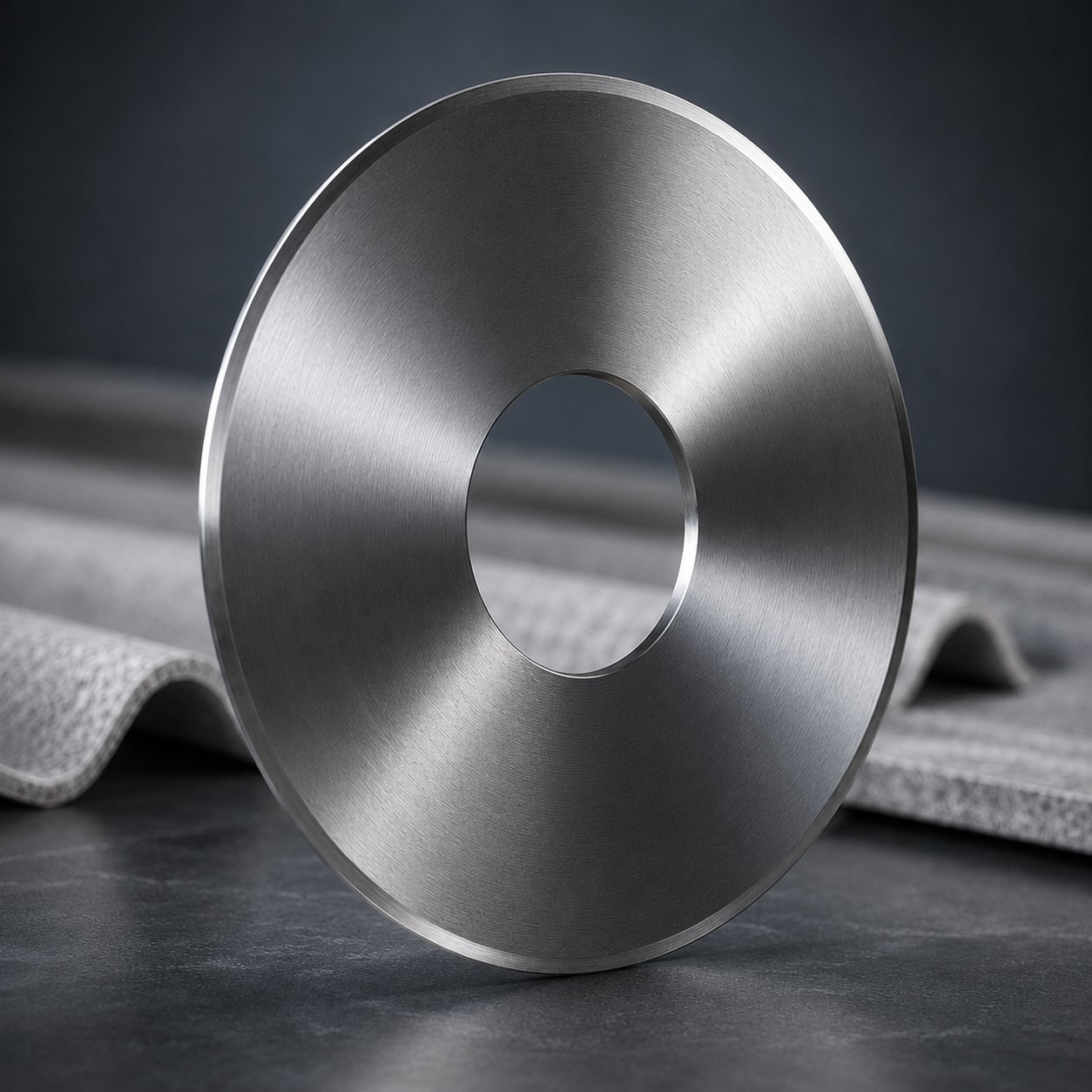
A catalog example: a disc knife for trimming the edges of an asbestos-cement sheet, made of a tungsten carbide cemented alloy, with a passport hardness of at least 89 HRA and a bending strength of at least 2800 MPa.
How to read the grade
Russian VK (ВК) grades (GOST 3882-74)
| Example | Meaning |
|---|---|
| ВК | tungsten-cobalt alloy: tungsten carbide + cobalt |
| ВК8 | about 8% cobalt, the rest tungsten carbide |
| ВК6, ВК15 | about 6 and 15% cobalt |
| letter В at the end (ВК4В) | an alloy of coarse-grained tungsten carbide |
The standard for sintered cemented carbides is GOST 3882-74. Besides the VK group it has alloys with titanium carbide (ТК) and with titanium and tantalum carbides (ТТК); they are mostly used on steel-cutting tools.
Chinese YG grades
| Example | Meaning |
|---|---|
| YG | tungsten-cobalt alloy, WC + Co |
| YG8 | about 8% cobalt |
| YG6, YG10, YG20 | about 6, 10, 20% cobalt |
| YT (for example YT15) | with titanium carbide, for machining steel |
| letters after the number | special features: grain size, additives |
Chinese suppliers state a cobalt tolerance in the alloy passport: for example, YG8 is 8% plus or minus half a percent. As cobalt grows, their density and hardness fall.
How to match VK and YG
By composition YG6 is close to ВК6 and YG8 to ВК8: it is the same tungsten carbide–cobalt system with the same share of binder. But "close in composition" does not mean "identical": grain size and additives differ between plants, and both hardness and chipping resistance depend on them. So you compare not the letters but the passport properties: HRA, bending strength, grain size.
What to choose for slate
Asbestos-cement and fibre-cement slurry is abrasive: it has cement and sand in it, so the knife dulls. The green sheet has wet layers; on a cured sheet there is impact on entering the sheet and vibration, which makes the edge chip.
| What happens to the knife | Which way to shift the grade |
|---|---|
| Dulls evenly, edge worn away | less cobalt, finer grain: harder |
| Chips out in pieces, cracks | more cobalt: tougher |
| Breaks whole | check the fit, shaft runout, impact on entry; the grade may be irrelevant |
Research on cemented carbides shows the same pattern: at equal hardness an alloy with little cobalt and coarse grain holds wear better, while one with much cobalt and fine grain resists fracture better. The final grade for your cutting is chosen by the knife manufacturer.
How we do it
- From the number, drawing or photo of the unit, we look for the item at the manufacturing plant. What we find, with the price, photos and specifications, we send before the order.
- We inspect the lot at the plant before shipment: part number, dimensions, lot, packaging.
What this article relies on
Below are the documents and materials we refer to, so that you can check what is said for yourself.
Standards and documents
Reference materials
- Journal "Izvestiya Vuzov. Powder Metallurgy and Functional Coatings" (NUST MISIS): alloys of the VK group (WC–Co), designation of coarse-grained alloyspowder.misis.ru ↗
- Moscow State University postgraduate paper "Development of new grades of VK group cemented carbides": ВК6, modification, foreign equivalentsaspirant.msu.ru ↗
- Superabrasives Powder, "Tungsten carbide classification": YG (WC–Co), YT (WC–TiC–Co) and their usessuperabrasivespowder.com ↗
- Cemented carbide supplier passport (Global Sources): cobalt content and density of YG6, YG8, YG10p.globalsources.com ↗
- Journal "Powder Metallurgy Technology" (USTB): wear resistance of low-cobalt and high-cobalt alloys at equal hardnesspmt.ustb.edu.cn ↗
The tables are compiled from the standard and suppliers' passports; the properties of a specific knife come from the manufacturer's passport.