Knives and discs for cutting sheets: carbide or waterjet
On the line a green sheet is cut with disc knives or a waterjet, and a hardened one with carbide-tipped or diamond saws. A carbide disc is cheaper to set up and simple; a jet does not blunt and makes less dust, but needs a high-pressure pump and clean water. An enquiry for a knife needs the dimensions, the carbide grade or hardness and the place on the line.
In short
5minutes to read
6sections
7sources
2catalog items
In this article
Contents
On a sheet line the material is cut in two states, and the tool for each is different. The green blank, straight after forming, while it is soft, is cut with disc knives or a waterjet. The finished, hardened sheet is cut with saws with carbide or diamond teeth. The choice between knife and jet on the green blank is a choice between a simple, cheap unit with a consumable and a complex installation with no consumable but with a high-pressure pump and requirements for the water. To order a knife we need its dimensions, material and hardness, and the place where it sits on the line.
Where on the line the sheet is cut
- Cutting off the blank on the format drum. When the layer has reached its thickness, it is cut along the generatrix of the drum and taken off.
- Edge trimming and cutting the green blank to size. The side edges are trimmed straight after forming. The trimmings can be returned at once to the process water and the slurry, which is described in patents on fibre-cement production. Cross-cutting gives the length of the sheet.
- Cutting and finishing the finished sheet after hardening: to size for an order, cut-outs, end trimming. Here the sheet is already hard and abrasive.
Green blank: disc or jet
Disc knife
A thin round knife rotates or rolls over the blank lying on a support. One patent on sheet cutting describes an arrangement where longitudinal knives cut the green sheet on a belt of resilient material with a rigid support underneath, which makes the cut clean. A knife of carbide holds its edge for a long time, but it blunts and chips: the slurry contains sand and cement. A blunt knife crushes and tears the edge, and the layers at the edge come apart.
Pros: a simple unit, easy to replace, an understandable consumable. Cons: the knife has to be changed and dressed, the edge suffers as it blunts, a stop for replacement.
Waterjet
An intensifier pump raises the water pressure to hundreds of megapascals, and a nozzle with a sapphire or diamond insert forms a thin jet. Equipment manufacturers write that a pure waterjet is easily built into a line and cuts the board in the green state, before final hardening, and that cutting green at the plant is preferable. Waterjet manufacturers add that there is no need to stop the line to change knives, and there is less dust. These are the sellers' arguments, but in substance they are right: a jet has no cutting edge that could blunt.
Pros: no blunting, no force on the blank, a clean edge, less dust. Cons: a high-pressure pump and its maintenance (seals, nozzles), the water must be well filtered, the water from the jet goes onto the blank and into the process water.
The catalog has a waterjet cutting unit: a booster with a maximum pressure of 300 MPa (working up to 250 MPa), water flow 3.7 l/min, a 5 µm filter, a sapphire nozzle.
Finished sheet: saws
A hardened sheet is an abrasive material. Saws with carbide or polycrystalline diamond (PCD) teeth are made for it. Tool manufacturers state that diamond saws for fibre cement last noticeably longer than carbide ones and cut faster; the specific multiples differ between brands and are advertising figures. On a large volume of cutting, diamond is usually better in tool life but costs more to buy.
Carbide: what to look at
Cemented carbide is grains of tungsten carbide in a cobalt binder. The less cobalt, the harder the carbide and the higher its abrasion resistance, but the more brittle it is and the easier it chips. The more cobalt and the coarser the grain, the tougher the carbide and the better it takes impact, but the faster it wears. The hardness of carbide is measured on the Rockwell A scale (HRA). Grades with a low cobalt share are usually above 90 HRA, grades with a high cobalt share and coarse grain are lower; the exact values are each manufacturer's own.
For a knife that cuts an abrasive slurry without impacts, a harder grade is usually taken. If the knife chips, the grade is too brittle for your unit, or there are impacts and vibration. If it blunts quickly without chips, look at a harder grade.
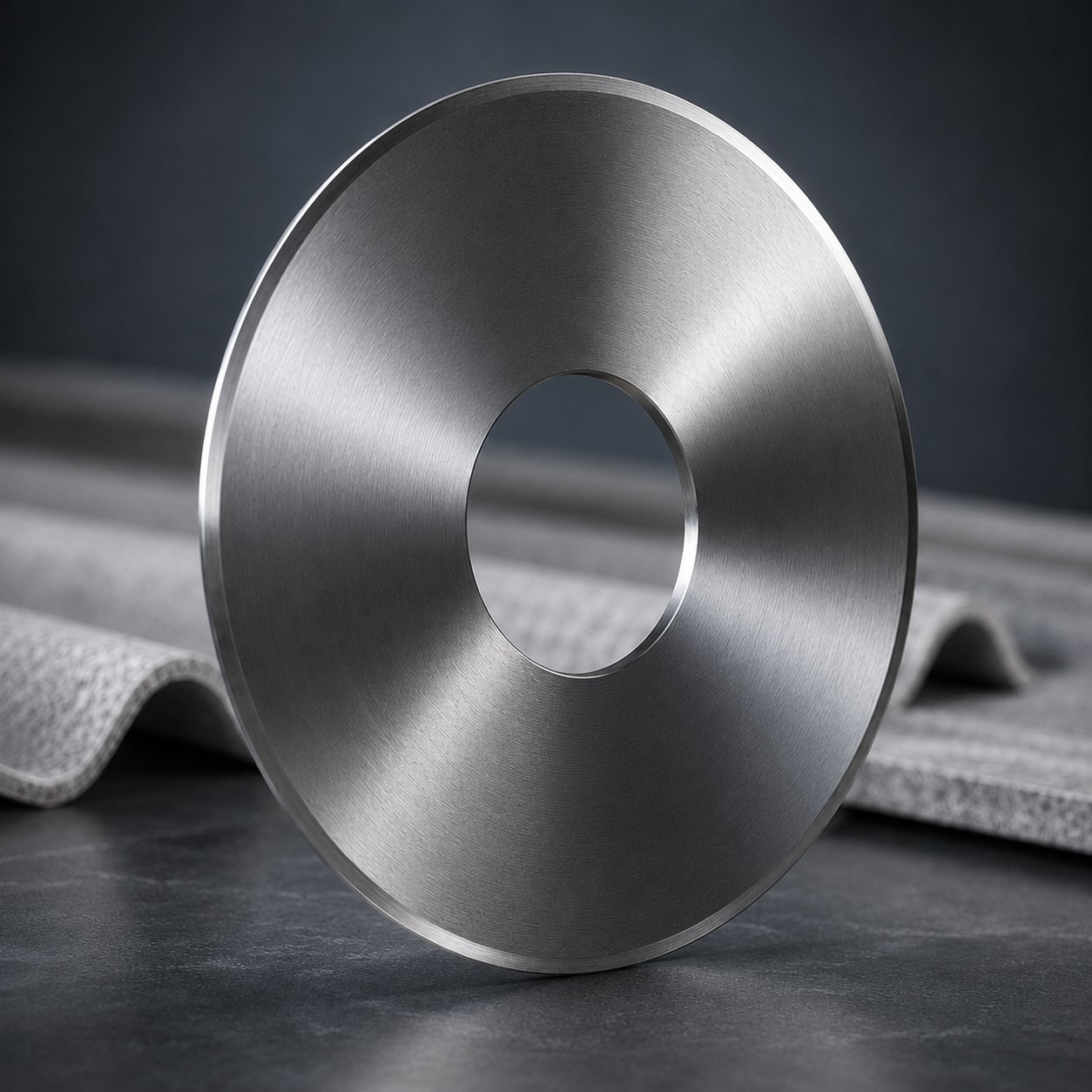
The catalog has a disc knife for trimming the edges of asbestos-cement sheets: outer diameter 280 mm, bore 130 mm, thickness 3.38 mm, hardness not below 89 HRA, bending strength not below 2800 MPa.
What to state in a knife enquiry
- The type: disc, straight, circular, opposed.
- The outer diameter, bore diameter, thickness; for a straight knife the length, width, thickness and holes.
- The grinding: angle, single or double bevel.
- The material: cemented carbide (grade or HRA hardness), steel, brazed tip.
- Where the knife sits: cut-off on the drum, edge trimming, cross-cutting, cutting the finished sheet.
- How many knives are fitted at once and how often they are changed.
- Photos of the knife and of the place of installation, the old knife with its marking.
How we do it
- By number, drawing or photo of the unit, we look for the item at the manufacturing plant. What we find, with the price, photos and specifications, we send before the order.
- We inspect the lot at the plant before shipment: part number, dimensions, lot, packaging.
What this article relies on
Below are the documents and materials we refer to, so that you can check what is said for yourself.
Reference materials
- MetalForming, March 2019, an article on waterjet cutting: cutting cement board in the green state on the lineweb.archive.org ↗
- KMT Waterjet, "Cutting fiber cement board": arguments for the jet against kniveskmtwaterjet.com ↗
- Patent US 12227456 "Fiber cement products and methods for the production thereof": trimming the edges straight after forming and returning the trimmingsimage-ppubs.uspto.gov ↗
- Application US 2002/0134209 "Sheet cutting process and apparatus": cutting a green sheet with longitudinal knives on a resilient beltpatents.justia.com ↗
- Metabo, "fibre cement cut" saw blades with diamond teethmetabo.com ↗
- Stanford Advanced Materials, the effect of cobalt content on the hardness and toughness of cemented carbidepowder.samaterials.com ↗
- taminota.com catalog: disc knife TMN-280-1303 and waterjet cutting unit TMN-XHB-04, manufacturer's data.
The link between cobalt, grain, hardness and toughness is confirmed both by a powder supplier and by patents on carbide inserts (for example US 6244364: image-ppubs.uspto.gov/dirsearch-public/print/downloadPdf/6244364); their figures for grades differ, so they are not quoted in the text. The choice of grade for a particular unit follows the experience of your line and the recommendation of the knife manufacturer.