Slurry pump for sheet plants: why it wears fast, what replaces it
A pump on slurry is eaten by sand and cement: the impeller, the casing liner and the shaft seal wear out. A slurry pump with a rubber or wear-resistant metal liner, running at low speed, lasts longer. For a replacement, copy the nameplate, measure the ports and write down what exactly it pumps and from where.
In short
5minutes to read
6sections
5sources
2catalog items
In this article
- 01Where such pumps work at a sheet plant
- 02Why the pump gets eaten
- 03Rubber or high-chrome iron
- 04Shaft seal
- 05What to replace it with
Contents
A pump on the slurry, stock and process water of a sheet plant wears fast because it pumps an abrasive: cement, sand, lumps of hardened slurry. The first to go are the impeller, the casing liner and the shaft seal. The pump that lasts longer is one made for slurry: with a rubber liner if the particles are small and rounded, or with a high-chrome iron liner if the particles are large and sharp, and one that turns slowly. For a replacement we need the nameplate, the port dimensions and an honest description of what the pump handles.
Where such pumps work at a sheet plant
- feeding slurry from the agitators and tanks to the machine;
- pumping out slurry and process water from sumps and settling tanks;
- transferring the sand suspension after the mill;
- pumping out water with waste from under the machine and from the cutting area.
Each place has its own duty: somewhere thin water with fines, somewhere thick slurry, somewhere large lumps. One pump "for everything" usually serves badly everywhere.
Why the pump gets eaten
- Abrasive. Particles of cement and sand strike and rub the impeller and casing. The impeller wears differently from the liner: it takes direct particle impacts and friction on the vanes, the casing takes the flow sliding along its walls.
- High speed. The faster the impeller turns, the harder each particle strikes. The patent literature on slurry pumps says directly that a slow pump lasts longer than a fast one: it has a larger and heavier impeller, and the wear energy is spread over a greater area.
- Wrong liner. Rubber damps the impact of small rounded particles well, but is cut by large sharp ones. Metal holds up against large lumps, but on fine slurry it can lose to rubber in life.
- Wrong duty point. A pump running far from its duty point in flow and head wears unevenly, and with insufficient suction head cavitation begins.
- Shaft seal. A gland without flushing with clean water lets slurry through to the shaft, and the shaft is worn through under the packing.
Rubber or high-chrome iron
| Rubber liner | High-chrome iron | |
|---|---|---|
| Particles | small, rounded | large, sharp |
| Impact | damped by elasticity | held by hardness |
| Risk | cuts from sharp lumps, destruction by oils | brittleness under the impact of a large lump |
A manufacturer of slurry pumps writes that submersible pumps with rubber parts on small rounded particles generally last longer than metal ones, while with sharp particles metal parts are needed. The usual material for metal parts is high-chrome white iron; various sources name 25 to 28 % chromium. The larger the particles, the thicker and harder the liner must be. On many pumps one frame accepts both rubber and metal wet-end parts, so the material can be changed without replacing the pump, which is worth confirming with the manufacturer.
For the slurry of sheet production, with cement, fibre and sand, there is no single answer. The guide is what wears on yours: if the impeller is worn evenly and smoothly, the abrasive is fine; if the rubber has cuts and tears, there are large lumps, and it is worth thinking of a screen or trap before the pump, or of metal.
Shaft seal
On slurry two options are used:
- Gland with flushing. Clean water is fed under pressure into the packing through the lantern ring. It keeps slurry away from the shaft. Without flushing, or with dirty water, a gland does not last.
- Centrifugal (dynamic) seal. An expeller on the shaft throws the slurry back while the pump runs; no flushing is needed, but a different seal is needed at standstill.
More on glands is in a separate article.
What to replace it with
Before ordering, collect:
- The pump nameplate in full: model, flow, head, speed, power.
- The diameters of the suction and discharge ports, the flanges, the arrangement.
- The type: horizontal, vertical submersible, cantilever.
- What it pumps: water with fines, slurry, sludge, sand; the approximate share of solids; whether there are large lumps.
- From where to where: lift height, pipe length, whether there is suction head at the inlet.
- How the old pump wears: photos of the impeller and casing after dismantling.
If the old pump served badly, repeating it is not necessary: with the same ports you can take a pump with a different liner, or one at a lower speed with a larger impeller.
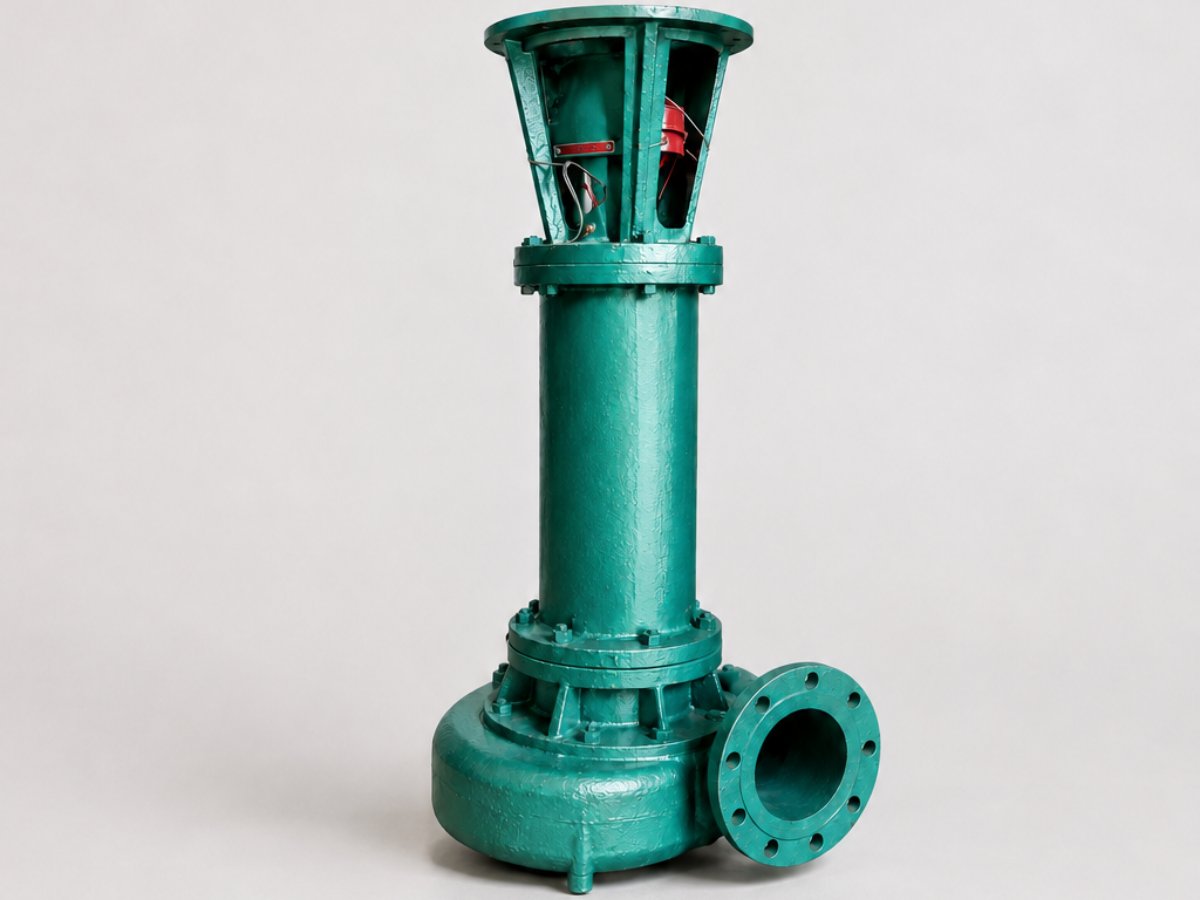
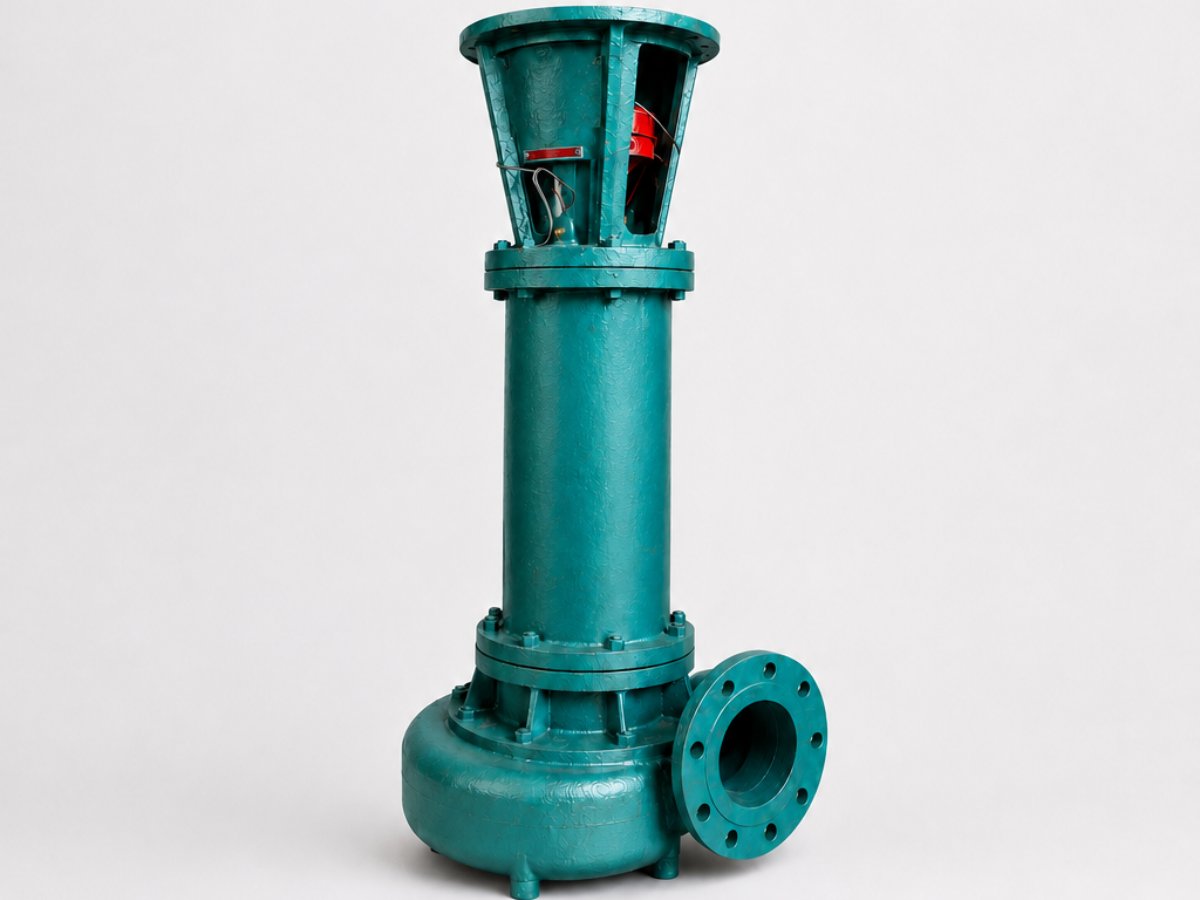
The catalog has vertical sump pumps NL100 (150 m³/h, head 10 m, 15 kW, 1450 rpm) and NL150 (250 m³/h, head 10 m, 22 kW, 1450 rpm, 150 mm port). Whether they suit your place is decided by the duty point and what they will pump.
How we do it
- From the nameplate and photos we look for a pump at the manufacturing plant, or a replacement with the same duty point, speed and ports.
- What we find we send before the order: the characteristic, dimensions, power. If the replacement has different ports or weight, we say so.
- At the plant we check the marking and nameplate of the pump being shipped against the agreed item.
What this article relies on
Below are the documents and materials we refer to, so that you can check what is said for yourself.
Reference materials
- Patent US 9574573 "Wear resistant slurry pump parts produced using hot isostatic pressing", background section: rubber for small particles, damage to rubber by large sharp particles and hydrocarbons, iron with 28 % chromium, a slow pump lasts longerpatents.google.com ↗
- Weir Minerals, materials on Warman slurry pumps: rubber parts on small rounded particles and metal on sharp ones, interchangeability of wet-end partsdirectindustry.com ↗
- 911 Metallurgist, "Slurry Pumps": rubber liner with small particles, a gland with flushing and a centrifugal seal911metallurgist.com ↗
- McLanahan, slurry pump service: liner thickness and hardness by particle sizemclanahan.com ↗
- taminota.com catalog: pumps TMN-NS-100 and TMN-NS-150, nameplate data.
The wear comparison is made from mining-industry materials, where slurry pumps are studied best. At a sheet plant the duty is milder, and the principles are the same.