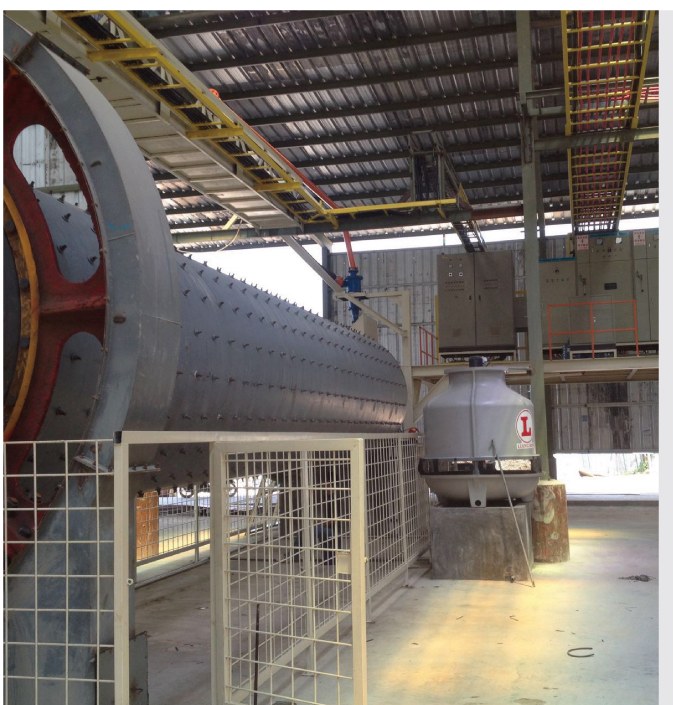
Ball mill for sand: lining, balls and what gets used up
In a ball mill for quartz sand the grinding balls are used up constantly, and the drum lining and the diaphragm grates more slowly. The trunnion main bearings, the girth gear and the lubrication are kept under watch. The condition of the mill shows in the fineness: when the residue on the sieve grows, it is time to check the balls and the lining.
In short
5minutes to read
6sections
7sources
1catalog item
In this article
- 01Why a slate plant grinds quartz
- 02How the mill is built
- 03What gets used up and what wears
- 04How the fineness is controlled
- 05What to state when ordering
Contents
What gets used up first in a ball mill for sand is what does the grinding: steel balls wear away every day and are topped up regularly. The drum lining and the grates of the partition between chambers wear more slowly. The trunnion main bearings, the girth gear and the drive pinion, and their lubrication, are watched separately: a failure here stops the mill for a long time. A buyer should keep a stock of balls in the needed sizes and know the dimensions of the lining and grates in advance: the lining is made for the drum of a specific mill.
Why a slate plant grinds quartz
A ball mill for sand is needed by plants that make autoclaved fiber cement sheet. In the autoclave, at raised temperature and pressure, the silica from the sand reacts with the lime released when the cement hardens. The result is strong calcium silicate hydrates, including tobermorite. For the quartz to react within the autoclave cycle, it is ground to a fineness close to that of cement: a fine powder has far more surface on which the reaction takes place.
Such grinding needs clean sand with a high silica content and little clay. Clay impurities change what forms in the autoclave, and the strength of the sheet may fall. Which sand and which fineness to use is set by the process regulations of your line. Asbestos-cement lines without an autoclave usually do without sand grinding.
How the mill is built
The drum lies on two hollow trunnions, each in its own main bearing. The drive is a motor, a gearbox and an open gear pair: a drive pinion and a girth gear on the drum. The sand enters the hollow trunnion through a hopper and a screw feeder and gets into the first chamber. There it is crushed by large balls. Through the slots of the partition it passes into the second chamber and is ground finer by small balls. The finished powder leaves through the outlet grate and the discharge trunnion.
Inside, the drum is protected by a lining, replaceable plates of wear-resistant metal or rubber. The profile of the plates lifts the ball charge as the drum turns, and the balls fall and roll. This is how grinding happens.
What gets used up and what wears
| Unit | What happens | How to notice |
|---|---|---|
| Grinding balls | Worn down by friction and impacts, get smaller | Grinding gets coarser, output falls; power draw changes |
| Lining | Profile smooths out, plates get thinner, bolts loosen | Poorer grinding at the same ball charge; plates knocking, leaks from under the bolts |
| Partition and outlet grate | Slots wear out or clog | Coarse particles in the finished powder or overfilling of the first chamber |
| Trunnion main bearings | Wear with poor lubrication or dirty oil | Bearing temperature rises at the same load |
| Girth gear and drive pinion | Tooth wear, misalignment, lack of lubricant | Noise and vibration, signs of dry contact on the teeth |
Balls wear all the time, which is why they are topped up, usually with new balls of the largest size in their chamber. Worn balls get smaller by themselves, and the charge stays mixed in size. How much to top up and how often is determined from the experience of your own mill: by the ball consumption per ton of sand, the drive power and the fineness. There is no general norm: it depends on the sand, the balls and the lining.
The lining is changed during a planned shutdown. It matters that grinding gets worse before the plate is worn down completely: a smoothed profile lifts the balls less well. After replacement and the first run-in, the lining bolts are re-tightened: a loosened plate starts to hammer and tears the bolts, and a bolt that falls inside damages the partition and the balls.
How the fineness is controlled
The finished powder is regularly screened on a control sieve and the residue in percent is read. If the residue grows at the same sand feed, the causes in order are: too few balls or they have worn small, the lining has worn, the partition is clogged or worn out, or a different sand has arrived (coarser, wetter, with clay). Wet sand sticks to the balls and the lining, so the moisture of the feed is also monitored.
What to state when ordering
- The mill nameplate: manufacturer, model, drum diameter and length.
- For the lining, the drawing of the plates from the passport. If there is none, the plate dimensions, thickness, profile, position and diameter of the bolt holes, photos with a ruler, and the material (metal or rubber).
- For the grates and the partition, the dimensions, slot width and fastening.
- For the balls, the diameters per chamber, the material (steel, cast iron, high-chromium alloy) and the mass needed.
- For the trunnion bearings, the gearbox and the gears, the nameplates and numbers from the passport.
How we do it
- From the number, drawing or photo of the unit, we look for the item at the manufacturing plant. What we find, with the price, photos and specifications, we send before the order.
- A ball mill for quartz sand is in the catalog; the whole machine is selected for the line.
- We inspect the lot at the plant before shipment: part number, dimensions, lot, packaging.
What this article relies on
Below are the documents and materials we refer to, so that you can check what is said for yourself.
Reference materials
- European application EP0263723: ground quartz, quartz sand and other siliceous components react with lime during autoclave curing, fineness close to Portland cementdata.epo.org ↗
- Patent US 7967907 "Fiber reinforced cement composition and products and manufacturing process": formation of tobermorite in autoclave curing, the role of the fineness of the siliceous componentpatents.google.com ↗
- SPbPU (Peter the Great St. Petersburg Polytechnic University), article on autoclaved materials: requirements for siliceous raw material, the effect of clay impuritieselib.spbstu.ru ↗
- Fabrico, ball mill maintenance guide: lining, trunnion main bearings, girth gear pair, bolt tighteningfabrico.io ↗
- Oxmaint, cement ball mill maintenance: lining, partition, trunnion bearingsoxmaint.com ↗
- 911 Metallurgist, "Ball Mill Media Maintenance": ball wear, top-up, size of the balls added911metallurgist.com ↗
- taminota.com catalog, ball mill for quartz sand: design of the chambers, trunnions and discharge as described by the manufacturing plant.