Standalone machineXinhuibo
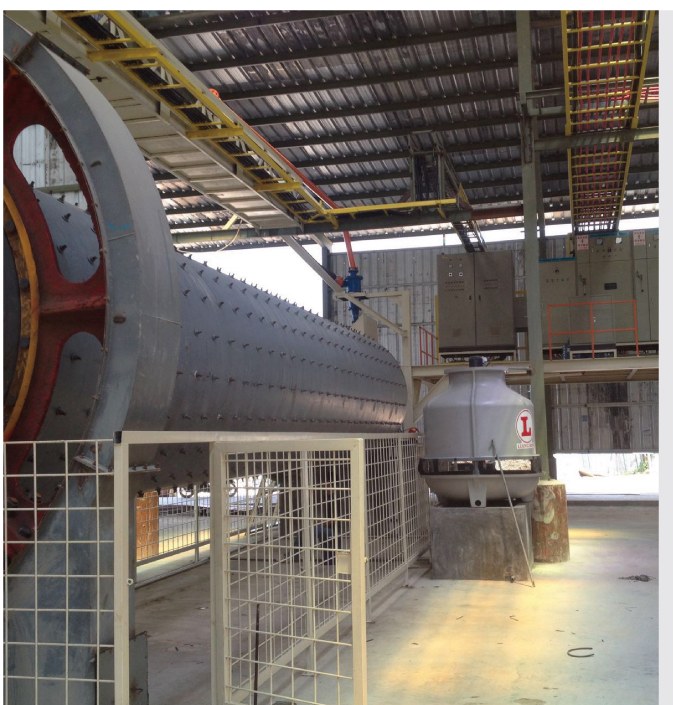
Ball mill for quartz sand
Capacity5–7т/ч
- TAMINOTA part number
- TMN-XHB-10
- Rotation speed
- 23.9 rpm
- Grinding media load
- 21 т
Wet grinding of quartz sand to the process fineness. Through the hopper and the feed screw in the hollow trunnion the material enters the first chamber; after crushing it passes through the openings of the partition into the second one, where it is ground down to a fine powder. Material that meets the specification leaves through the grate into the discharge chamber and then goes by screw to a conveyor or a storage bin. Assemblies: drive, discharge section, main bearings, gear casing, rotating and feeding parts.
- Brand
- Xinhuibo
- Category
- Standalone machine
- Industry
- Asbestos and fiber cement
- Availability
- Project supply
What to send for selection
- 01Part number or the number on the nameplate
- 02Photos of the unit and its nameplate
- 03Model of the machine the unit is fitted to
- 04Quantity
Specifications
TMN-XHB-10
- Feed size
- ≤25 mm
- Moisture
- <1.5%
- Grinding fineness
- 6–10% (сито 4900 отв/см²)
How to get this item
- 01You send the part number or a nameplate photo
- 02You get the plant’s invoice and a lead time
- 03Inspection at the plant, delivery, documents
Related articles
- Cement plant spare parts from China: what is ordered and howAt a cement plant what is changed most often is what rubs against clinker and raw meal: grinding balls and mill liners, kiln lining, filter bags, elevator belts and buckets. Next come large bearings, gearboxes and kiln rollers. Standard units are ordered by number, cast wear parts by drawing or sample with the material grade.
- Ball mill for sand: lining, balls and what gets used upIn a ball mill for quartz sand the grinding balls are used up constantly, and the drum lining and the diaphragm grates more slowly. The trunnion main bearings, the girth gear and the lubrication are kept under watch. The condition of the mill shows in the fineness: when the residue on the sieve grows, it is time to check the balls and the lining.
- Autoclave at a slate plant: what it is for and what gets servicedAn autoclave is needed where the mix contains ground quartz sand: under saturated steam pressure the sand reacts with the lime from the cement, and the sheet gains strength in a single cycle. What wears out in it: the seal of the quick-opening lid and its mechanism, steam traps and drainage, valves and safety valves, rails and cars. In Uzbekistan the autoclave is pressure equipment and falls under technical regulation CMR No. 493.
- Autoclave or air curing: which to choose for the sheetThe choice between an autoclave and curing in air is a choice of mix composition, not only of equipment. The autoclave gives fast strength gain and lets ground sand replace part of the cement, but it needs steam, a boiler and a pressure vessel. A mix with PVA fibre does not survive the autoclave; it is cured in air.
- A minimal slate plant laboratory: what it must haveA slate plant laboratory needs two parts. The first checks the finished sheet to GOST: a bending and load testing machine, a pendulum impact tester, a drying oven, scales with a hydrostatic weighing fixture, a freezer and measuring tools. The second watches the raw materials and the mass: cement, fibre opening or refining, concentration. Periodic tests can be given to an outside laboratory; acceptance tests are better done in house.
- Fibre cement facade boards: can a slate plant make themA facade board can be formed on the same Hatschek machine as slate. But a facade board is a different product: it needs a press, curing to the board's own recipe, precise cutting, often sanding, primer and a coating on the face, and to be sold under European requirements it needs EN 12467 tests for strength and resistance to water, frost and temperature swings. It is not "slate without the wave" but a separate process stage and a separate market.
- Quartz sand for autoclaved fibre cement: its role and the dust hazardGround quartz sand works in the sheet as a reagent during autoclave treatment: under steam pressure the silica reacts with the lime of the cement and gives calcium silicate hydrates. That is why the sand is ground to a fineness close to that of cement, and the fineness is monitored with a sieve and by specific surface. The dust of ground quartz is respirable crystalline silica: it causes silicosis and is classed as a Group 1 carcinogen.
Request
Send a part number or a photo — we will find the factory
Items from the catalog · 1
- TMN-XHB-10 · Ball mill for quartz sand