Cellulose, PVA and polypropylene in fibre cement: what each is for
In an asbestos-free sheet the fibres share the work. Cellulose holds cement particles on the screen while the layer builds up and reinforces the sheet, but before that it is pulped in water and refined. The synthetic fibres PVA and polypropylene reinforce the sheet, but they do not act as a filter and the ordinary grades do not survive an autoclave. Which fibre to use and how much is decided by the curing method and the line's process regulations.
In short
8minutes to read
9sections
12sources
2catalog items
In this article
- 01What the owner needs to decide
- 02What each fibre does
- 03How much fibre is in the slurry
- 04How cellulose is prepared
- 05How to measure freeness
Contents
In an asbestos-free fibre-cement sheet the fibre does two different jobs. The first is technological: on the screen cylinder of a Hatschek machine the fibre must form a mesh and hold fine cement particles on it while the water leaves the slurry. Cellulose does this job. The second is reinforcement of the finished sheet. Cellulose and the synthetic fibres do that: polyvinyl alcohol (PVA) and polypropylene (PP). Synthetics cannot act as a filter themselves, so ground cellulose is still added to a slurry with PVA or PP. And which reinforcing fibre is possible is decided by the curing method: ordinary PVA and PP do not withstand the autoclave.
What the owner needs to decide
- Which curing method the plant uses. Autoclave: reinforcement with cellulose. Air curing: cellulose together with PVA or PP. For more on the choice, see the article "Autoclave or air curing".
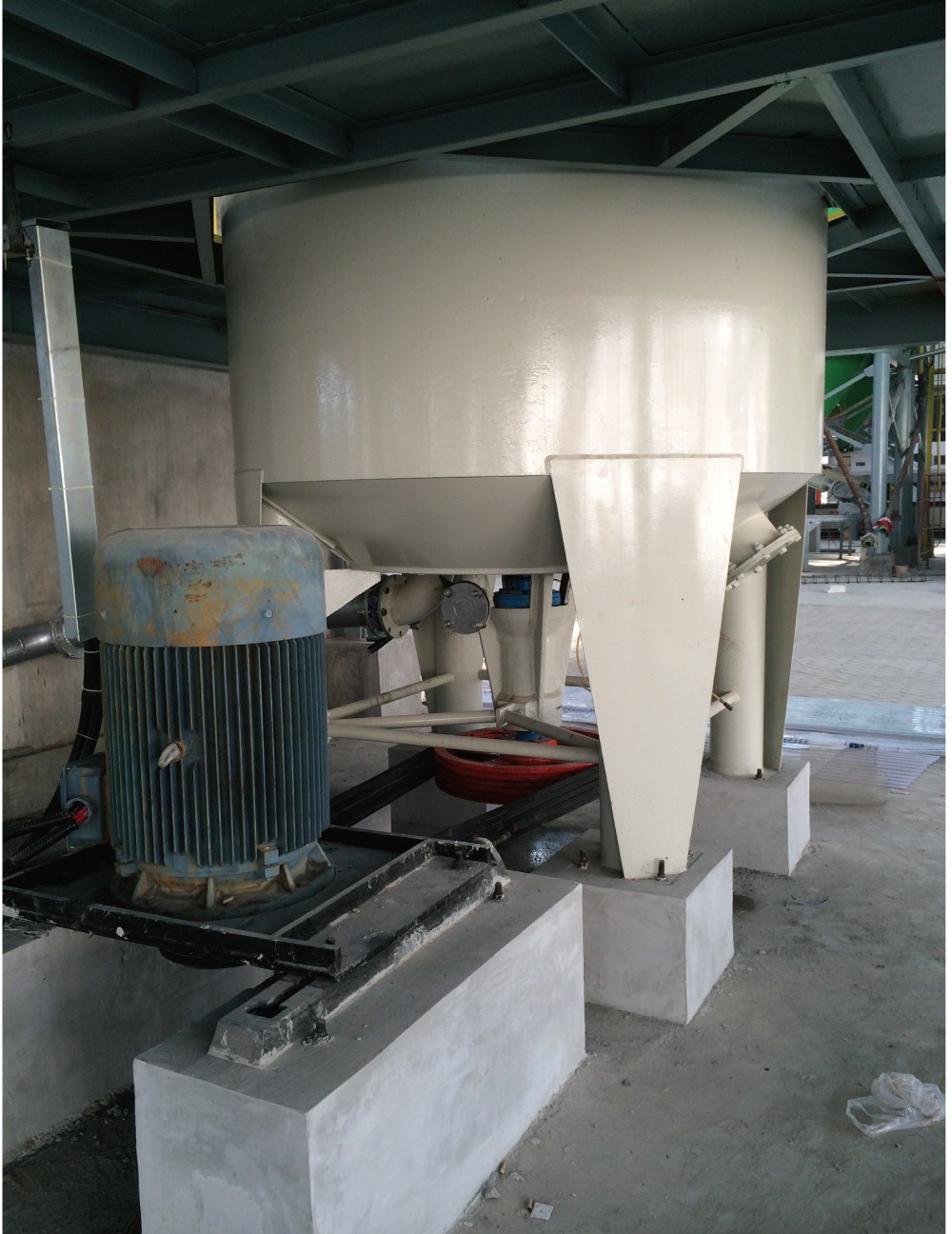
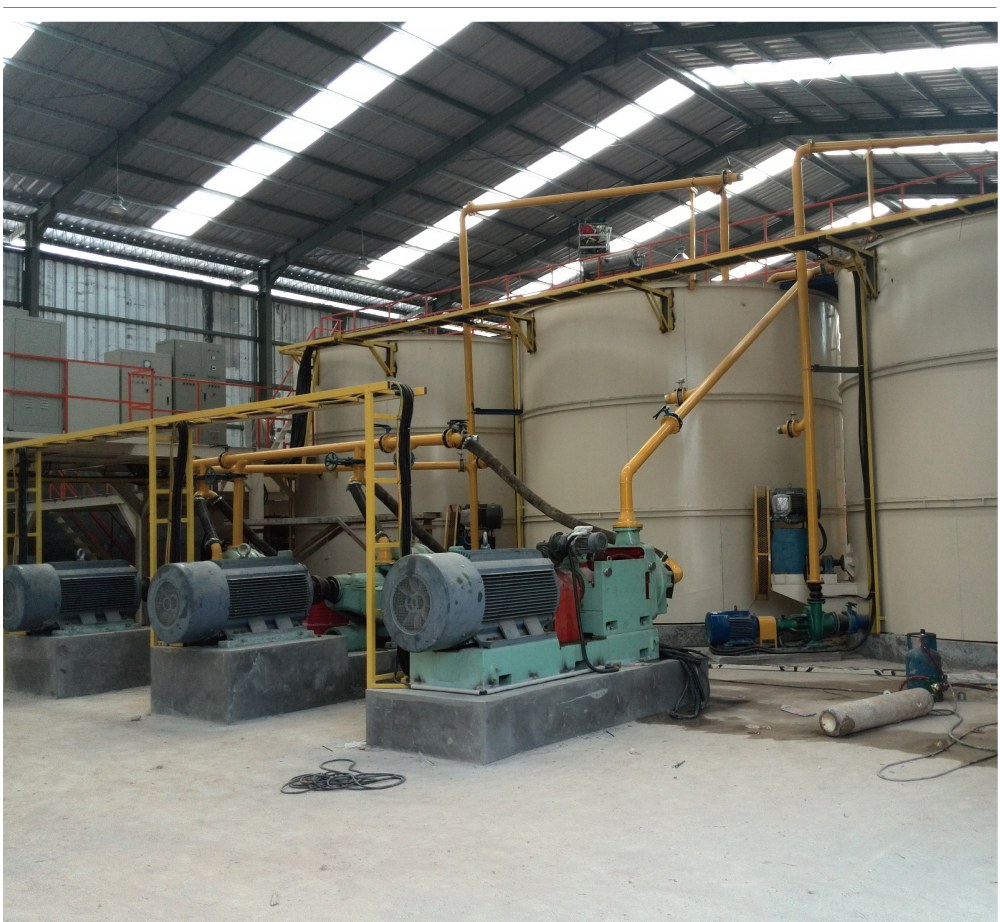
- Whether there is a cellulose preparation stage. Cellulose from bales cannot be poured straight into the mixer: a pulper and a disc refiner are needed.
- Which fibre can be bought consistently. Changing the cellulose or synthetic grade changes the slurry. A new grade is tested on a trial batch of sheet, not on a whole shift at once.
What each fibre does
| Fibre | What it does in the slurry | Autoclave | What matters |
|---|---|---|---|
| Cellulose (most often unbleached kraft) | Filter on the screen, reinforcement, lowers sheet density | Withstands | Works only after pulping and refining |
| PVA | Reinforces the sheet | Ordinary PVA: no | Stable in the alkaline cement environment, bonds well with cement |
| Polypropylene (PP) | Reinforces the sheet | Ordinary PP: no | The fibre surface is often treated to improve wetting and bond with cement |
Cellulose
Microfibrils on the surface of the refined fibre form a filter that catches fine cement particles as the layer builds up. In the hardened sheet the same branched fibrils reach into the cement stone and improve the bond of the fibre with it. Cellulose also lowers the density of the sheet. Most often unbleached cellulose cooked by the sulphate (kraft) process is used.
Cellulose has a weak point: in the alkaline environment of cement it tends to become brittle over time. Makers of fibre and sheet look for different remedies against this. This is one of the reasons the recipe and fibre grade are not changed without a trial.
PVA
Kuraray, the maker of the PVA fibre KURALON, writes that its fibre is stable in the strongly alkaline cement environment and keeps its reinforcing properties. The bond with cement is explained by hydroxyl groups in the fibre molecule: they form hydrogen bonds with the hydration products. Since the ban on asbestos this fibre has been used as a replacement in roofing and facade products: corrugated sheets, flat slate, roofing tiles.
Ordinary PVA fibre dissolves in wet heating from about 130 °C. That is why the slurry with it is cured without an autoclave. The patent of the same maker describes a special PVA designed for the autoclave. If a supplier offers such a fibre, the regime is tested together with it on a trial batch.
Polypropylene
PP fibre also reinforces an air-cured sheet. According to patent US 9388076, most synthetic fibres, including PP, are destroyed at autoclave temperature. In a laboratory test in the same patent that imitates the autoclave (15 h at 160 °C in alkaline water), ordinary PP fibre broke into pieces and fused slightly. The surface of PP fibre for fibre cement is often treated to improve wetting and bond: the patent on such fibres names fibrillation, plasma or corona treatment, and application of a sizing agent. The fibre number (dtex), length and type of treatment are set by the supplier to suit the slurry.
How much fibre is in the slurry
The figures below are taken from open patents. They describe other people's recipes and are not a norm for your line.
| Product | Composition per patent |
|---|---|
| Air-cured sheet, Western Europe | about 2% PVA, about 5% cellulose, about 80% cement; the sheet is pressed, roofing tiles and corrugated sheets |
| PVA slurry per another patent | 4–5% ground cellulose and 1.5–3% PVA by weight |
| Autoclaved sheet, Australia and the USA | unbleached cellulose, about 35% cement, about 55% finely ground silica; usually without a press |
| PP fibre in a fibre-cement patent | 0.1–5% by weight, preferably 1–3% |
Your recipe is set by the line's process regulations. If there are no regulations, the recipe is requested from the line manufacturer and tested on trial sheets: strength, water absorption, delamination.
How cellulose is prepared
- Pulping. Cellulose arrives in bales. The bales are broken up in water into separate fibres in a pulper.
- Refining. The pulped fibre is refined in a disc refiner. The fibre splits at the surface and becomes more flexible. This is what makes it a filter.
- Mixing. The refined cellulose is fed into the mixer with the cement and the other components of the slurry.
The order of adding synthetics and the mixing time are set by the fibre supplier and the line's regulations.
How to measure freeness
The depth of refining is measured in the laboratory by the drainage of a slurry sample. Two common methods:
- Schopper-Riegler, degrees SR (ISO 5267-1). A 1 l sample of suspension with 2 g of oven-dry fibre is poured into the instrument. The freeness is calculated from the volume of water V that has run out through the side opening: °SR = (1000 − V) / 10. The stronger the refining, the slower the slurry gives up water and the higher the number. It is measured with water at 20 °C: each degree above lowers the reading by about 0.46 °SR.
- Canadian Standard Freeness, CSF (ISO 5267-2). The result is in millilitres. Here it is the other way round: the stronger the refining, the smaller the number. In fibre-cement patents values from 100 to 750 ml CSF occur, in one example 150 ml.
Both methods are laboratory ones. They do not necessarily show how the slurry will behave on the machine. So the required value is taken from the regulations of your own line and checked against how the layer builds up.
What can be seen in practice:
- Weak refining: as a rule, the fibre works worse as a filter, and more cement particles leave with the water as the layer builds up. The filter in the slurry is precisely the refined, split fibre.
- Heavy refining: the slurry drains more slowly and the fibres are shortened more. Heavily refined fibre, according to patent application US 2013/0338269, works mainly for filtration and adds little to the strength of the sheet.
There is a trap: if refining produced a lot of fines, CSF can rise anomalously (false freeness), usually at values below 100 ml. This is noted in the TAPPI T 227 method.
What to check in a fibre batch
- The batch quality document from the maker: type of cellulose (sulphate, bleached or unbleached, softwood or hardwood), batch number.
- Dryness of the bale. Cellulose in a bale contains water. Dry matter is determined by drying a sample at 105 ± 2 °C per ISO 638-1. Without this, dosing "by bale weight" wanders.
- Refining after the refiner. A sample of the new batch is refined in the usual regime and °SR or CSF is measured. If the number is very different at the same regime, the regime is chosen anew.
- Synthetics: grade, fibre number (dtex), cut length, type of surface treatment. For the autoclave, written confirmation from the supplier that the fibre is designed for the autoclave.
- Trial sheets. A new grade is tested on a sheet: strength, delamination, water absorption.
Where mistakes are made
- Cellulose is swapped for a "similar" one without a trial. Different fibre means different refining and different layer build-up.
- Ordinary PVA or PP is put into an autoclave slurry. In the autoclave such fibre dissolves or breaks down, and no reinforcement is left from it.
- Cellulose is removed from a slurry with synthetics. Synthetics do not catch cement particles, and the layer does not build up.
Safety
The pulper and disc refiner are stopped, disconnected from power and locked out with a padlock on the disconnecting device before cleaning or inspecting the rotor or plates, so that the machine cannot be started while people are inside. This is how the lockout procedure is set out in OSHA standard 1910.147; for you, it is set by the plant's occupational safety rules and the machine passport.
How we do it
- We select the pulper and disc refiner for cellulose at the manufacturing plant to suit the line capacity. What we find, with specifications, we send before the order.
- From a number, drawing or photo we select spare parts for these machines: rotor, screen, plates, seals.
- We work under a contract with the manufacturing plant. We check the batch at the plant before shipment. A defect confirmed by an inspection report is replaced by the manufacturing plant; we go after the replacement.
What this article relies on
Below are the documents and materials we refer to, so that you can check what is said for yourself.
Standards and documents
- ISO 5267-1:1999 "Pulps — Determination of drainability — Part 1: Schopper-Riegler method": scope 10–90 °SR, the result may not reflect how the slurry behaves on the machinetext ↗
- ISO 5267-2:2025 "Pulps — Determination of drainability — Part 2: "Canadian Standard" freeness method": result in millilitrestext ↗
- OSHA 29 CFR 1910.147 "The control of hazardous energy (lockout/tagout)": lockout of energy sources when servicing machinestext ↗
- TAPPI T 227 "Freeness of pulp (Canadian standard method)", 2026 revision draft (text om-21): 3 g of fibre in 1 l of water, a measure of drainage rate, false rise of the reading below 100 ml, the laboratory result does not necessarily match the machinetext ↗
- EN ISO 638-1:2022 "Paper, board, pulps and cellulosic nanomaterials — Determination of dry matter content by oven-drying method — Part 1": drying at 105 ± 2 °Ctext ↗
Reference materials
- Patent US 6676744 B2, "Background" section: cellulose as a process fibre that forms a mesh on the screen; unbleached kraft cellulose; Western European sheet with PVA (~2%) and cellulose (~5%), ~80% cement, press and air curing; autoclaved sheet on unbleached cellulose (~35% cement, ~55% silica); PVA in general is not stable in the autoclave; refining 100–750 CSFpatents.google.com ↗
- Patent US 9388076 B2: cellulose is a process fibre, density regulator and reinforcement; microfibrils catch fine particles; synthetics do not catch them; PP and most synthetic fibres are destroyed at autoclave temperature, test in a Parr bomb for 15 h at 160 °C and pH 13patents.google.com ↗
- Patent application US 2013/0338269 A1: filtering fibre holds cement particles; breaking up bales in water, refining, mixing with cement; 4–5% cellulose and 1.5–3% PVA by weight; example of 150 CSF; heavily refined fibre is for filtration, not for strength; tendency of cellulose to embrittle in cementpatents.google.com ↗
- Patent US 10611683 B2, Etex (PP fibres for fibre cement): surface treatment for wetting and bond (fibrillation, plasma or corona, sizing agent), fibre number and cut length 3–50 mm, share 0.1–5%, preferably 1–3% of the product weightpatents.google.com ↗
- Patent US 5380588 A (Kuraray): ordinary PVA fibre dissolves in wet heating from about 130 °C, so the slurry with it was cured without an autoclave; a fibre stable in the autoclavepatents.google.com ↗
- Kuraray, KURALON for cement reinforcement: stability in the strongly alkaline cement environment, hydrogen bonds of hydroxyl groups with hydration products, roofing and facade products (corrugated sheets, flat slate, tiles), replacement for asbestos after the bankuralon.kuraray.com ↗
- Zarubina A. N., Serdyukova Yu. V., Verevkin A. N., Kononov G. N. "Technology of Paper and Board Production" (Технология производства бумаги и картона), MGUL, 2016, laboratory work 1: SR-2 instrument, °SR formula, temperature 20 °C, correction of 0.46 °SR per degree, change of the fibre in refiningmf.bmstu.ru ↗