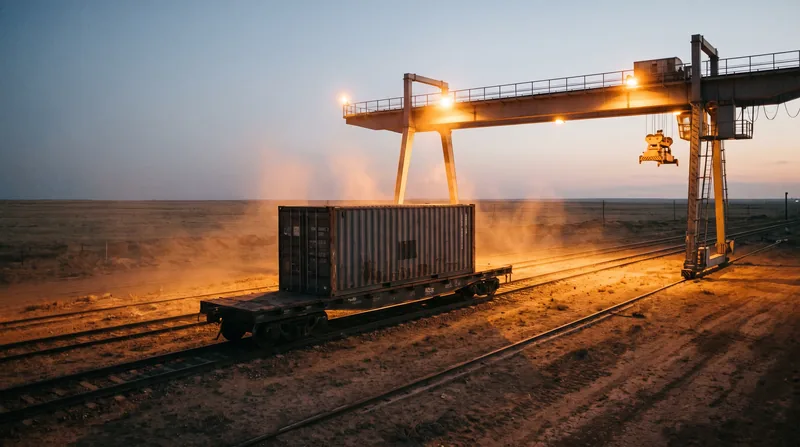
Steel from China to Uzbekistan goes by rail through Kazakhstan. Two working crossings: Dostyk on the Kazakh side and Alashankou on the Chinese side, Altynkol and Khorgos. At the crossing the gauge changes: Chinese 1 435 mm against 1 520 mm in Kazakhstan and Uzbekistan, so the cargo is transshipped from the Chinese wagon into a broad-gauge wagon, or the container is lifted by crane onto another flat wagon. Then through Kazakhstan to the Saryagash–Keles crossing and the stations of the Tashkent hub, or to the stations of Samarkand, Navoi and Bukhara. The road leg through Kyrgyzstan, Irkeshtam or Torugart, then Osh and Andijan, works for the Fergana valley and for urgent small lots; 12 m bars do not fit into a truck.
Container or open wagon
The choice of shipping unit determines the length and mass of what can be ordered. The internal length of a 40-foot container is 12.03 m, so an 11.7 m bar fits and a 12 m bar does not. The maximum gross mass of 20- and 40-foot containers is the same, 30.48 t, the payload around 26–28 t depending on tare; a 20 t coil travels in a 20-foot box because a heavy load in a short box distributes better over the flat wagon. An open wagon takes around 70 t and any length up to 12 m: 12 m bars, I-beams, channels and large-diameter pipe go this way. A container gives a seal from mill to warehouse and is transshipped by crane in one operation; an open wagon is transshipped bundle by bundle at the crossing, and every bundle passes through the hook twice.
| Product | Shipping unit | Why |
|---|---|---|
| 11.7 m rebar, 6 m hollow sections | Shipping unit40-foot container | Whythe length fits, seal from mill to warehouse |
| 12 m rebar, I-beam, channel, 12 m pipe | Shipping unitopen wagon | Why12 m does not fit a container |
| Coil up to 20 t | Shipping unit20-foot container on a cradle | Whymass, distribution over the flat wagon, moisture protection |
| Coil over 20 t, thick 1 500×6 000 plate | Shipping unitopen wagon | Whycontainer payload exhausted |
| Large-diameter pipe, ductile iron DN300 and above | Shipping unitopen wagon, flat wagon | Whysize and 6 m length with socket |
Documents at every node
- The contract and its specification: the grade to the mill’s standard next to the project grade, size, length, volume in tonnes, weight basis for shipment, document requirements.
- Invoice and packing list from the mill: by bundle, with numbers, net and gross mass; the packing list lines match the certificate lines.
- The mill certificate and the bureau’s inspection report with photographs, before loading, not after.
- A certificate of origin issued in China: confirms the mill and country of manufacture for Uzbek customs.
- The SMGS rail consignment note for the wagon or container, which is also the shipping document along the whole 1 520 mm route; on the road leg, a CMR.
- The customs declaration in Uzbekistan with the HS code: rebar 7214, hot-rolled plate and coil 7208, cold-rolled 7209, galvanised and coated 7210, sections 7216, seamless pipe 7304, welded pipe 7306, wire rod 7213.
- The certificate of conformity issued in Uzbekistan under the list of products subject to mandatory conformity assessment; it is prepared from the mill certificate and is therefore not issued without it.
The declaration, the codes and the certification in Uzbekistan are handled by the bureau itself: the buyer receives the batch at the warehouse with a complete set of papers, not a stack of documents in Chinese that must be carried somewhere.
Why there are no transit times here
Transit time is made up of the queue at the crossing, the availability of broad-gauge wagons, the weather on the pass and the work of customs in a given week; none of these is under the supplier’s control. A number of days written on the site would be a promise the bureau does not control, so it is absent here in any form. What the bureau controls and writes into the contract: the date the batch is ready at the mill, the inspection date, the container or wagon number and the destination station. By that number the batch is tracked along the whole route, and the buyer sees its position rather than an estimate.