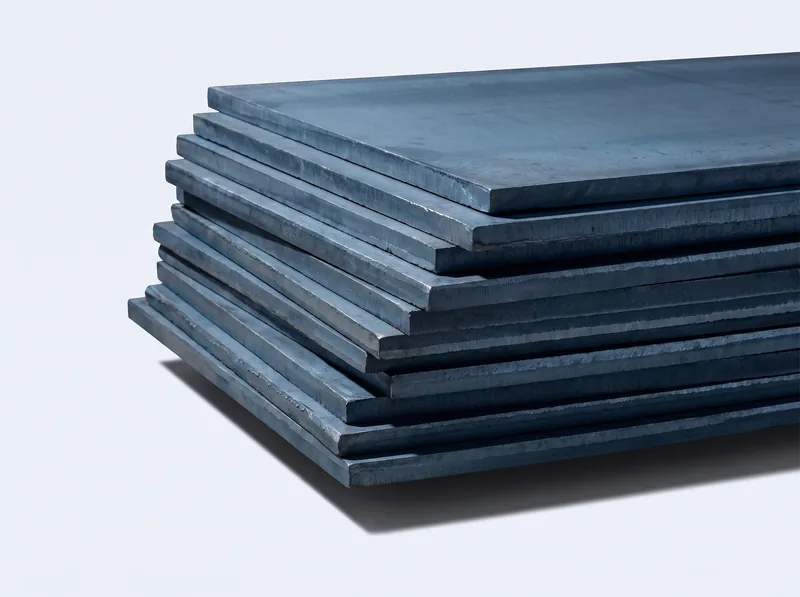
St3sp/ps · Q235B · t 1.5–100 · 1 500×6 000 · GOST 19903
Hot-rolled plate St3
Hot-rolled plate of ordinary-quality carbon steel for steel structures, tanks and machine building
Sheet and plate are flat-rolled steel products cut to length: from hot-rolled heavy plate for structures to cold-rolled, galvanized and stainless sheet for machine building, ventilation, food and chemical equipment. The bureau finds a producing mill for your specification, agrees the grade, thickness, format and coating, inspects the batch at the mill before shipment and delivers it to your warehouse with the mill test certificate and the inspection report.
St3sp/ps · Q235B · t 1.5–100 · 1 500×6 000 · GOST 19903
Hot-rolled plate of ordinary-quality carbon steel for steel structures, tanks and machine building
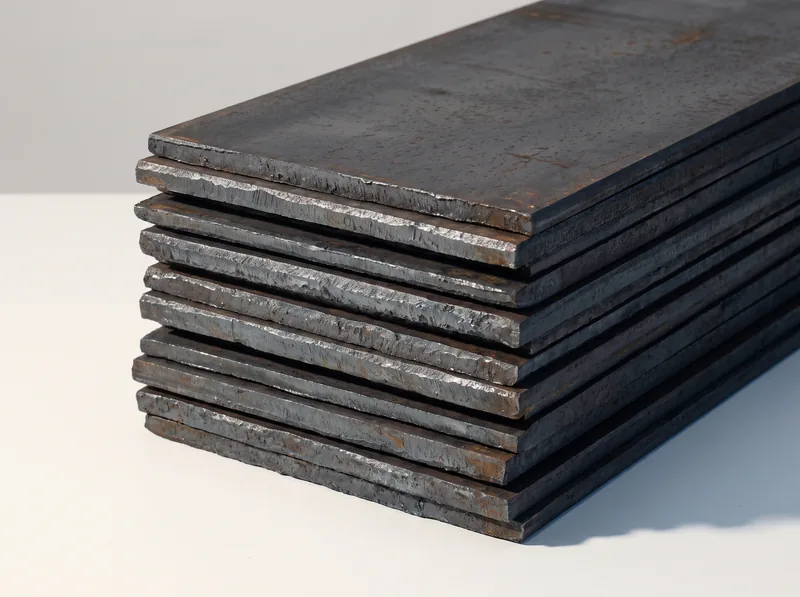
09G2S · Q355B · t 2–50 · 1 500×6 000 · GOST 19281
Low-alloy hot-rolled plate of increased strength for structures operating at low temperatures
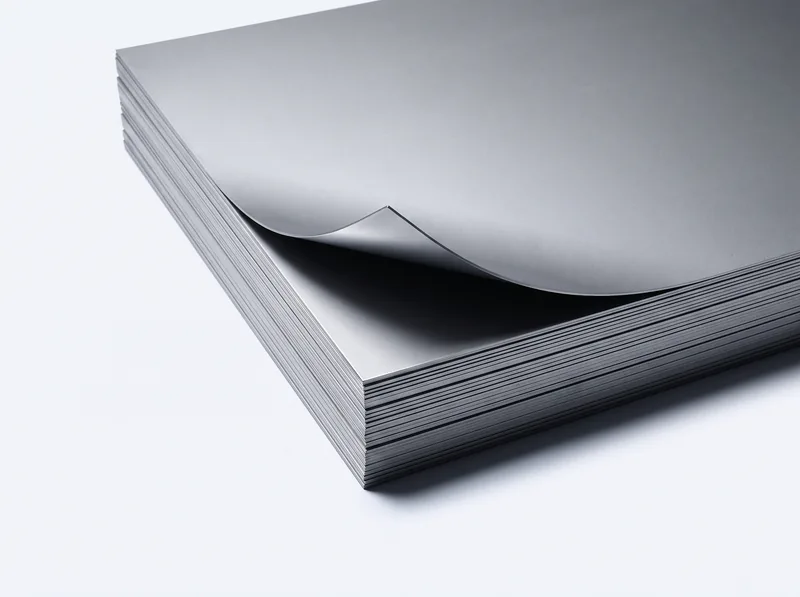
08ps · DC01 · SPCC · t 0.5–3 · 1 250×2 500 · GOST 19904
Cold-rolled low-carbon steel sheet with close thickness tolerance and clean surface for stamping, bending and painting
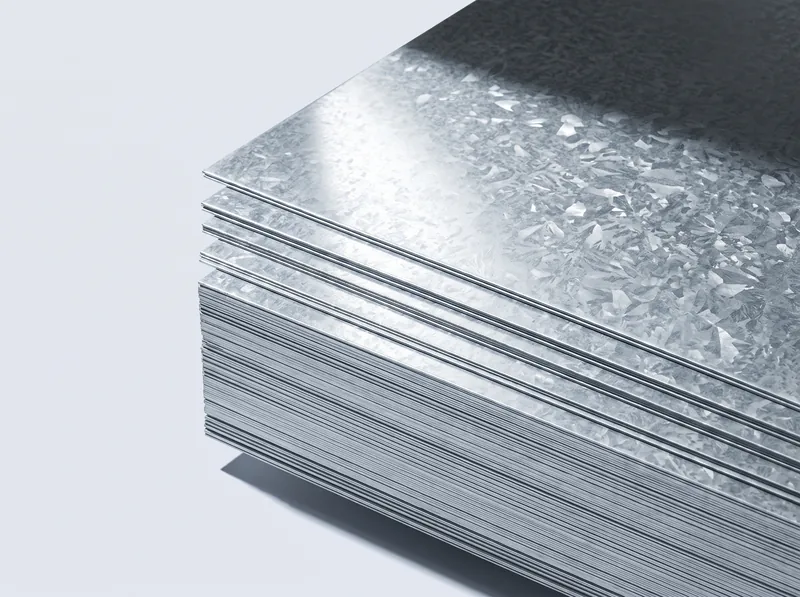
DX51D+Z · 08ps · Z100–Z275 · t 0.3–3 · 1 250×2 500 · GOST 14918
Cold-rolled sheet with hot-dip zinc coating for ventilation, profiles, roofing and enclosures
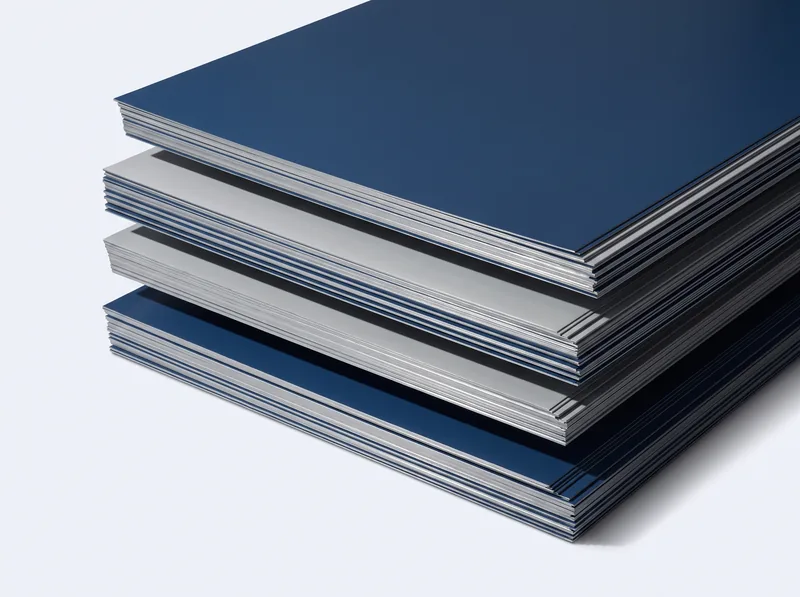
PPGI · DX51D+Z · RAL · PE / PVDF · t 0.3–1.2 · 1 250×2 500 · GOST 34180
Galvanized sheet with a paint coating to the RAL catalogue for roofing, facades, sandwich panels and enclosures
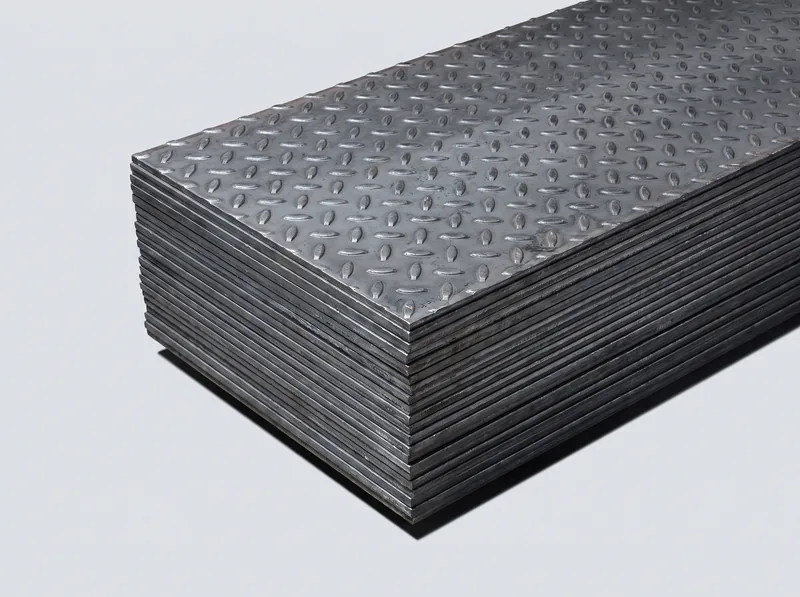
St3 · Q235B · teardrop / diamond · t 2.5–12 · 1 500×6 000 · GOST 8568
Hot-rolled plate with lentil or diamond pattern for platforms, stair treads and floors with a non-slip surface
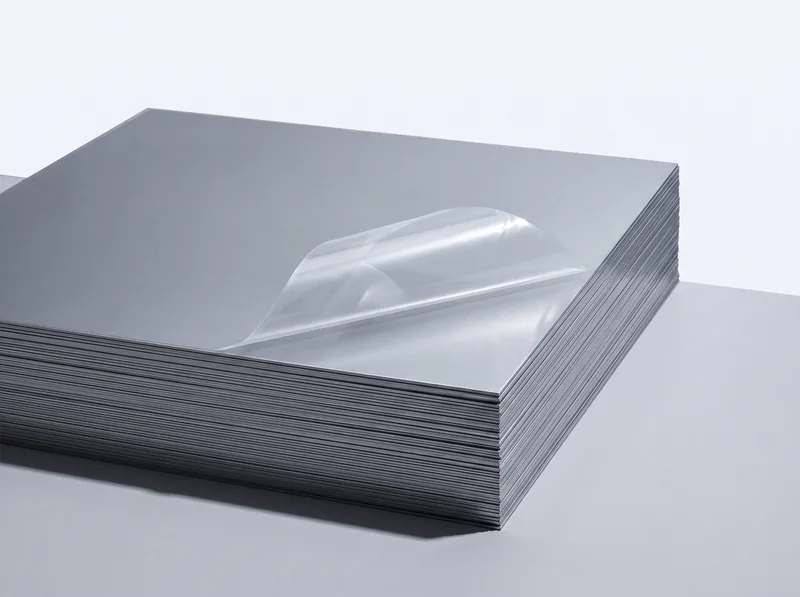
AISI 304 / 304L · 08Kh18N10 · 1.4301 · 2B / BA / No.1 · t 0.5–50 · 1 500×3 000 · ASTM A240
Chromium-nickel austenitic sheet for food and chemical equipment, tanks and architecture
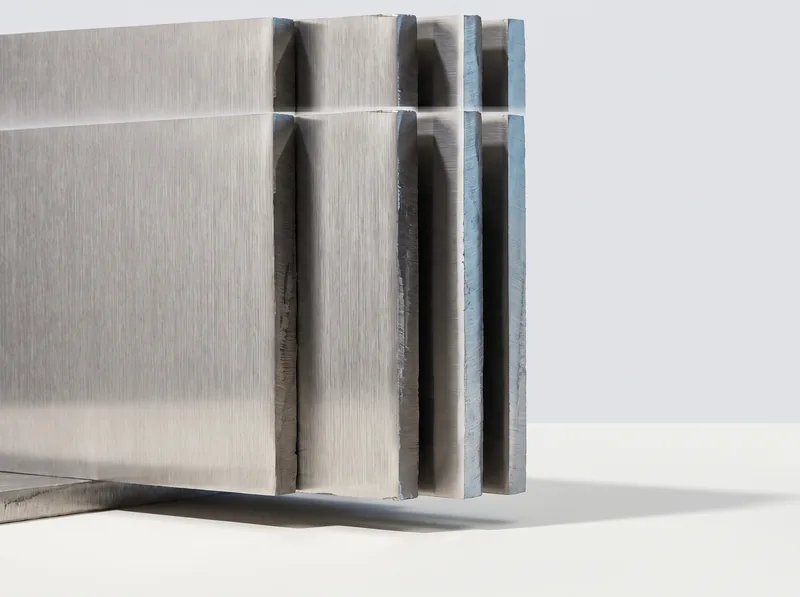
AISI 316L · 03Kh17N14M3 · 1.4404 · 2B / No.1 · t 0.5–50 · 1 500×3 000 · ASTM A240
Austenitic sheet with molybdenum for chloride environments, chemical plants, water treatment and marine equipment
Sheet and plate are classified by the production route and by the surface finish. Hot-rolled plate is rolled from a slab above the recrystallisation temperature: it goes into steel structures, tanks and machine building and serves as the base for chequered plate. Cold-rolled sheet is produced from hot-rolled coil after pickling and rolling in the cold state — its thickness is held to a tighter tolerance and its surface is cleaner, so it goes into stamping, painting and enamelling. Galvanized sheet and pre-painted sheet are a cold-rolled base with a protective layer applied on a continuous line. Stainless sheet is a separate group by chemical composition: chromium-nickel steels 304 and 316L.
For Uzbekistan the base standard is GOST: dimensions of hot-rolled plate to GOST 19903-2015, of cold-rolled sheet to GOST 19904-90, technical requirements to GOST 14637-89, GOST 16523-97 and GOST 19281-2014. Mills in China roll to GB/T 3274-2017, GB/T 708-2019, GB/T 2518-2019 and GB/T 12754-2019, export batches to ASTM and EN. Grades in these systems are not identical: St3sp, Q235B and S235JR are close in yield strength but differ in impact toughness requirements and deoxidation. In the specification the bureau fixes the grade and the standard against which the mill issues the certificate, and lists the nearest equivalents as equivalents, not as identity.
Inspection of sheet at the mill before shipment follows one procedure for every item in the category: thickness measured with a micrometer at several points of the sheet and checked against the tolerance of the standard, width and length measured with a tape, flatness and squareness of cut checked, surface examined for laminations, laps, tears and rolled-in scale, marking and tags checked against the mill test certificate (MTC) by heat number and chemical composition, packaging checked. For coated products the zinc or polymer layer is measured with a coating gauge; for stainless steel the composition is verified with a portable analyser. The inspection report with photographs is handed to you before shipment; defects recorded in the report are replaced — the replacement is supplied by the producing mill under its contract with the bureau.
| GOST | GB (China) | ASTM | EN | Note |
|---|---|---|---|---|
| St3sp / St3ps | Q235B | A36 | S235JR | Nearest equivalents. Q235B and S235JR specify impact toughness at +20 °C, GOST 14637 by category; A36 has a higher yield strength, 250 MPa. |
| 09G2S | Q355B (Q345B before 2018) | A572 Grade 50 | S355JR / S355J2 | Nearest equivalents by strength. The 09G2S category for impact toughness at −40 or −70 °C is specified separately; Q355B is tested at +20 °C. |
| 08ps | DC01 | A1008 CS Type B | DC01 | SPCC to JIS G3141 is the same class of general-purpose cold-rolled low-carbon steel. |
| 08ps to GOST 14918 | DX51D+Z | A653 CS Type B | DX51D+Z | The DX51D+Z designation in GB/T 2518 matches EN 10346. Zinc coating weight (Z100–Z275) is specified separately from the grade. |
| GOST 34180 based on 08ps | TDC51D+Z | A755 based on A653 | DX51D+Z to EN 10169 | The grade describes the steel substrate and the zinc. Type and thickness of the polymer layer, RAL colour and environment class are set by the specification. |
| 08Kh18N10 | 06Cr19Ni10 | 304 | 1.4301 (X5CrNi18-10) | 12Kh18N10T is the equivalent of titanium-stabilised grade 321, not of 304. |
| 03Kh18N11 | 022Cr19Ni10 | 304L | 1.4307 (X2CrNi18-9) | Low-carbon version of 304 (carbon up to 0.03 %) for welded structures without subsequent heat treatment. |
| 03Kh17N14M3 | 022Cr17Ni12Mo2 | 316L | 1.4404 (X2CrNiMo17-12-2) | Molybdenum 2–3 % to ASTM A240. Mills in China certify to ASTM or EN; the GOST grade is entered in the MTC on request as an equivalent. |
Equivalents are the closest match, not identical: chemistry and tolerances differ between standards. The exact grade and standard are written into the contract.
Price request
Steel pricing depends on grade, size, tonnage and delivery terms on the day of contract. A number on the page would be wrong by the time you read it.
Request received