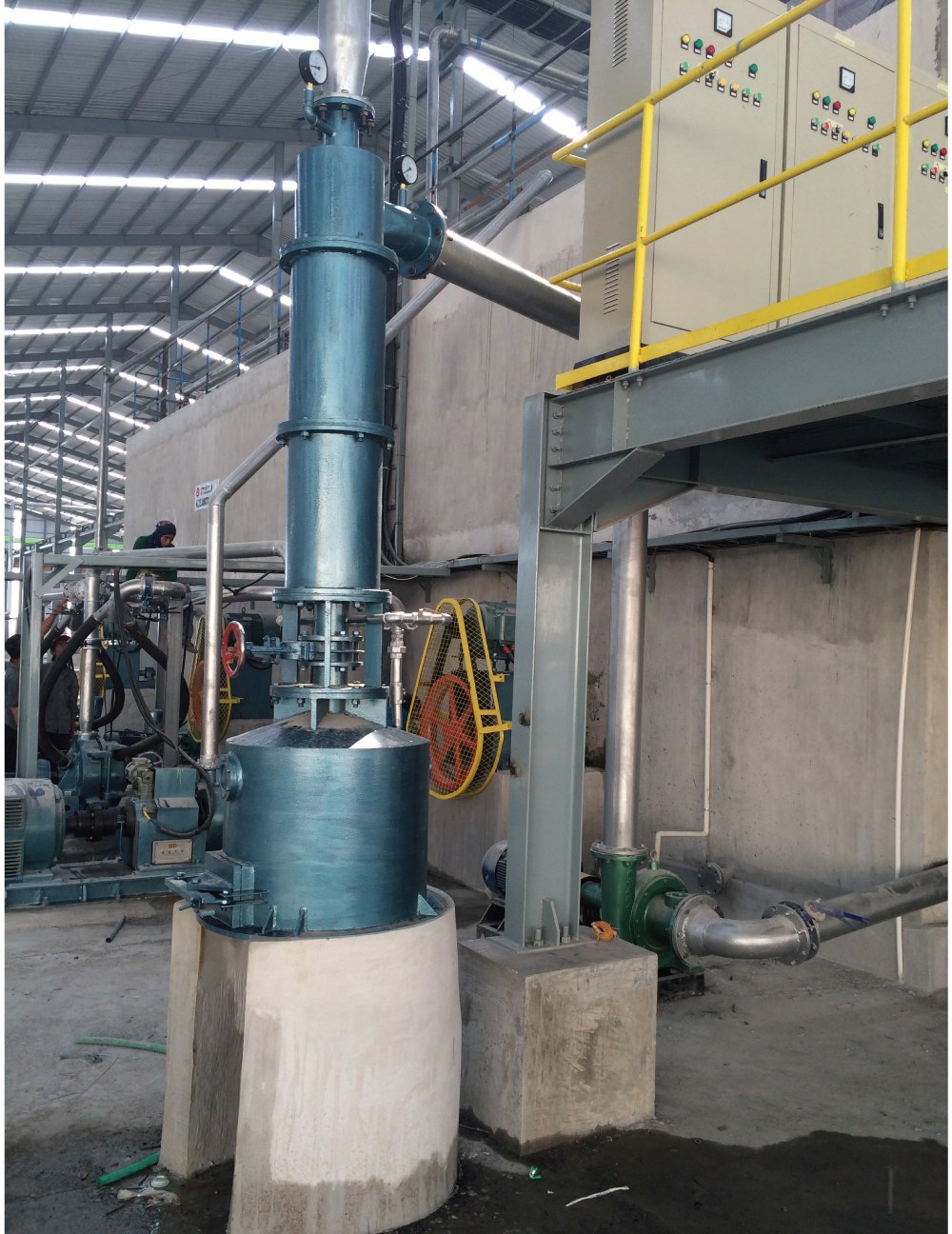
Vortex stock cleaner: why it is there and what gets replaced
A vortex cleaner removes sand, scale and metal from the stock before they reach the refiner, the screen and the felt. What wears in it is the lower cone, the inlet nozzle and the liners, as well as the valves and seals of the dirt trap. A falling pressure drop, dirt in the cleaned stock and a clogged reject line are signs the cleaner needs to be taken apart.
In short
4minutes to read
6sections
6sources
1catalog item
In this article
- 01How it works
- 02Why this matters for slate
- 03What wears
- 04Signs that the cleaner works badly
- 05What to record for an order
Contents
A vortex cleaner (also called a high density cleaner or a cone cleaner) removes heavy contaminants from the stock: sand, scale, wire, nuts, fragments. It stands before the refiner and before forming, and protects what is expensive and slow to order: the refiner plates, the screen of the mesh cylinder and the forming felt. What wears in the cleaner itself is the lower part of the cone, the inlet nozzle and the liners, and the valves of the dirt trap and their seals. It is worth knowing their dimensions and keeping them in stock: without the cleaner the line either stops or sends dirty stock onto the felt.
How it works
The stock enters the upper part under pressure, tangentially, and starts to spin. It then goes down the cone in a spiral. Centrifugal force presses the heavy particles against the wall, and they slide down into the lower chamber, the dirt trap. The cleaned stock rises along the center and leaves through the upper central nozzle.
The dirt trap is periodically isolated from the cleaner and emptied through a valve into a sludge collector. So that fiber does not leave with the trash, dilution water is fed from below: it lifts the fiber back into the flow. How often to purge the dirt and how much water to use depends on how much trash is in the stock.
Pressure gauges stand at the inlet and the outlet. The pressure drop between them is the main working indicator of the cleaner.
Why this matters for slate
Sand in the stock works as an abrasive wherever it ends up. In the disc refiner it rounds off the edges of the bars and the refining gets worse. On the mesh cylinder it wears through the screen. It gets stuck in the felt and breaks the fiber. Fine metal can cut through the felt or the screen. That is why an extra failure of the cleaner often costs more than its spare parts: the consumables of the forming machine start to wear faster.
What wears
| Part | Why | How to notice |
|---|---|---|
| Lower cone and liner | All the abrasive is thrown out to here | Wall wear, roughness, leaks; poorer cleaning |
| Inlet nozzle, head | The flow with sand hits one point | Local wear, leak at the flange |
| Dirt trap valves | Sand and metal between the seats | Valve does not hold, dirt escapes constantly or does not escape |
| Seals and gaskets | Abrasive, vibration | Seepage at the joints |
| Pressure gauges | Clogged by stock | Readings frozen or jumping |
Cone wear speeds itself up. A smooth wall gives an even vortex, and a worn one gives eddies, which wear it away even faster. That is why manufacturers make the lower part replaceable and protect it with ceramic: a ceramic liner lasts longer under heavy abrasive.
Signs that the cleaner works badly
- The pressure drop has fallen or risen without a change in the stock regime. Fallen: cone wear or a leak; risen: a clogged outlet nozzle or dirt trap.
- Sand in the cleaned stock, in a sample after the cleaner, on the screen, in the sediment of the agitator.
- The dirt trap is overfilled or the purge valve does not open.
- Lots of fiber in the reject: too little dilution water or a worn cone.
- The screen, the felt and the refiner bars wear faster than usual.
The inlet pressure is checked separately. If the pump does not give the required pressure, the vortex is weak and the cleaning is poorer even with a sound cone. The working pressure and consistency are set by the cleaner's passport and the regulations of your line.
What to record for an order
- The cleaner nameplate: manufacturer, model, capacity.
- For the cone and liner, the drawing from the passport or the dimensions: upper and lower diameters, length, flanges, fastening, material (steel, ceramic). Photos with a ruler.
- For the inlet head, the inlet and outlet diameter and the flanges.
- For the dirt trap valves, the type, diameter, actuation (manual or pneumatic) and the marking on the body.
- For the seals, the dimensions and material.
How we do it
- From the number, drawing or photo of the unit, we look for the item at the manufacturing plant. What we find, with the price, photos and specifications, we send before the order.
- Vortex cleaners of the FSG model range are in the catalog; the machine is selected for the capacity of the line.
- We inspect the lot at the plant before shipment: part number, dimensions, lot, packaging.
What this article relies on
Below are the documents and materials we refer to, so that you can check what is said for yourself.
Reference materials
- Vector Solutions, training course "High Density Cleaners": design, dirt trap, dilution water, purge frequencyvectorsolutions.com ↗
- Toscotec, description of the high density cleaner: ceramic liner of the lower conetoscotec.com ↗
- Voith, HC cleaners: cone and inlet wear, ceramic liningvoith.com ↗
- Patent US 4092848 "Method and apparatus for determining hydrocyclone interior wear": wear of the conical part, wear accelerated by roughnesspatents.google.com ↗
- Patent US 4090956 "Hydrocyclone": cone wear at a single point with a single inletpatents.google.com ↗
- taminota.com catalog, FSG vortex cleaner: design, back-flushing and inlet and outlet pressure gauges as described by the manufacturing plant.