Liquid ring vacuum pump: why vacuum drops and what to replace it with
The vacuum of a liquid ring pump most often drops because of the sealing water: it is too warm, too little of it, or the circuit is scaled. Next come air leaks in pipes and boxes, and wear of the pump itself. Choose a replacement by capacity at your vacuum, speed, connection and power, not by a similar brand.
In short
5minutes to read
5sections
3sources
1catalog item
In this article
If the vacuum on a sheet machine has dropped and the boxes and felt are in order, check the pump's sealing water first: its temperature, flow and the cleanliness of the circuit. This is the most frequent cause. The second is air leakage: in pipes, flanges, box seals, glands. The third is wear of the pump: clearances, the impeller, the port plates. A pump is replaced by its duty point (what volume of air it must evacuate at your vacuum) and by speed, connection and power. A similar brand without these figures is a lottery.
How a liquid ring pump works
In the casing an impeller with blades rotates eccentrically. The water fed into the pump is thrown to the wall and forms a ring. Between the blades and the ring there are pockets that alternately grow (suction) and shrink (discharge). Here the water is both the seal and the cooling. That is why the pump is so sensitive to it: change the water and the vacuum changes.
Why the vacuum drops
The sealing water is warm
The colder the sealing water, the lower its vapour pressure, and the deeper the vacuum and the higher the pump capacity. When the water heats up, it starts to boil under the vacuum, vapour takes the place of air, and the capacity falls. An industry article on vacuum systems notes that cooling-tower water in hot weather (above 35 °C outside) noticeably cuts the capacity of liquid ring pumps. For Central Asia in summer this is a common picture: a pump that held vacuum in winter "does not pull" in July.
Too little water
A manufacturer of liquid ring pumps states that a pump normally runs about 5–14 °C warmer than the supply water. If it is hotter than that, there is too little water. The causes: clogged orifice plates or feed nozzles, low pressure in the line, a clogged filter. A water shortage by itself gives a low vacuum. The flow is kept close to the rated one: industry recommendations advise keeping it within about ±5% of the rated value.
Scale and deposits
Hard water and cement in the process water produce deposits in the casing, on the impeller and in the heat exchanger. According to the same manufacturer, lime deposits raise the power consumption, reduce the capacity and can damage the pump. Deposits in the heat exchanger also heat the sealing water, and the circle closes.
Air leakage
The pump evacuates everything that comes to it. If there is a leak in the pipes, flanges, at the ends of the boxes or in the glands, part of the capacity goes to it. The sign: the pump runs "normally" by temperature and current, while the vacuum on the boxes is lower than before.
Wear
The clearances between the impeller and the end plates grow, the blades wear, and water with abrasive eats the working surfaces. If the pump runs at too deep a vacuum, below what the passport permits, cavitation starts, and it destroys the impeller.
What to check in order
- The sealing water temperature at the inlet and the pump temperature.
- The flow and pressure of the sealing water, the filter, the plates, the nozzles.
- The heat exchanger and circuit, for scale.
- The vacuum at the pump and on each box: if it is deep at the pump and weak at the box, look for a leak or blockage between them.
- Motor current and noise: cavitation is heard as crackling.
- Only after that, opening up and measuring the clearances.
What to replace it with
To choose, you need figures, not a brand:
- Capacity (m³/min or m³/h) at your working vacuum, not the maximum. For a pump it falls as the vacuum deepens.
- Working vacuum (kPa or mm Hg) on the machine.
- Speed, drive type (direct, belt, through a gearbox), motor power.
- Connection: the diameters and flanges of the ports, their arrangement, the overall size and the frame fixing.
- Sealing water: what the plant has and at what temperature in summer.
- The nameplate of the old pump and its passport, if they have survived.
If the manufacturer of the old pump is unknown, the nameplate is copied in full, the pump is photographed from both sides and the ports are measured. How to read a pump nameplate is covered in a separate article.
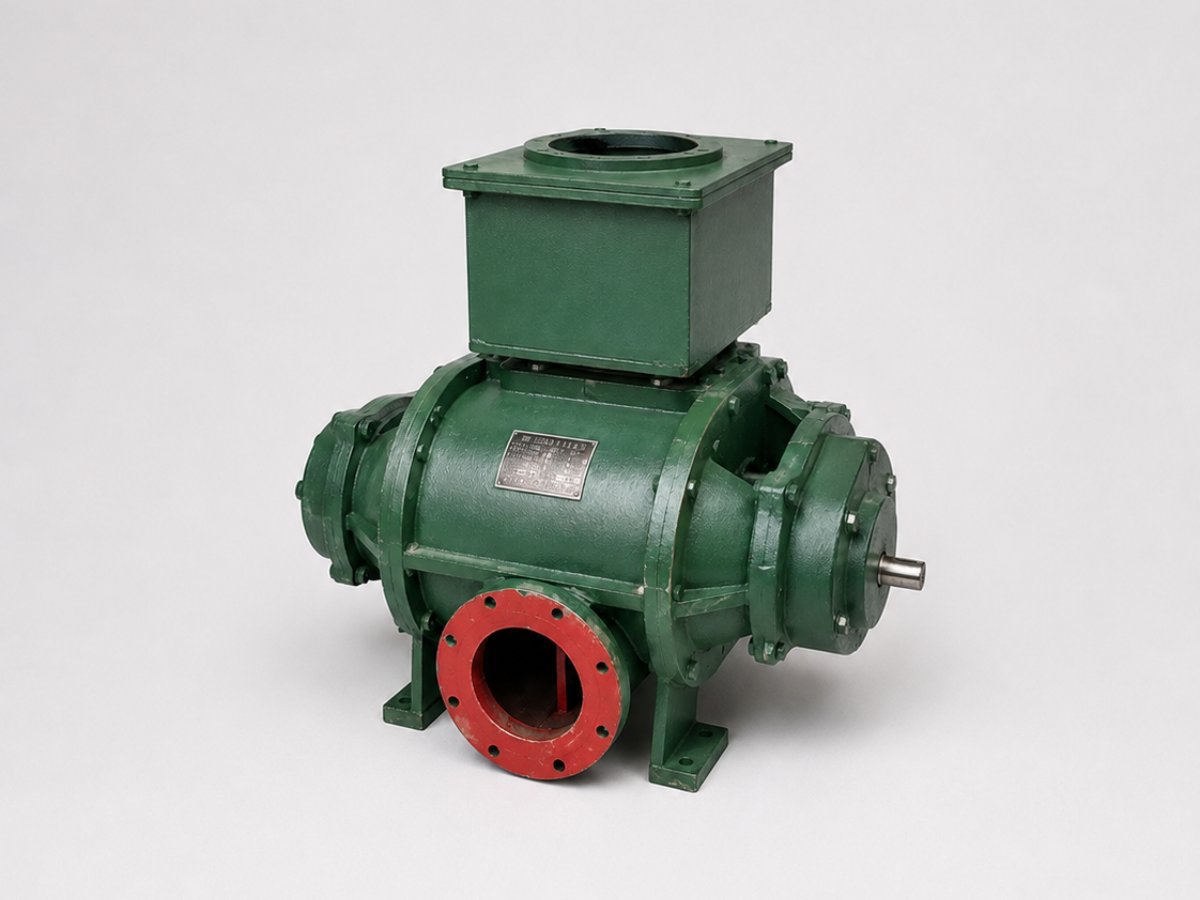
The catalog has a vacuum pump ZBK-16A: rated pumping speed 11 m³/min at a vacuum of 40 kPa, 400 rpm, ports Ø200 mm, motor 22 kW. Its version and duty point are checked against your machine before ordering.
How we do it
- From the nameplate and photos we look for a pump at the manufacturing plant, or a replacement with the same duty point, speed and ports.
- What we find we send before the order: the characteristic, dimensions, power. If the replacement has different ports or weight, we say so.
- At the plant we check the marking and nameplate of the pump being shipped against the agreed item.
What this article relies on
Below are the documents and materials we refer to, so that you can check what is said for yourself.
Reference materials
- Chemical Processing, "Succeed at Vacuum System Troubleshooting": the effect of sealing liquid temperature on the capacity of liquid ring pumps, flow control, cavitationchemicalprocessing.com ↗
- Nash, "Hot Pump Operating" and the maintenance tips section: overheating as a sign of low water flow, causes of low flow, lime deposits: andnashpumps.com ↗nashpumps.com ↗
- taminota.com catalog: vacuum pump TMN-RB-16A (ZBK-16A), nameplate data.
The order of checks is compiled from manufacturer materials and an industry article. The limits on temperature and flow for your pump are in its passport.