Pump nameplate: flow, head, speed and how to pick a replacement
On a centrifugal pump nameplate the key figures are flow Q in m³/h and head H in meters at rated speed. That is one point of its curve. A replacement is chosen by that point, the speed and the ports, not by motor power: a pump of the same power can give a different head.
Updated
Contents
On a centrifugal pump nameplate the main figures are flow Q and head H. Flow is how much liquid the pump moves in an hour, in m³/h. Head is how high in meters it can lift water at that flow. Both figures are given at the rated speed n. Together they set one point on the pump curve. The power on the nameplate is the motor power, and a replacement is not chosen by it alone: a pump of the same power may give more flow and less head, or the other way round.
What the nameplate says
| Line | Symbol | What it means |
|---|---|---|
| Model | for example NL150 | the plant's designation; the catalog is looked up by it |
| Flow | Q, m³/h | flow at the rated point |
| Head | H, m | height the water is lifted at the rated point |
| Speed | n, rpm | shaft speed; Q and H depend on it |
| Power | P, kW | motor power or power at the pump shaft |
| Efficiency | η, % | if given, at the rated point |
| Net positive suction head | NPSH, m | how much inlet pressure the pump needs to avoid cavitation |
| Ports | DN, mm | inlet and outlet diameters |
| Number, date | — | for contact with the plant |
The set of lines differs from plant to plant. The nameplate of a Grundfos NB pump, for example, has the model, flow, head, speed, permitted pressure and temperature, efficiency and the MEI energy efficiency index, but no power: that is read from the motor nameplate.
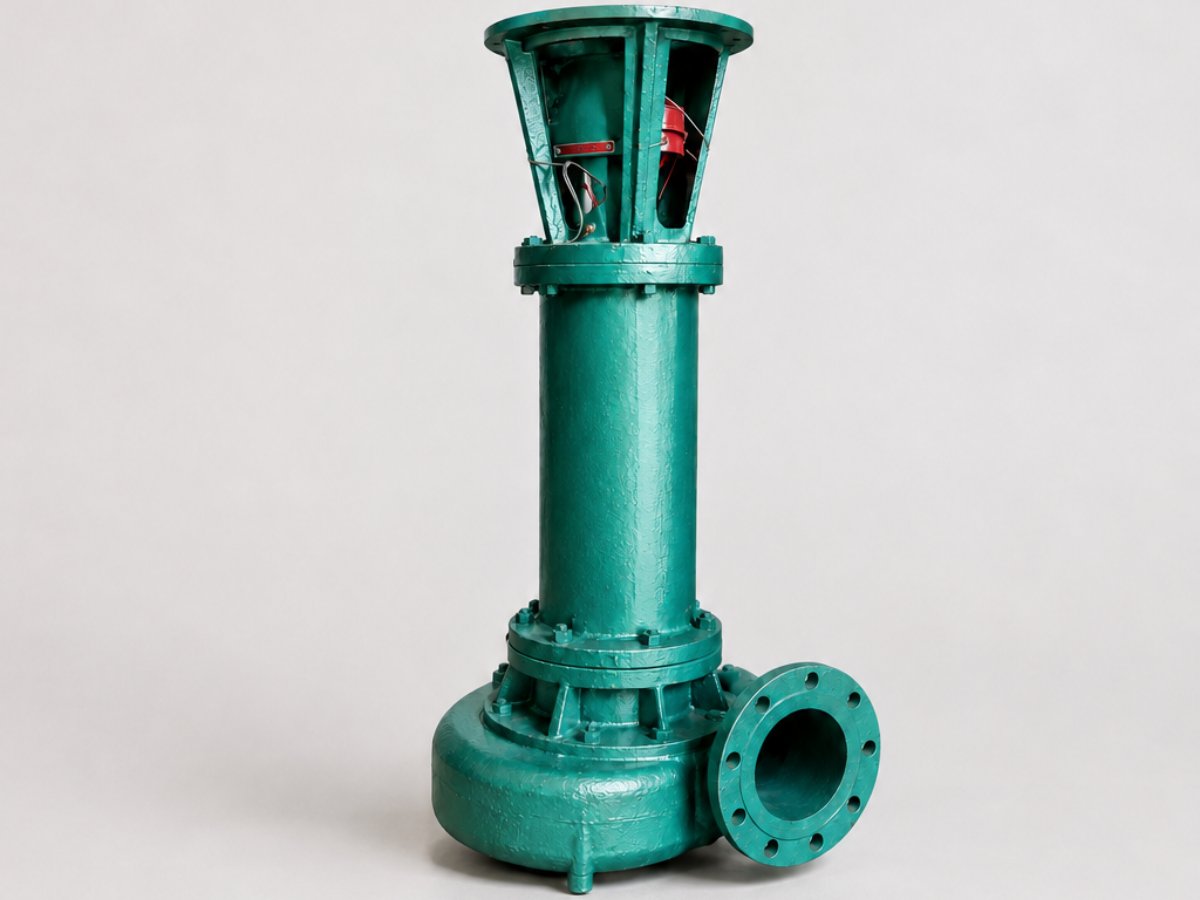
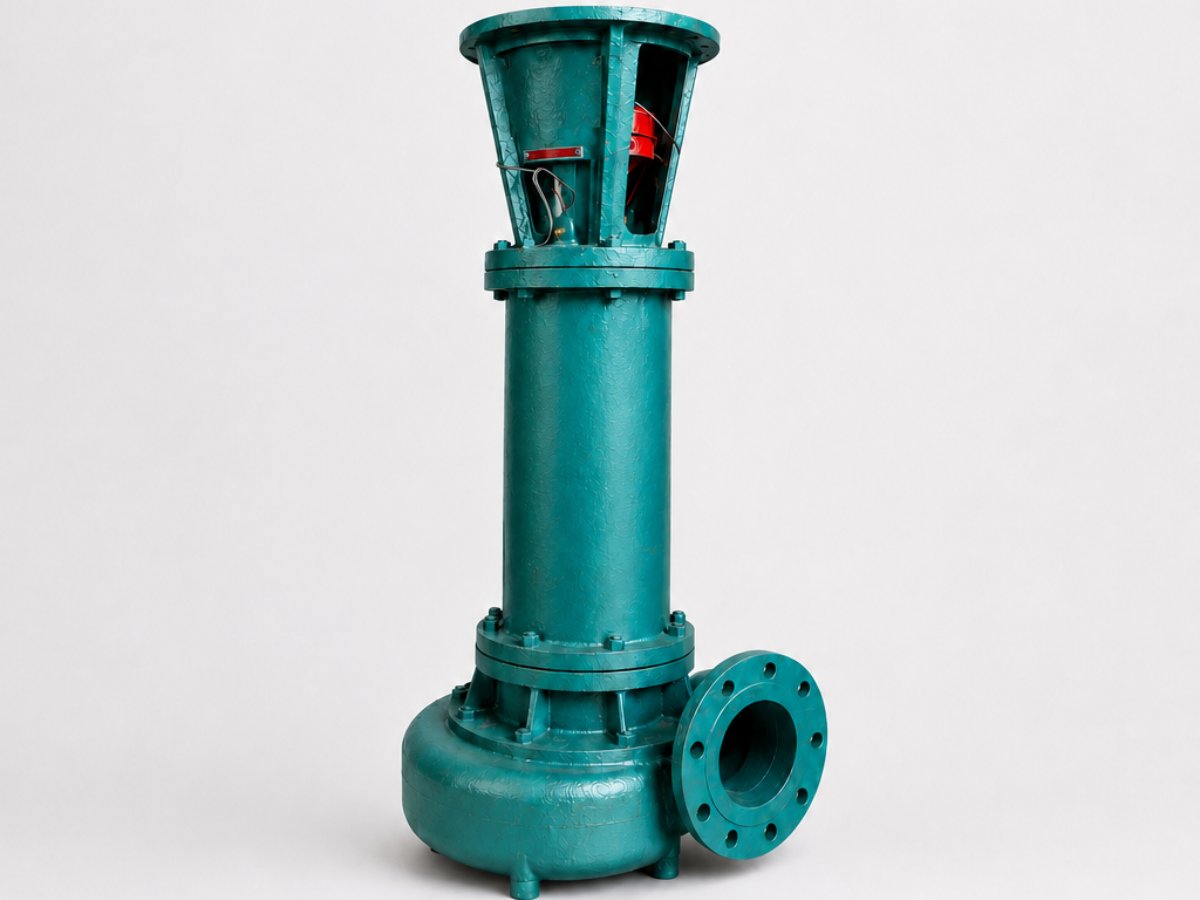
An example from the catalog: vertical slurry pump NL150 — flow 250 m³/h, head 10 m, 22 kW, 1450 rpm, outlet port 150 mm.
Head is not pressure
Head is written in meters, not bar. Meters of head do not depend on the density of the liquid: the pump lifts water and slurry to the same height. The outlet pressure, however, differs: with slurry it is higher, because slurry is heavier. And more power is needed for a heavy liquid. So a pump selected for water can overload its motor on thick slurry.
For water, 10 m of head is roughly 1 bar.
Duty point
A pump does not run "at the nameplate figures" by itself. It runs where its curve crosses the curve of your system: lift height, pipe length and diameter, valves, filters. That crossing is called the duty point.
A pump curve is a line: the more flow, the less head. If the system is "light" (short wide pipes), the pump moves right along the curve: flow rises, head falls, power rises. If the system is "heavy", it moves left: flow falls. Grundfos advises selecting a pump so that the duty point is as close as possible to the best efficiency point.
Hence a common mistake. An old 22 kW pump is replaced by a new 22 kW pump of another model. The power is the same, but the curve is different. In the same system the new pump gives less flow or is overloaded.
Speed and the affinity laws
If the speed changes, the pump figures change too. The relationship is:
| When speed changes | Flow | Head | Power |
|---|---|---|---|
| 2 times | 2 times | 4 times | 8 times |
| 10% lower | 10% lower | about 19% lower | about 27% lower |
A practical conclusion. A pump at 1450 rpm (four-pole motor) cannot be replaced with the same pump at 2900 rpm without recalculation: the head rises fourfold, the power eightfold. The reverse is also true: a motor with a different number of poles will "drop" the pump.
Trimming the impeller acts in a similar way. The plant reduces the outside diameter of the impeller, and flow and head fall at the same speed. That is why one pump model can have different figures on the nameplate: impellers of different diameter.
How designations are read
For standard end-suction pumps under ISO 2858 the designation consists of three numbers: inlet diameter, outlet diameter and nominal impeller diameter. For example, 80-50-250: inlet 80, outlet 50, impeller 250 mm. Grundfos adds the actual impeller diameter after a slash: in NBG 125-100-160/160-142 the nominal impeller is 160 mm and the actual one is 142 mm.
Slurry and mud pumps have no single scheme. The outlet port diameter is often in the designation. For the NL150 pump in our catalog the outlet port is 150 mm. What the letters mean is each plant's own: we found no reliable general key. Check against the plant's catalog.
A vacuum pump is a separate matter
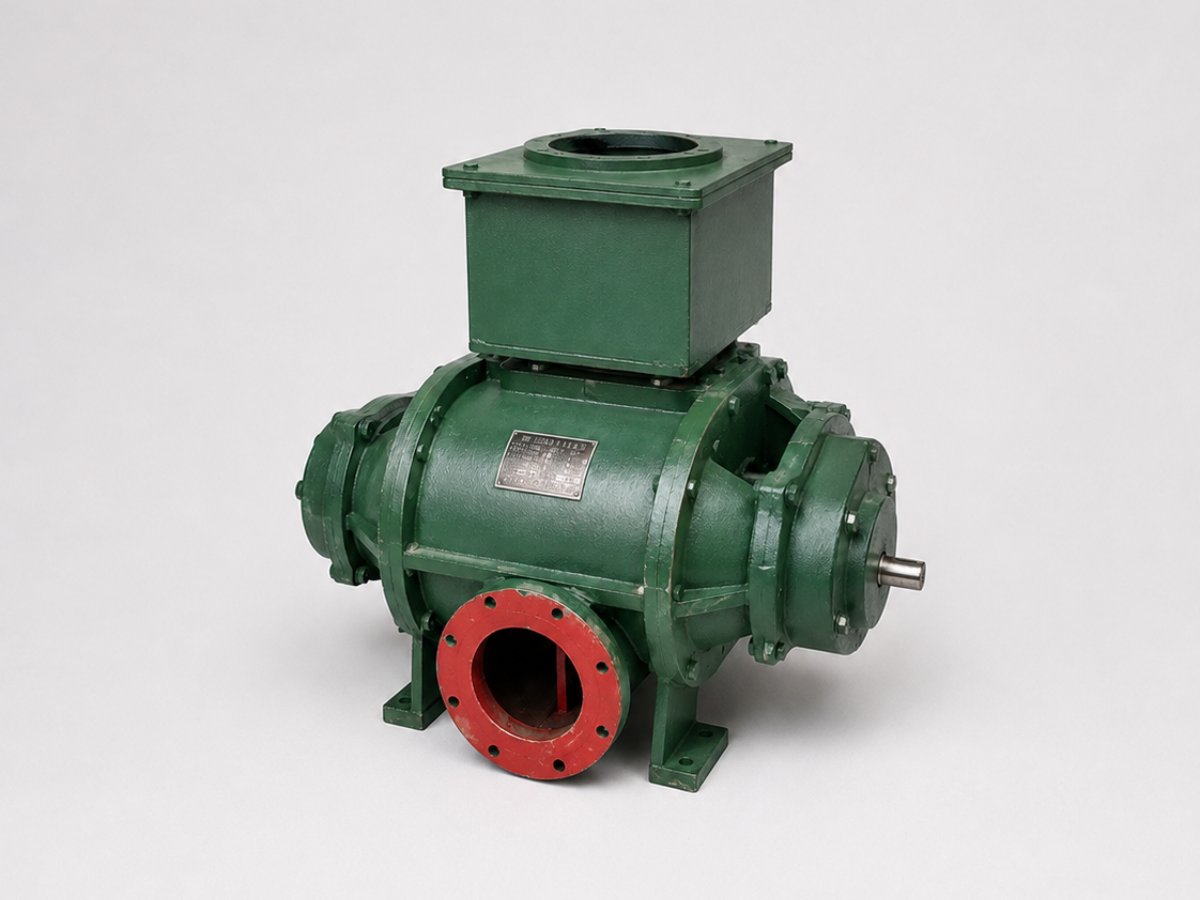
A Roots vacuum pump moves gas, not liquid. Its nameplate carries other figures: pumping speed (m³/h or m³/min), ultimate pressure or vacuum (kPa, mbar), speed. A Roots pump usually works together with a backing pump: on its own it compresses gas weakly. This can be seen in the layout of the installation. It must be replaced together with a check of the second pump.
An example from the catalog: Roots pump ZBK-16A — rated pumping speed 11 m³/min, vacuum 40 kPa, 400 rpm, ports Ø200 mm, motor 22 kW.
What to copy into a replacement request
- A photo of the whole nameplate.
- Q, H, n, power and, if present, NPSH.
- What it pumps: water, slurry, oil; temperature; whether there are solids and what size.
- Port diameters and connection type: flange, thread.
- Version: horizontal, vertical, submersible; length of the submerged part.
- If available: where the pump works now — outlet pressure from the gauge, lift height.
How we do it
- From the nameplate and photos we look for the pump at the manufacturing plant, or a replacement with the same duty point, speed and ports.
- We send what we find before the order: the curve, dimensions, power. If the replacement has different ports or weight, we say so.
- At the plant we check the marking and nameplate of the pump being shipped against the agreed item.
What this article relies on
Below are the documents and materials we refer to, so that you can check what is said for yourself.
Standards and documents
- BSI. BS EN ISO 2858:2010 End-suction centrifugal pumps — designation, nominal duty point and dimensionstext ↗
Reference materials
- Grundfos ECADEMY. What is a pump curvegrundfos.com ↗
- Grundfos ECADEMY. How to read a pump curve (duty point, NPSH margin)grundfos.com ↗
- Grundfos. About pump curves (course module, PDF)grundfos.com ↗
- Grundfos. Pump hydraulics (affinity laws, PDF)grundfos.com ↗
- KSB. Centrifugal pump lexicon: Impeller trimmingksb.com ↗
- Grundfos. NB, NBG Installation and operating instructions (nameplate and designation under ISO 2858, PDF)grundfos.com ↗
- Leybold. How does a Roots pump workleybold.com ↗
- TAMINOTA catalog: TMN-NS-150, TMN-NS-100, TMN-RB-16A — nameplate data.