Slurry pump designation: what 4/3C-AH and similar mean
In a designation like 4/3C-AH the first number is the suction port in inches, the second is the discharge port, the letter is the frame size with the bearing assembly, and AH is a series of horizontal slurry pumps. The impeller and liner material is usually not visible in the designation: it is written separately. To order an impeller and liners you need the full designation, the pump serial number and the part numbers.
In short
4minutes to read
6sections
6sources
2catalog items
In this article
- 01What to record to order an impeller and liners
- 02How to read the designation
- 03What is not in the designation
- 04Vertical mud pumps
- 05If there is no nameplate
Contents
Horizontal slurry pumps at slate plants often carry a designation in the style of the AH series: for example, 4/3C-AH or 3/2C-AH. This system of designations was once introduced by one manufacturer and then taken over by many Chinese plants making compatible pumps. The first number is the suction port in inches, the second is the discharge port. The letter before AH is the frame size with the bearing assembly, and AH is the series itself. The impeller and liner material is usually not stated in the designation; it is written separately. So the designation alone is not enough to order spare parts.
What to record to order an impeller and liners
- the full designation with the whole nameplate, including the pump serial number;
- part numbers, if they are cast or stamped on the impeller and the liners;
- wet-end material: metal (high-chrome iron) or rubber;
- impeller diameter and number of vanes, if the impeller can be removed and measured;
- shaft seal type: gland seal with flushing, expeller (a dynamic seal impeller) or mechanical seal;
- drive: direct through a coupling or by belt, motor speed.
Photos: the nameplate, the pump from both sides, the worn impeller and liners next to a ruler.
How to read the designation
Example: 4/3C-AH.
| Part | What it usually means |
|---|---|
| 4 | diameter of the suction (inlet) port, inches |
| 3 | diameter of the discharge (outlet) port, inches |
| C | frame size: the supports with the shaft and bearings |
| AH | series: horizontal slurry pump for heavy duty |
Ports. In descriptions of 4/3 pumps the suction port is given as 4 inches and the discharge port as 3 inches. On the manufacturer's curves the suction and discharge sizes are also shown in the corner of the sheet; these are the inner diameters of the connections.
Frame. In the dimension tables of AH pumps the same pair of ports appears with different letters (4/3C and 4/3D), and with the letter the dimensions and the power the frame can transmit grow. The manufacturer gives no direct decoding of the letter in open materials; on the curves it writes that the suitability of the frame is checked for each operating point and drive. The practical conclusion: a 4/3C pump and a 4/3D pump are different machines, and their impellers and liners may not match.
Series. Besides AH, slurry pumps have other series: for light duty, for high head, vertical submersible. The series letters differ from plant to plant.
What is not in the designation
Material. The wet end of slurry pumps is made of wear-resistant white iron or with rubber liners, and in many pumps these parts are interchangeable on one frame. The pump designation does not change because of it. So when ordering an impeller, write the material separately, otherwise the wrong one arrives.
Impeller. On the curve the manufacturer gives for the impeller the number of vanes, the diameter, the type (closed or open), the part number and the material. Impellers of different diameters are fitted into one casing for different operating points.
Parts list. The Chinese standard for slurry pumps names the main parts that are replaced as they wear: the impeller (叶轮), the casing liner (护套), the liner plates (护板), the expeller (副叶轮). It is useful to know these words for an order: this is how a Chinese plant will name the part.
Vertical mud pumps
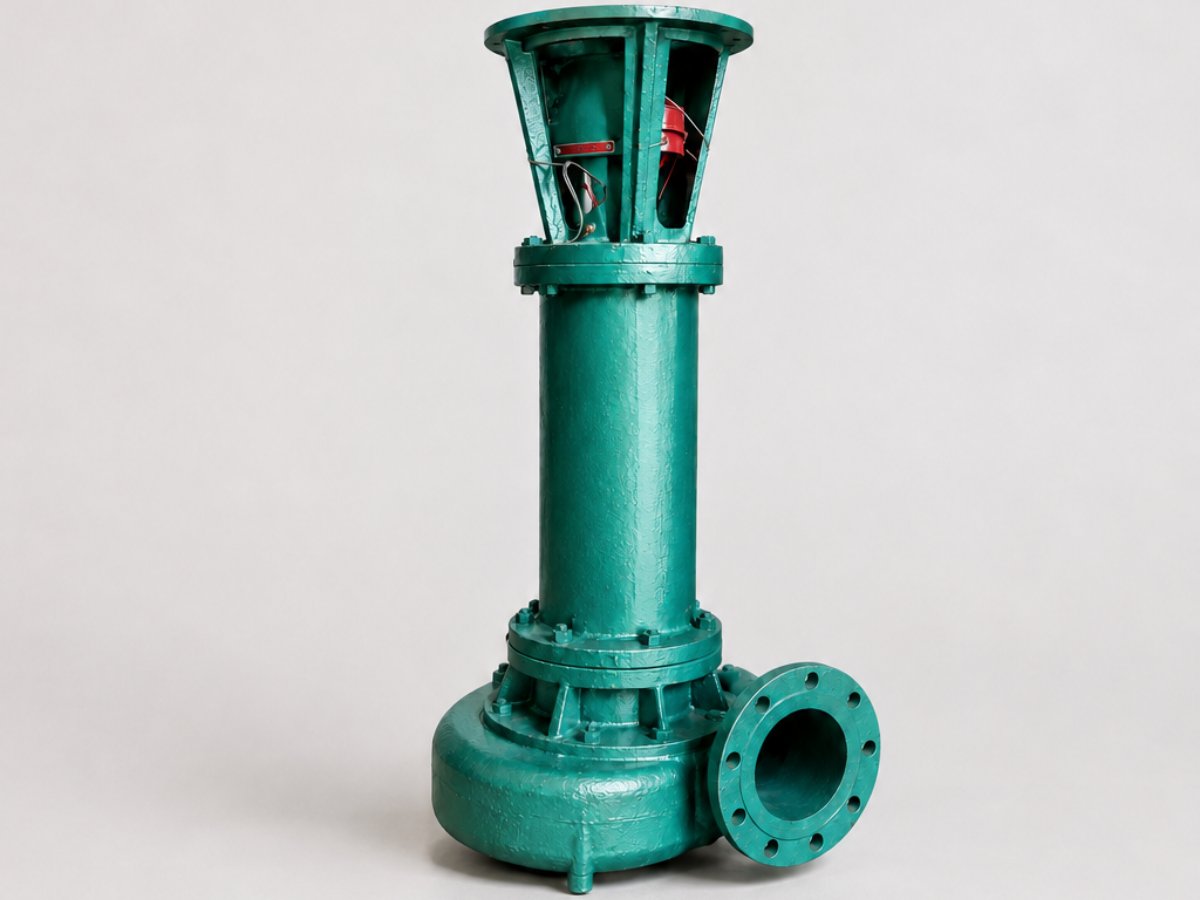
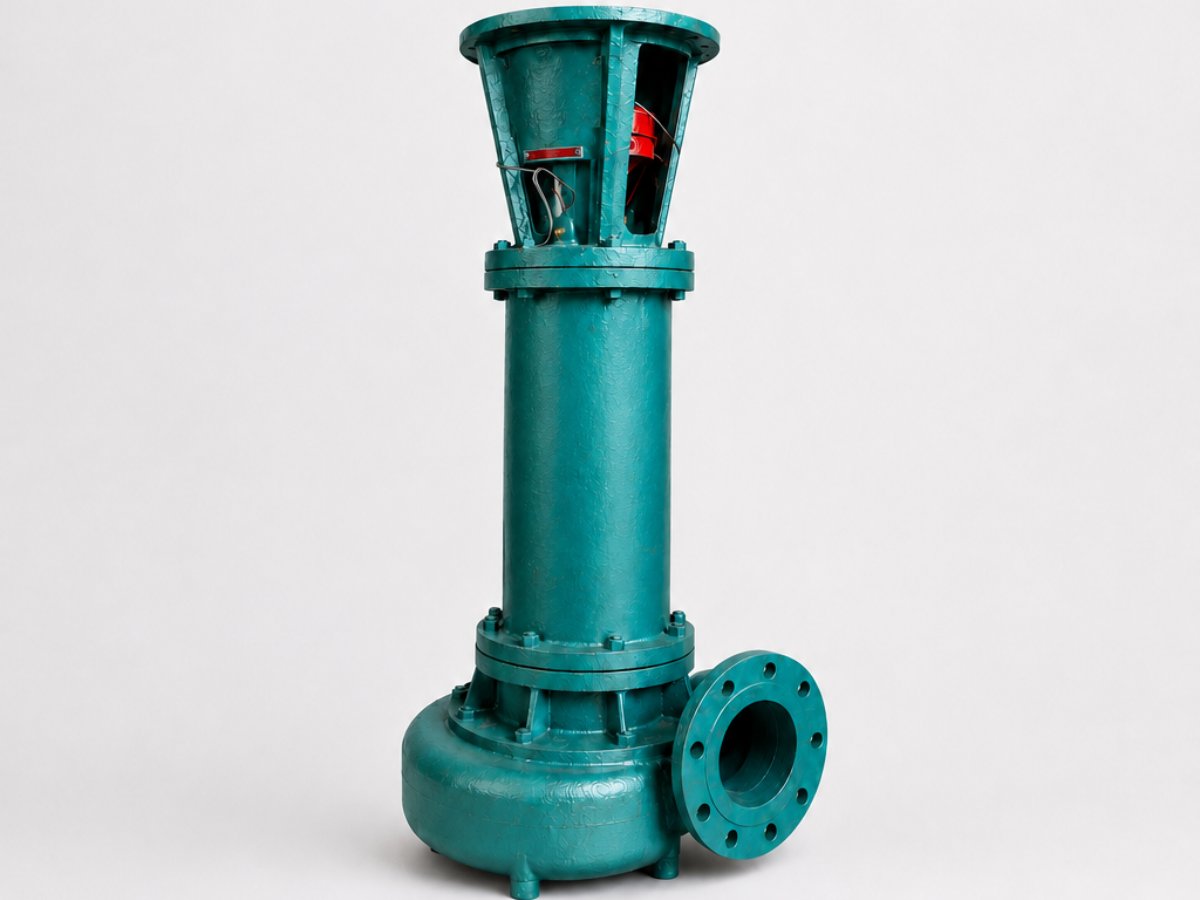
In vertical sump pumps the designation is often built differently: the number is the diameter of the discharge port in millimeters. For example, the NL150 pump has a 150 mm outlet port. Each plant has its own letters; check against the catalog.
If there is no nameplate
- Measure the ports at the flanges: inner diameter, outer diameter of the flange, number and diameter of holes.
- Take the dimensions of the impeller and liners, photograph the worn parts.
- Write down the motor and pulleys, if the drive is by belt.
- From this data the plant selects a compatible pump or parts. Before paying you need its drawing with the connection dimensions.
How we do it
- From the nameplate and photos, we look for a pump at the manufacturing plant, or a replacement with the same operating point, speed and ports.
- What we find we send before the order: the characteristic, dimensions, power. If the replacement has different ports or weight, we say so.
- At the plant we check the marking and the nameplate of the pump being shipped against the agreed item.
What this article relies on
Below are the documents and materials we refer to, so that you can check what is said for yourself.
Reference materials
- Weir Minerals, Warman pump curves: suction and discharge sizes, impeller data (vanes, diameter, type, number, material), frame check for the operating pointprovince-sud.nc ↗
- Dimension table of Warman AH pumps (4/3 CAH, 4/3 DAH and others)es.scribd.com ↗
- PaperIndex, 4/3 C-H pump: 4 inch suction port, 3 inch discharge portpaperindex.com ↗
- Shijiazhuang Sunbo Pump, 4/3C-AH pumpdirectindustry.com ↗
- Hebei Yuezhong, AH series pumps: interchangeable wet end of high-chrome alloy and rubberb2brazil.com ↗
- Draft group standard T/ACCEM "渣浆泵" (slurry pumps), 2024: main parts and their materialsttbz.org.cn ↗
The decoding of the frame letter is a conclusion from dimension tables, not from a manufacturer's document; for a specific pump, check against its passport.