What the letters and numbers in a gearbox model mean
A Chinese gearbox model usually encodes the series, the position (horizontal or vertical), whether a motor is attached, the housing size, the ratio and sometimes the motor power. But the order and meaning of the letters differ between plants, so take the exact decoding from the catalog of the plant whose nameplate is on the housing.
Updated
Contents
A gearbox model is a compressed description: which series, how it is positioned, whether a motor is attached, what size the housing is, by what factor it reduces speed, and sometimes the motor power. For example, in a model like XWD4-…-29 the letters usually say "cycloidal, horizontal, with motor", the digit 4 is the size and 29 is the ratio. But there is no single standard for these letters. The same letter at two plants can mean different things, and the digits come in a different order. So this article explains the general logic, but the exact decoding comes only from the catalog of the plant whose name is on the nameplate.
What is usually encoded in the model
In Chinese gearboxes the model contains five kinds of information.
| What | What it looks like | Example |
|---|---|---|
| Type or series | the first letter or letters | X is the cycloidal series at the Wuma plant; other plants, and worm and helical gearboxes, have their own letters |
| Position | a letter | W is horizontal (卧式), L is vertical (立式) |
| Drive | a letter | D means a directly attached motor |
| Housing size | a number | 2, 4, 9 are the size number in the plant's range |
| Ratio | a number, most often the last one | 11, 29, 35, 43 |
| Motor power | a number, not at every plant | 4 means 4 kW |
The examples below show how differently this is written.
Why the decodings differ
Let us check two open catalogs.
Catalog of the Wuma plant (Zhejiang). In its code table: W is horizontal, L is vertical, D is with motor, E is two-stage, B is explosion-proof motor, N is motor with brake, T is variable-speed motor. An example from the same catalog: XLD15-9-43 is a cycloidal, vertical, with motor, motor 15 kW, size 9, ratio 43. Here the power comes before the size.
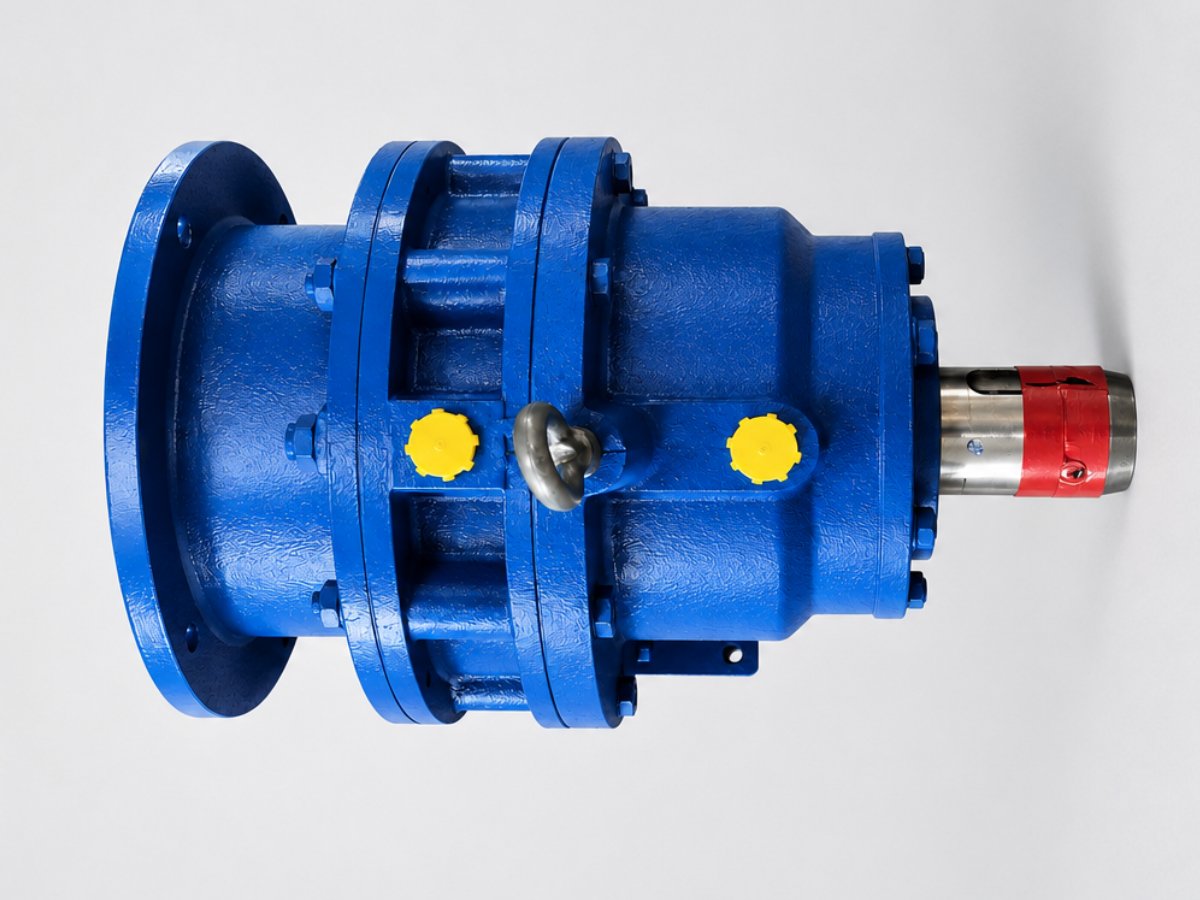
The GUOMAO gearbox from the TAMINOTA catalog. The model is written BWD2. The ratio (35) and the serial number are on the nameplate as separate lines and are not in the model. The letter B comes first here, in the place of the series. Whether it means the same as at Wuma, explosion protection, or is a series name cannot be told from one model. It is checked in the GUOMAO catalog.
So: at one plant the letter B in the code is an explosion-proof motor, at another it stands in the place of the series. One plant puts the power and ratio in the model, another puts them on the nameplate separately. Showcase websites that translate such descriptions by machine contradict each other even more. So a decoding "from the internet" cannot be applied to your nameplate.
How to find the ratio
The ratio is how many times slower the output shaft turns than the input shaft. With a 1450 rpm motor and a ratio of 29, the output shaft makes about 50 rpm.
Where to find it:
- On the nameplate, as a separate line: "速比", "i =", "ratio". This is the most reliable source.
- In the model, usually the last number. But check it against the catalog: at some plants the last number means something else.
- If the nameplate has worn off, count it. Mark the position of the input shaft and turn it, counting turns until the output shaft makes one full turn. The number of input turns is the ratio. If the motor has been removed and the gearbox is still in place, this is done by hand.
If the motor speed and the speed of the machine are known, the ratio equals their quotient.
Select by torque, not by kilowatts
A common mistake in a replacement is to choose a gearbox "for 15 kW" from the motor nameplate. What loads a gearbox is not power but the torque on the output shaft. At the same power, the slower the shaft turns, the higher the torque:
torque, N·m ≈ 9550 × power, kW ÷ output shaft speed, rpm.
A 4 kW motor with a ratio of 29 gives about 760 N·m at the output. With a ratio of 59 it is already about 1550 N·m (not counting losses in the gearbox). A housing that withstands the first may not withstand the second.
Plants state the permitted output torque and a safety margin factor, the service factor, in their catalogs. For example, SEW-Eurodrive defines it as the ratio of the maximum permitted gearbox torque to the actual torque. SEW itself warns that the method of determining it is not standardized and depends on the manufacturer, so the service factors of two brands are not compared directly. Hence the practical rule: a replacement is checked by the permitted torque and size in the new plant's catalog, not by a matching model.
What else to check in a replacement
- Output shaft: diameter, length, key. For a hollow shaft, the bore diameter.
- Mounting: feet or flange, the spacing of the holes, the height of the output shaft axis.
- Position: horizontal or vertical. The oil level and the fill and drain points depend on it.
- Input: motor directly attached (D), a flange for a standard motor, or a free input shaft.
- Motor: if it comes with the gearbox, its nameplate is needed too.
What to send for sourcing
- A photo of the whole gearbox nameplate and a close-up.
- A photo of the gearbox in place, showing the mounting, input and output.
- The ratio, or the speeds of the motor and of the machine.
- Dimensions of the output shaft and mounting.
- The motor nameplate.
- What the gearbox drives, such as a conveyor, mixer or pump, and how often it starts.
How we do it
- From the nameplate we find the manufacturing plant and decode the model from its catalog, not from other people's descriptions.
- If the exact model is not available, we select a replacement by torque, ratio and connection dimensions. Before the order we send a dimensional drawing.
- Where a decision needs the plant's answer, on torque, lubrication or version, we pass on its word.
What this article relies on
Below are the documents and materials we refer to, so that you can check what is said for yourself.
Reference materials
- Zhejiang Wuma Reducer. Catalog, section "Example for type designation" (published on yunzhan365)yunzhan365.com ↗
- SEW-Eurodrive. Service factor fBdownload.sew-eurodrive.com ↗
- SEW-Eurodrive. Conditions for selecting gear units based on the service factordownload.sew-eurodrive.com ↗
- TAMINOTA catalog: TMN-RD-02 — nameplate data of a cycloidal gearbox.