How to choose a VFD (frequency inverter) for a motor
A VFD is chosen by the motor current and by the load, not only by kilowatts. For a pump or fan the light-duty rating is enough; for a conveyor, mixer or crusher the heavy-duty one is needed. Three more questions: the supply voltage, whether fast braking is needed, and how long the motor runs at low speed.
Updated
Contents
- Step 1. Current and voltage from the nameplate
- Step 2. Light or heavy duty
- Step 3. Supply: one phase or three
- Step 4. Is a braking resistor needed
- Step 5. Low speed and motor heating
- Above 50 Hz
- Long cable to the motor
- If the line has a YCT adjustable-speed motor
- Standards
- What to put in a VFD request
- How we do it
A variable frequency drive (VFD, also called a frequency inverter) is chosen by the rated motor current from the nameplate and by the nature of the load. Kilowatts are only a guide. Every VFD has two ratings: for light duty (pumps, fans) and for heavy duty (conveyors, mixers, crushers, hoisting). The same VFD in heavy duty drives a motor of lower power. After that check the supply voltage, whether a braking resistor is needed and how long the motor will run at low speed.
Step 1. Current and voltage from the nameplate
From the motor nameplate copy the rated current, the voltage with the connection, and the power. The VFD must supply at least this current in the chosen duty.
Why current and not power. Motors of the same power can have different currents: their efficiency and power factor differ, as does the number of poles. In its selection guide ABB advises choosing a drive by the required current and power, not by a single kW figure. And if the motor works in a hot shop or with reduced load capacity, even more margin is needed.
An example from the catalog. A motor of 15 kW, 1465 rpm, 380 V Δ / 660 V Y, current 29.0 A at 380 V. A 380 V VFD must supply 29 A continuously in the required duty. The motor is connected in delta, as it would be on the mains.
Connection. A three-phase 380 V VFD outputs three phases of 380 V. A 380 Δ / 660 Y motor is connected to it in delta. A 220 Δ / 380 Y motor is connected in star. Star-delta starting is usually not needed with a VFD: the VFD itself provides the smooth acceleration.
Step 2. Light or heavy duty
Manufacturers give two current ratings. The names differ, the meaning is the same.
| Duty | What it is called | Overload | What for |
|---|---|---|---|
| Light | ND, LO, VT, "normal" | about 110% for one minute | centrifugal pumps, fans: torque grows with speed |
| Heavy | HD, HO, CT | about 150% for one minute | conveyors, agitators, mixers, crushers, mills, screw pumps, hoisting |
The overload figures and the cycle length differ between series. For example, in the Danfoss FC 360 light duty is 110% for a minute, heavy duty 150–160% for a minute depending on power. In the Siemens SINAMICS G120X it is 110% for 60 seconds in a 300-second cycle and 150% for 60 seconds in a 600-second cycle. Look at the table for your series.
What follows. A VFD rated for 11 kW in light duty may drive only 7.5 kW in heavy duty. If a VFD is chosen "by kilowatts" for a crusher, it will trip when starting under load.
Step 3. Supply: one phase or three
- 380 V mains, three phases is the usual case for a shop. A VFD for 380–480 V.
- 220 V mains, one phase: VFDs with a single-phase input exist, but only for small powers. Their output is three phases of 220 V. The motor is connected to them at 220 V, that is in delta for a 220 Δ / 380 Y nameplate.
A VFD does not raise the voltage: roughly what is at the input is at the output. A three-phase 380 V VFD will not work properly from 220 V. Not all manufacturers allow feeding a three-phase VFD from a single phase, and then with a reduced output current. This must be checked in the manual of the specific series.
Step 4. Is a braking resistor needed
When a VFD lowers the speed quickly, the motor acts as a generator and returns energy to the VFD. The voltage inside rises and the VFD trips on protection. A braking resistor turns this energy into heat.
A resistor is needed if:
- a heavy load must be stopped fast: a conveyor, flywheel, centrifuge;
- the load is lowered: a lift, winch;
- there are many stops.
For a pump or fan that stops by coasting, a resistor is usually not needed.
The switch for the resistor (the braking chopper) is built into low and medium power VFDs in many series. For example, in the ABB ACS580-01 it is built in at small frame sizes, and the resistor is bought separately. In large VFDs the chopper is often external.
Step 5. Low speed and motor heating
An ordinary motor is cooled by a fan on its own shaft. At low speed it blows weakly, while the current at constant torque stays the same. The motor heats up.
SEW-Eurodrive writes that below about 20 Hz a self-ventilated motor must not be loaded continuously with rated torque. ABB gives an example in its guide: a self-ventilated four-pole motor at 300 rpm holds about 80% of torque. If a conveyor or mixer runs at low speed for long periods, a motor with an independent fan or a motor with margin is needed.
At low speed the gearbox lubrication conditions also change. Ask the gearbox manufacturer about it.
Above 50 Hz
A VFD can run a motor above 50 Hz. But power does not rise above the rating, and torque falls. The bearings and rotor balance also have a speed limit. If more than the rated speed is needed, it is decided together with the motor manufacturer.
Long cable to the motor
A VFD outputs pulses. On a long cable they cause voltage spikes on the winding, and the insulation ages faster. Manufacturers set a maximum cable length for each series. If the motor is far away, an output reactor, a dU/dt filter or a sine filter is fitted. Put the cable length in the request.
If the line has a YCT adjustable-speed motor
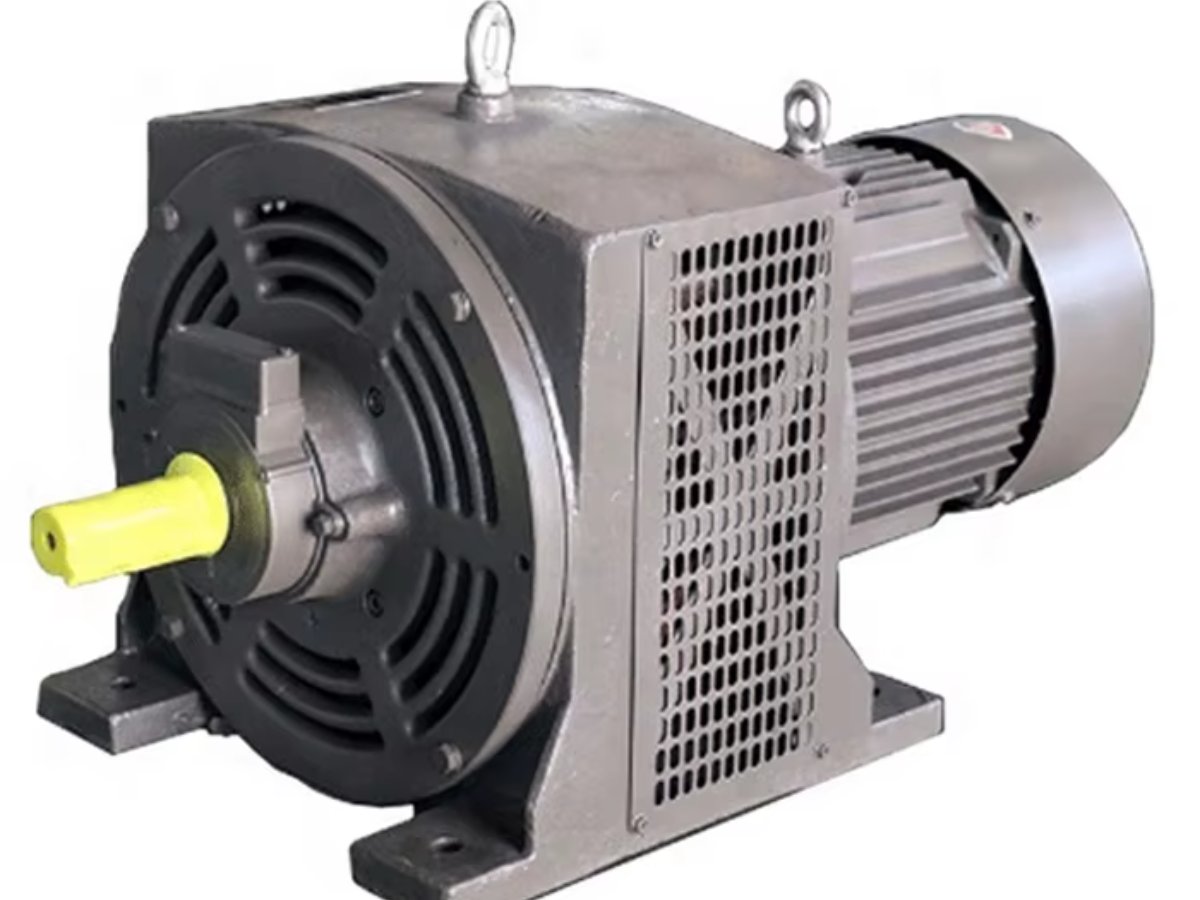
On old lines the speed is often changed without a VFD, with a YCT series motor. The catalog has one: YCT250-4B. Its speed is set by the excitation voltage, and feedback comes from a tachogenerator. This is another way of regulation, and a VFD is not added to such a motor. If a YCT is replaced by an ordinary motor with a VFD, choose by the torque and speed range from the nameplate: for the YCT250-4B that is 118 N·m and 132–1320 rpm. Take Step 5 into account: at the low end of such a range an ordinary motor needs an independent fan.
Standards
Adjustable speed electrical power drives are described by the IEC 61800 series. Part 2 sets general requirements and rated data, part 3 sets electromagnetic compatibility (categories C1–C4 by place of installation), part 5-1 sets safety.
What to put in a VFD request
- The motor nameplate: power, current, voltage with connection, speed.
- The machine: pump, fan, conveyor, mixer, hoist.
- Supply: 380 V three phase or 220 V single phase.
- Speed range and how long it runs at low speed.
- How often it starts and stops, and whether fast braking is needed.
- Cable length to the motor.
- How it is controlled: panel buttons, a 4–20 mA signal, link to a controller.
How we do it
- From the motor nameplate and the description of the machine we select a VFD at the manufacturing plant: current, duty, voltage, braking.
- We send what we find before the order with its specifications; if the VFD needs a resistor, filter or reactor, we say so at once.
- At the plant we check the marking and nameplate of the VFD being shipped against the agreed item.
What this article relies on
Below are the documents and materials we refer to, so that you can check what is said for yourself.
Standards and documents
Reference materials
- ABB. ACS580 technical eBook (drive selection, load types, field weakening, motor thermal load capacity)library.e.abb.com ↗
- ABB. ACS580-01 Quick installation and start-up guide (braking chopper)library.e.abb.com ↗
- Danfoss. VLT Midi Drive FC 360 Design Guide (ND and HD duty, built-in brake chopper, cable length)assets.danfoss.com ↗
- Danfoss. Brake Resistor Design Guideassets.danfoss.com ↗
- Siemens. SINAMICS G120 brochure (Low Overload and High Overload, load types, single-phase modules)assets.new.siemens.com ↗
- Siemens. SINAMICS G120X datasheet (copy at RS)docs.rs-online.com ↗
- SEW-Eurodrive. Operation of a self-ventilated motor below 20 Hzdownload.sew-eurodrive.com ↗
- WEG. Specification of Electric Motors (Δ/Y connections, field weakening, pulses on a long cable, PDF)static.weg.net ↗
- ABB. ACS800 Sine Filterslibrary.e.abb.com ↗
- REO. IEC 61800-3: EMC for power drive systems (overview of the standard)reo.co.uk ↗
- TAMINOTA catalog: TMN-EM-15, TMN-EM-22 — nameplate data.