How to choose a replacement for a burnt-out motor that fits the place
For the new motor to fit without rework, it must match not only the kW and speed but also the frame size (shaft height), version (feet or flange), shaft (diameter, length, key) and the spacing of the foot holes. The same power comes in different frame sizes in different series.
Updated
Contents
A new motor will fit in place of the old one without rework if three groups of data match. Electrical: power, speed, voltage and connection. Mechanical: frame size (shaft axis height), version (foot-mounted, flange-mounted or both), shaft and key dimensions, and the spacing of the foot holes or the flange dimensions. Operating conditions: IP rating, duty type, insulation class. A match in kilowatts and speed guarantees nothing, because the same power comes in different frame sizes in different series. Below: what to take off the old motor and where mistakes are most common.
Step 1. Electrics: power, speed, voltage
This is the data from the nameplate. Each line is covered in detail in the article on the motor nameplate.
- Power: take the same. A lower one cannot be fitted. A higher one can, but it often comes in a larger frame with a different shaft.
- Speed: the same number of poles, about 3000, 1500, 1000 or 750 rpm at 50 Hz.
- Voltage and connection. If the cabinet has star-delta starting, you need a 380 Δ / 660 Y motor. If the motor is connected in star to 380 V, a 220 Δ / 380 Y motor will do.
If the nameplate burned together with the motor, the power can be recovered from the motor protection breaker setting or from the machine's passport. The speed comes from the drive ratio and the speed of the machine.
Step 2. Frame size: axis height
The frame size is the number in the motor designation: 112, 132, 160, 180. It equals the height of the shaft axis above the foot mounting plane in millimeters. The series of frame sizes is set by the international standard IEC 60072-1: from 56 to 400.
The axis height must match exactly. Otherwise the motor shaft will not line up in height with the shaft of the gearbox or pump, and the coupling cannot be connected without shims or reworking the frame.
The letter after the number (S, M, L) is the housing length. The spacing of the foot holes along the axis depends on it. According to a catalog of one AIR series manufacturer: for frame 160S it is 178 mm, for 160M it is 210 mm, with the same width of 254 mm. A 160M motor will not fit a frame made for 160S without new holes.
Step 3. Version: feet or flange
The mounting method is marked with an IM code under the standard IEC 60034-7.
| Code | How it is mounted |
|---|---|
| IM B3 (IM 1001) | on feet, shaft horizontal |
| IM B5 (IM 3001) | on a flange with through holes, no feet |
| IM B14 (IM 3601) | on a small flange with threaded holes in the end shield |
| IM B35 (IM 2001) | on feet and with a flange |
| IM V1 (IM 3011) | on a flange, shaft vertical, pointing down |
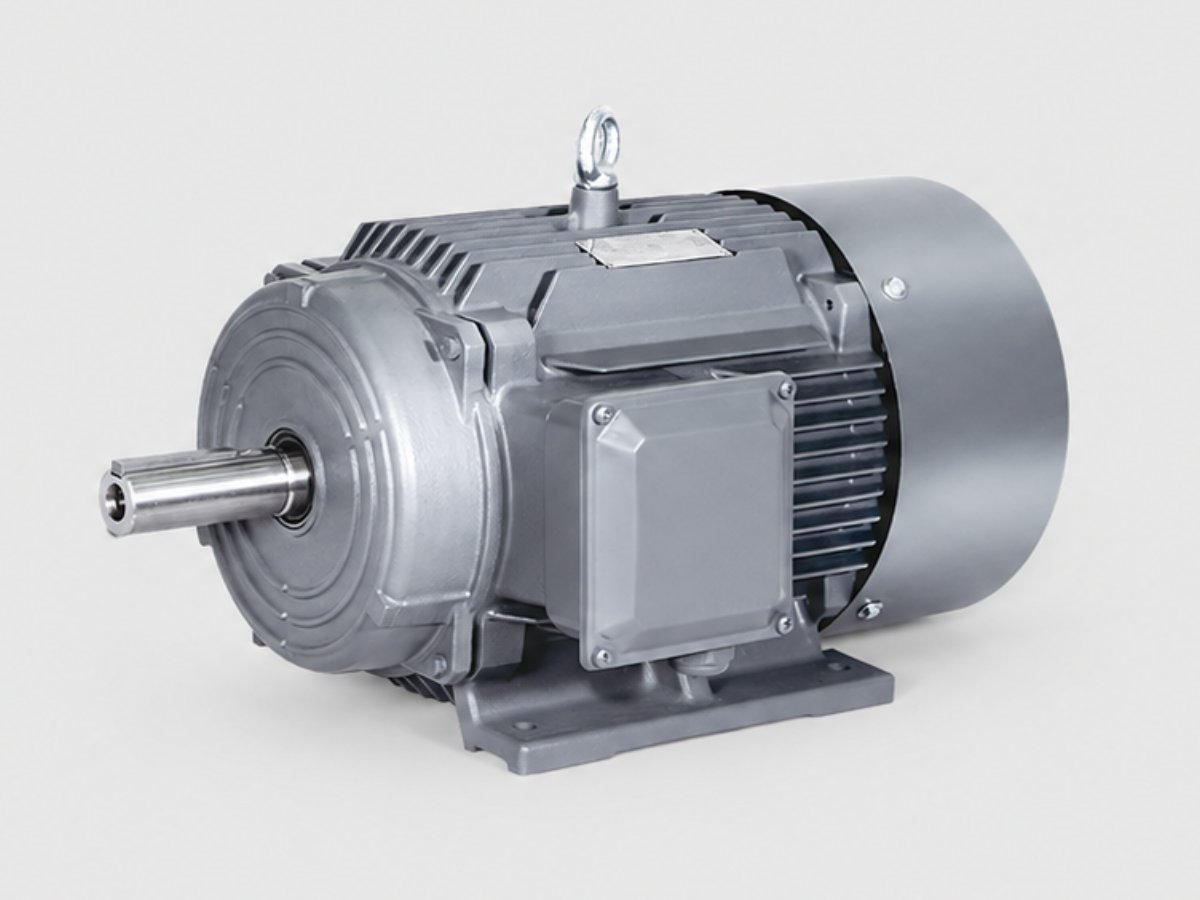
For flange motors, besides the code, check the flange dimensions: bolt circle diameter, centering spigot diameter, outside diameter, and the number and size of the holes. The 4 kW motor from the catalog is B5: flange-mounted, no feet.
Step 4. Shaft and key
Take these off the old motor:
- shaft diameter;
- length of the protruding part;
- key width;
- whether there is a threaded hole in the shaft end.
The shaft diameter depends not only on the frame size but also on the number of poles. In the same AIR catalog: a two-pole 160S has a 42 mm shaft, a four-pole 160S has 48 mm. A half-coupling from the old shaft will not fit a new shaft of a different diameter.
The trap: the same power in different frame sizes
Each series of motors ties power to frame size in its own way. Compare:
| Power and speed | AIR series (per the manufacturer's catalog) | Motor from the TAMINOTA catalog |
|---|---|---|
| 11 kW, 2 poles | AIR132M2: frame 132 | YE3-160M1-2: frame 160 |
| 15 kW, 4 poles | AIR160S4: frame 160S | OCV3164B: frame 160L |
The power and speed are the same, but the axis height or housing length differs. If you replace a Soviet or Russian AIR motor with a Chinese motor "by kilowatts", it may turn out taller or longer. So in a replacement, compare the frame size and the connection dimensions, not only the nameplate.
What to do if there is no exact match:
- ask the plant whether it has a version for the needed axis height and foot dimensions;
- fit a larger-frame motor on an adapter plate: this is rework and is priced separately;
- for a flange motor, an adapter flange. This is also rework.
Operating conditions
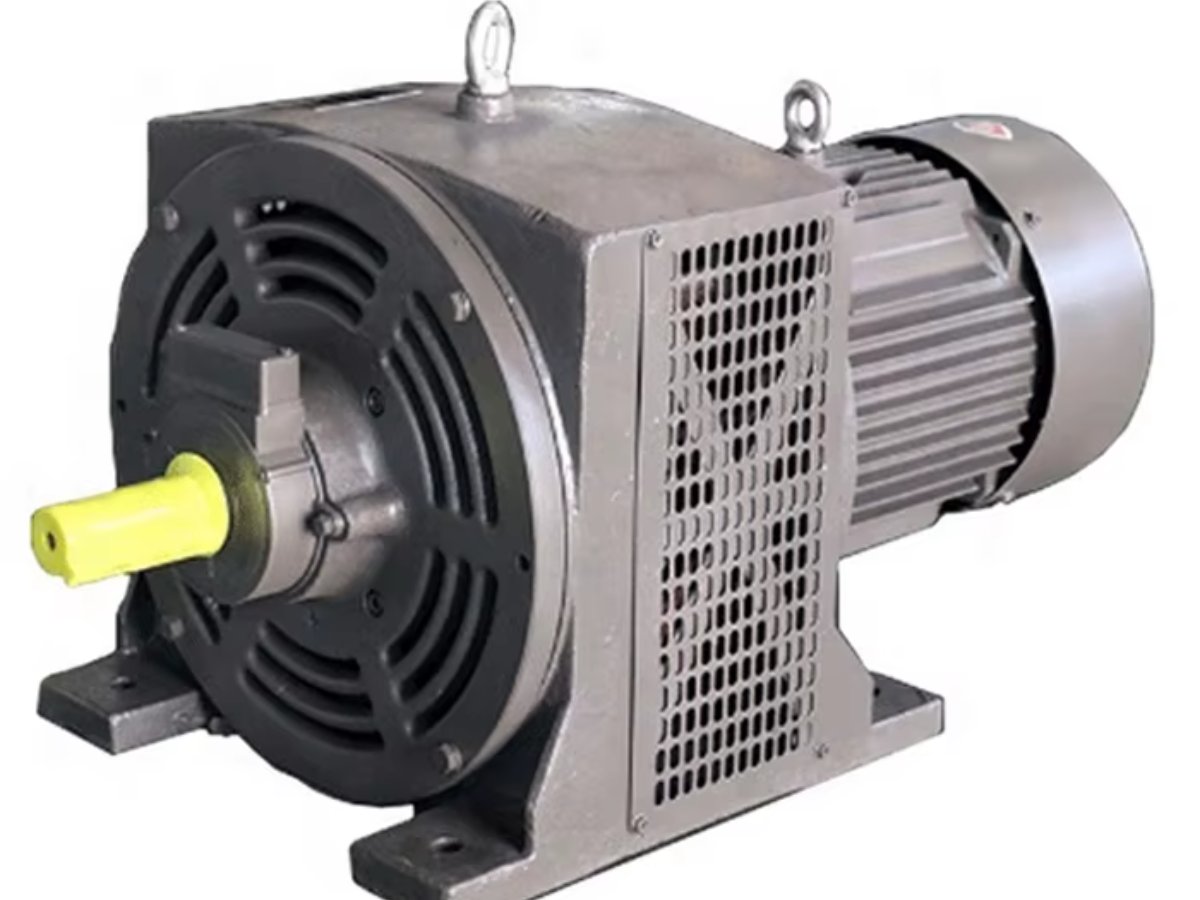
The new motor must be no worse than the old one in IP rating, insulation class and duty type. An IP21 motor, like the variable-speed YCT in the catalog, is meant for a clean room. A dusty workshop needs IP54 or IP55.
If the motor runs from a frequency converter, say so when you request the part. The choice of motor depends on it and, possibly, the converter settings.
Why it burned out
Before replacing, it is worth understanding the cause. Overload, a lost phase, water in the terminal box, a seized bearing, frequent starts: a new motor in the same conditions will burn out again. The cause is for your electrician or a motor repair shop to find. Without that, the replacement treats only the consequence.
What to send for sourcing
- A photo of the nameplate, even if only partly readable.
- A photo of the motor in place, showing the feet, the flange and the coupling.
- Axis height, spacing of the foot holes along and across the axis.
- Shaft diameter and length, key width.
- For a flange: bolt circle diameter, spigot, number of holes.
- What the motor drives and how it starts: direct, star-delta, or from a frequency converter.
How we do it
- From the nameplate and dimensions we find a motor with the same axis height, version and shaft. If there is none, we offer the closest and write what will have to change.
- Before the order we send the nameplate and a dimensional drawing of the new motor, and you check it against the installation place.
- We take the answer on dimensions from the manufacturing plant's catalog, not from summaries.
What this article relies on
Below are the documents and materials we refer to, so that you can check what is said for yourself.
Standards and documents
- IEC 60072-1:2022. Rotating electrical machines — Dimensions and output series (description in the Standards Council of Canada database)text ↗
Reference materials
- SDS Drives. Universal Motors — Mounting Options (IM codes per IEC 60034-7)download.sdsdrives.com ↗
- Насосэлектропром. Электродвигатели АИР — технические характеристики и присоединительные размеры по ГОСТ 31606dn.ru ↗
- TAMINOTA catalog: TMN-EM-11, TMN-EM-15, TMN-EM-22, TMN-EM-04, TMN-AM-250 — nameplate data.