How to read an electric motor nameplate: kW, rpm, IP, insulation
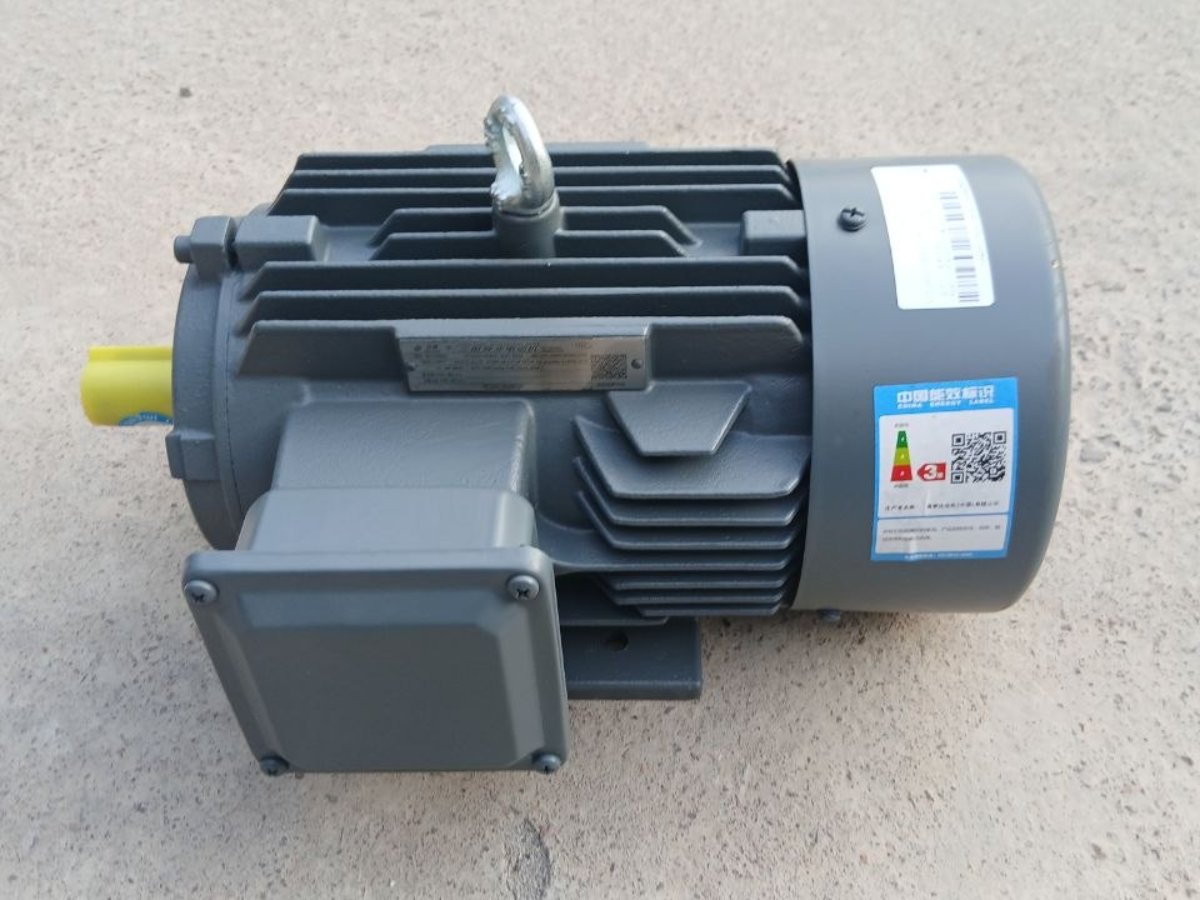
To find a replacement, copy six things from the nameplate: power in kW, voltage with the connection (Δ or Y), speed, frame size, mounting version (B3, B5) and IP rating. Insulation class, duty type and efficiency help choose an equivalent motor, not just a similar one.
Updated
Contents
A motor nameplate is a passport on one line. To find a replacement you need six items from it: power in kW, voltage together with the connection (Δ is delta, Y is star), speed in rpm, frame size, mounting version and IP rating. With these you pick a motor that fits the place and connects without reworking the cabinet. The other lines (insulation class, duty type, efficiency, current) are needed so that the replacement is no worse than the old motor. Below: what each line means and which mistakes are most common.
What the standard puts on the plate
The set of data is defined by the international standard IEC 60034-1. According to public summaries of the standard, the nameplate of an induction motor should show: manufacturer and type, serial number, number of phases, rated power, voltage, frequency, current and speed, duty type, insulation thermal class, IP rating, efficiency class (if applicable) and mass. The standard itself is paid, so the list is taken from service companies' summaries.
Chinese plants write the same lines, often repeating them in Chinese characters. The digits and Latin designations do not change because of that.
Line by line, with an example
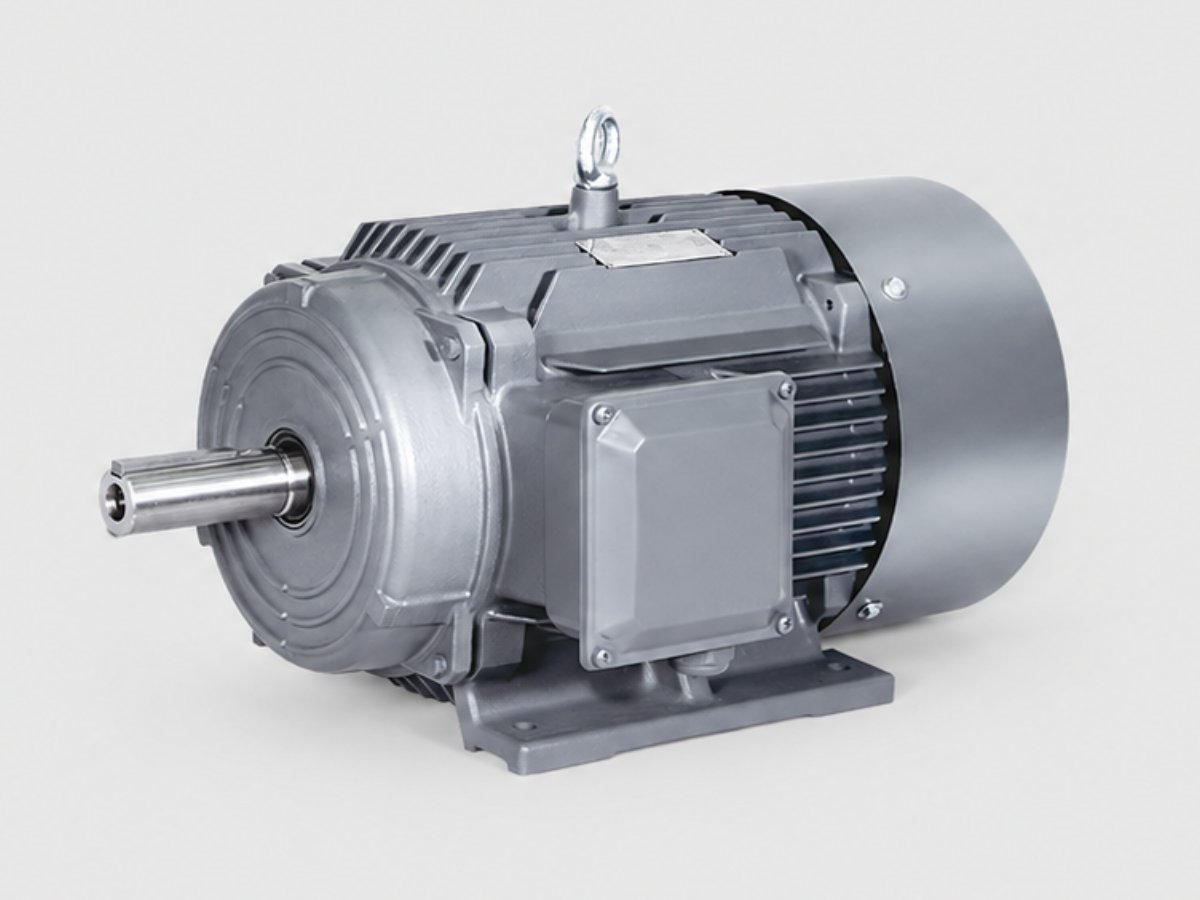
Take the 15 kW motor from the catalog.
| Line | Value | What it means |
|---|---|---|
| Model | OCV3164B | the manufacturer's designation; use it to find the catalog |
| Power | 15 kW | mechanical power at the shaft, not the power drawn from the grid |
| Voltage | 380 V Δ / 660 V Y | on a 380 V grid the motor is connected in delta |
| Current | 29.0 / 16.6 A | the current for each connection: 29 A at 380 V in delta |
| Frequency | 50 Hz | grid frequency |
| Speed | 1465 rpm | a four-pole motor |
| Efficiency | 92.1% | the share of input power that goes to the shaft |
| cos φ | 0.86 | power factor |
| IP | IP55 | protection against dust and water jets |
| Insulation | F, 155 °C | the maximum temperature of the winding insulation |
| Version | IM B3 | foot-mounted |
| Frame size | 160L | shaft axis height 160 mm, long housing |
| Mass | 126 kg | for rigging and the foundation |
Voltage and connection: Δ and Y
The nameplate almost always shows two voltages separated by a slash. The winding is the same; what changes is how its ends are connected in the terminal box. The star voltage is √3 times (about 1.73 times) the delta voltage.
- 220 Δ / 380 Y: on a 380 V grid the motor is connected in star. This is the case for the 1.5 kW motor from the catalog.
- 380 Δ / 660 Y: on a 380 V grid it is connected in delta. Such motors allow star-delta starting: the motor is started in star with a lower current, then switched to delta. This is the case for the 15 and 22 kW motors from the catalog.
For your request this matters: if the cabinet has star-delta starting, you need a motor rated 380 Δ / 660 Y. A 220 Δ / 380 Y motor will not work in that circuit.
Speed and number of poles
At 50 Hz the field in the motor rotates at one of the standard speeds: 3000, 1500, 1000 or 750 rpm, for 2, 4, 6 and 8 poles. The rotor of an induction motor lags slightly, so the number on the nameplate is a little lower.
| On the nameplate | Poles | Synchronous speed |
|---|---|---|
| 2870–2950 rpm | 2 | 3000 |
| 1440–1480 rpm | 4 | 1500 |
| 960–980 rpm | 6 | 1000 |
| 720–740 rpm | 8 | 750 |
The ranges in the table are approximate. Take a replacement with the same number of poles: a 3000 rpm motor in place of a 1500 rpm one will drive a pump or conveyor twice as fast.
IP: protection against dust and water
The IP code is set by the standard IEC 60529. The first digit is protection against solid objects and dust (0 to 6), the second is protection against water (0 to 8).
| Code | Dust | Water |
|---|---|---|
| IP54 | dust may enter, but not in an amount that interferes with operation | splashing water from any direction |
| IP55 | the same | low-pressure water jets from any direction |
| IP65 | no dust enters | low-pressure water jets |
| IP21 | objects of 12.5 mm and larger (fingers) | vertically dripping water |
You can replace with an equal or higher IP. An IP21 motor (like the variable-speed YCT in the catalog) is meant for a clean, dry room. It is not put into a dusty workshop in place of an IP55 one.
Insulation class and duty type
Insulation thermal class is the maximum temperature the winding insulation withstands: B is 130 °C, F is 155 °C, H is 180 °C. Class F is the most common. Motors are usually rated for an ambient temperature up to 40 °C. Some manufacturers fit class F insulation but keep the temperature rise at class B level, which gives a reserve for hot workshops. If your workshop gets very hot in summer, ask the plant what temperature rise of the winding is permitted.
Duty type is marked from S1 to S9 (per IEC 60034-1). S1 is continuous: the motor runs at constant load for as long as needed. S2 is short-time duty with full cooling afterwards. S3 is intermittent periodic duty, with pauses. An S3 motor put on continuous work will overheat. Pumps, fans and conveyors usually need S1.
Efficiency class: IE
The standard IEC 60034-30-1 (2014 edition) sets efficiency classes for induction motors from 0.12 to 1000 kW: IE1 is standard, IE2 is high, IE3 is premium, IE4 is super premium. The higher the class, the lower the losses at the same power. The minimum efficiency for each class depends on power and number of poles.
If the nameplate gives an IE class, copy it. If it gives only the efficiency in percent, that is enough too: the plant will pick an equivalent model from it.
Frame size and version
The frame size (160L, 180L, 112M) is a number equal to the height of the shaft axis above the foot mounting plane in millimeters. The letter S, M or L shows the housing length. The standard IEC 60072-1 sets a series of frame sizes from 56 to 400.
The mounting version is the IM code: B3 is foot-mounted, B5 is flange-mounted, B35 is foot-mounted with a flange. This is covered in more detail in the article on replacing a burnt-out motor.
What to copy into your request
- Manufacturer and model.
- Power, kW.
- Voltage with the connection: for example, 380 Δ / 660 Y.
- Speed.
- Frame size and IM version.
- IP, insulation class, duty type.
- Efficiency or IE class, if shown.
- A photo of the whole nameplate.
How we do it
- From the nameplate photo we find the manufacturer and model, or an equivalent replacement with the same power, speed, voltage, frame size and version.
- If something has worn off the old nameplate, we ask for the shaft and foot dimensions instead of guessing.
- We send you what we found before the order: the nameplate of the new motor and its specifications. We mark any differences from the old one.
What this article relies on
Below are the documents and materials we refer to, so that you can check what is said for yourself.
Standards and documents
- IEC 60072-1:2022 (description in the Standards Council of Canada database)text ↗
Reference materials
- MB Drive Services. What information belongs on a nameplate? (a summary of IEC 60034-1)mb-drive-services.com ↗
- ABB. Technical note: IEC 60034-30-1 standard on efficiency classes for low voltage AC motors (2018)library.e.abb.com ↗
- TÜV Rheinland. IP testing (protection levels per IEC 60529)tuv.com ↗
- myElectrical. Understanding electric motor insulation and temperaturemyelectrical.com ↗
- Fabrico. Motor duty cycles (S1–S9 per IEC 60034-1)fabrico.io ↗
- TAMINOTA catalog: TMN-EM-1K5, TMN-EM-15, TMN-EM-22, TMN-EM-11, TMN-AM-250 — nameplate data.