How to read a hydraulic pump model: what YB1-50/50 means
A Chinese hydraulic pump model usually encodes the pump type and its displacement: how many milliliters of oil it delivers per shaft revolution. YB1 is a series of vane pumps, and the numbers after the hyphen are the displacement. But for a new pump to fit, the model alone is not enough: you need the flange, shaft, ports and direction of rotation.
Updated
Contents
A hydraulic pump model tells you two main things: what kind of pump it is and what its displacement is. At Chinese plants YB1 is a series of fixed-displacement vane pumps for medium and low pressure systems: presses, machine tools, lifts. The number after the hyphen is the displacement in milliliters per shaft revolution. Two numbers with a slash, as in YB1-50/50, usually mean a double pump: two sections on one shaft. For a replacement to fit without rework, four more things are added to the model: pressure, direction of rotation, shaft and flange, and ports.
The three pump types you meet most often
| Type | How to recognize it | Where it is used |
|---|---|---|
| Gear | elongated housing, two gears inside; at Chinese plants the model often has the letters CB | lifts, loaders, simple hydraulic power units |
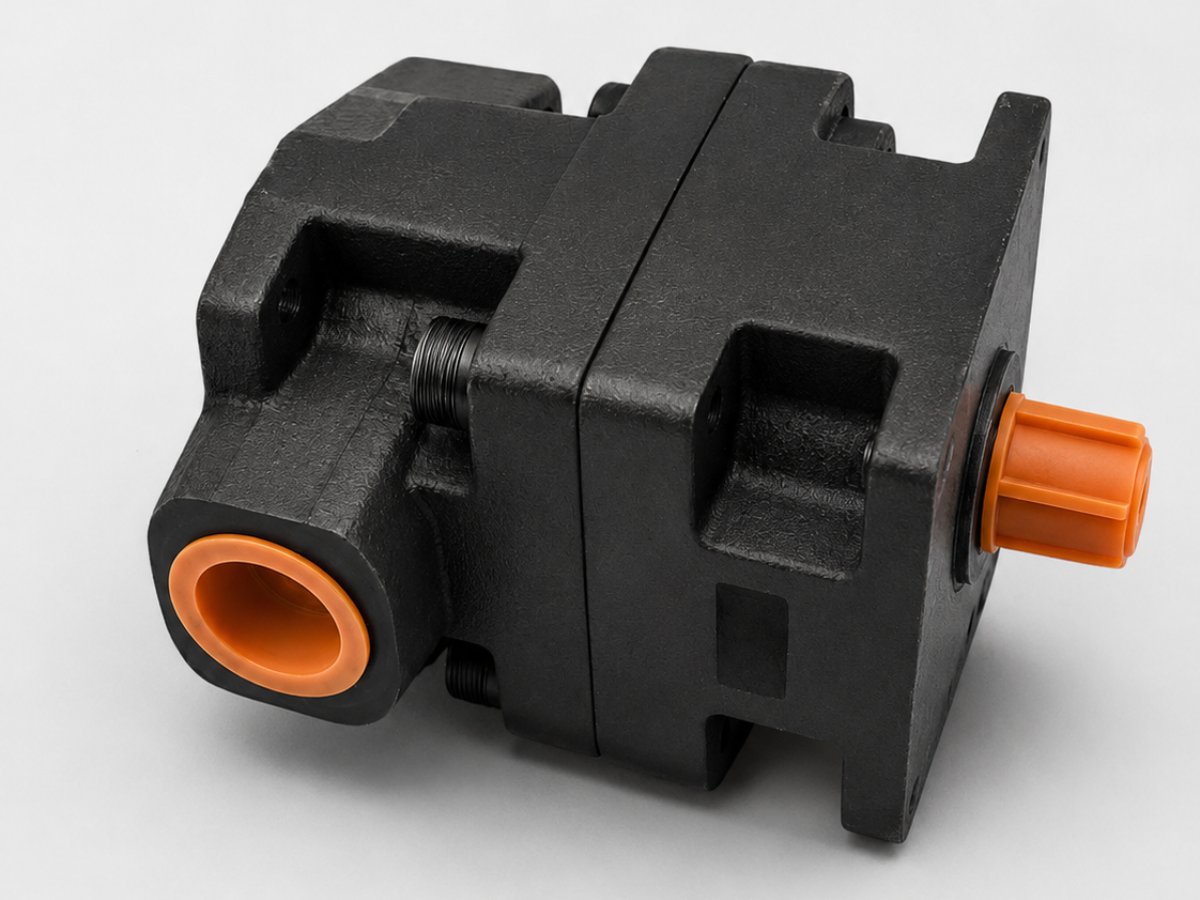
| Vane | housing closer to round, a rotor with vanes inside; at Chinese plants the series YB, YB1 | machine tools, presses, plastic molding |
| Axial piston | heavy, often with a regulator on the side; works at high pressure | powerful presses, mobile machinery |
Pumps of different types are not interchangeable "head-on", even if the displacement matches. They have different permitted pressure, noise and oil cleanliness requirements.
What YB1-50/50 means
Let us break it down on a pump from our catalog.
- YB is a vane pump. By common practice at Chinese plants, the letters are taken from the Latin spelling of the words: Y from 叶片 (yèpiàn, "vane, blade"), B from 泵 (bèng, "pump"). In the same way a gear pump is often marked CB, from 齿轮泵 (chǐlún bèng). 1 is the series number.
- 50 is a displacement of 50 ml/rev. One Chinese manufacturer's table for the YB1 series gives a range from 2.5 to 100 ml/rev and a rated pressure of 6.3 MPa.
- 50/50 is two sections of 50 ml/rev each. This is how double pumps are marked: one shaft, two independent flows at the outlet. They can be split into two circuits or combined. The designation of the sections differs between plants, so check the "front / rear" order against the pump's passport.
We saw the decoding of the YB1 series in the catalog of one Chinese manufacturer. We found no single open standard for this model designation in Russian or English. So any Chinese model is checked against the pump passport or the plant's answer.
How to calculate flow
Flow is the displacement multiplied by the shaft speed.
Example: 50 ml/rev × 1000 rpm = 50,000 ml/min, that is 50 liters per minute per section. This is the theoretical flow. The real one is slightly lower, because some oil leaks through the clearances. Manufacturers state this as volumetric efficiency.
The practical conclusion: if you fit a pump with the same displacement on a motor with a different speed, the flow will change. For a press this can noticeably change the stroke speed.
What else is needed besides the model
The model tells you about the hydraulics, but not whether the pump will fit in place. For that you need mechanical data.
- Direction of rotation. Look from the shaft side: clockwise or counterclockwise. A pump fitted "the wrong way round" does not pump and may fail. The YB1 table of one manufacturer states clockwise rotation from the shaft side. But check against the arrow on the housing of your own pump.
- Flange. The number of holes, the spacing between them, the diameter of the centering spigot. The dimensions of flanges and shaft ends for pumps in the metric series are standardized (ISO 3019-2), but Chinese series do not always follow them.
- Shaft. Diameter, length, type: keyed or splined. For a splined shaft, the number of teeth.
- Ports. Thread or flange at suction and delivery, and their size. The suction port is usually larger.
- Pressure. Rated and maximum, per the passport. If the system pressure is higher than the pump is rated for, it will not last long.
Take these measurements with calipers and photograph the pump from three sides: the shaft side, the side with the ports, and the nameplate.
Hydraulic blocks and valves: their own standard
Next to a pump there is often a block of hydraulic equipment: directional valves and valves on a common plate. For directional valves, the mounting dimensions of the plate are described by ISO 4401. The size is marked by a code like 4401-03, 4401-05, 4401-07. It decides where the P, A, B and T holes are and what diameter they have. If the valve carries such a code, it is enough to find a valve with the same mounting pattern from another manufacturer.
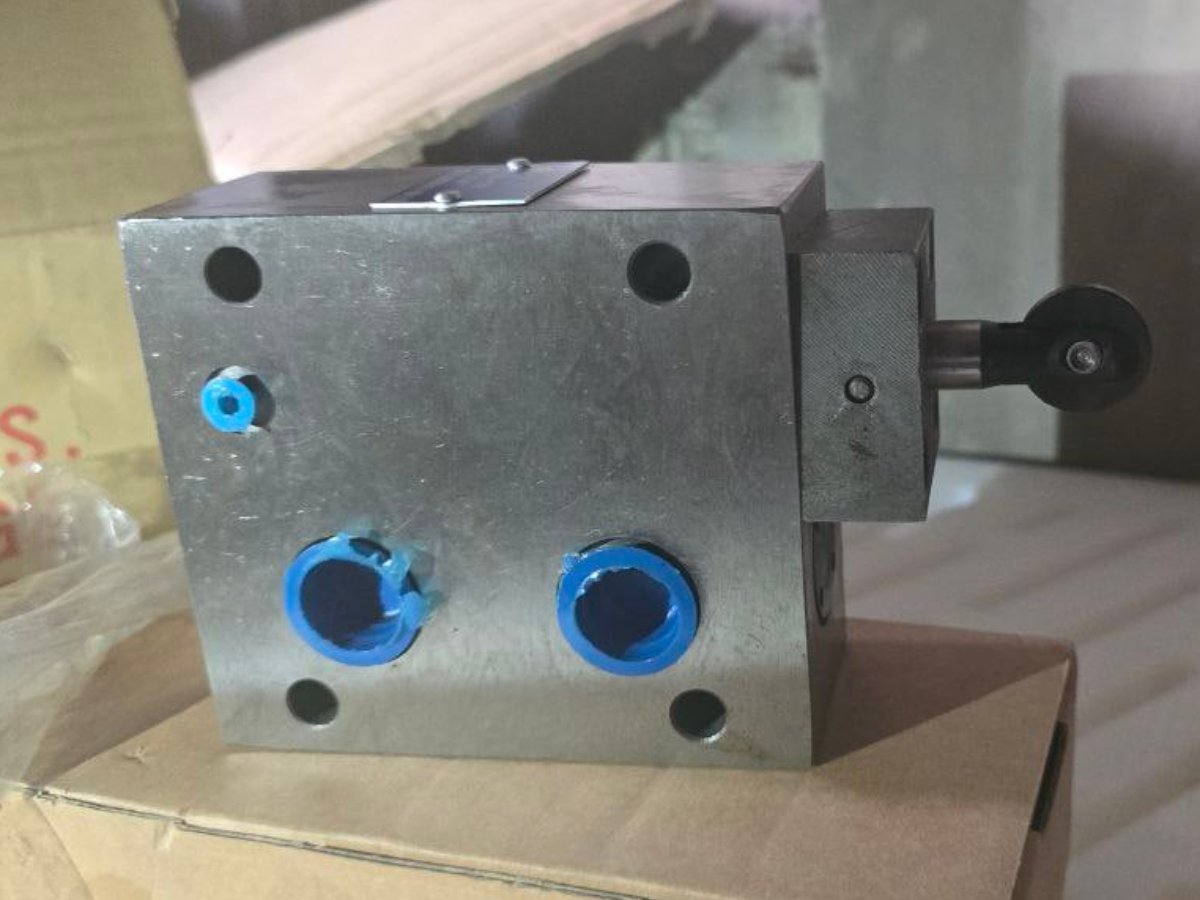
For a block as a whole (like the LCI-63B in the catalog) there is no standard. It is selected by the plate, the hydraulic diagram and a photo of the nameplate.
If the pump has only a Chinese model
This is a common case. The procedure is:
- Copy the model in full, with all letters and digits. If there are Chinese characters, photograph them.
- Take the mechanical dimensions: flange, shaft, ports.
- Write down what machine the pump sits on, what motor drives it and at what speed.
- If you have the machine's hydraulic diagram, attach it.
From these data, the same pump is sought at the same plant, or an equivalent with the same fit. If the equivalent differs, you see it before the order, not at installation.
How we do it
- From the model, photos and dimensions we look for the pump at the manufacturing plant, or an equivalent with the same fit. We send you what we found before the order: model, displacement, pressure, flange, shaft.
- If the dimensions of the equivalent differ from your pump, we write exactly how.
- At the plant we check the marking and nameplate of the pump being shipped against the agreed item.
What this article relies on
Below are the documents and materials we refer to, so that you can check what is said for yourself.
Standards and documents
- BSI. Hydraulic fluid power — Dimensions and identification code for mounting flanges and shaft ends of displacement pumps and motors — Metric series (ISO 3019-2)text ↗
Reference materials
- Catalog of the YB1 series of one Chinese manufacturer (displacement, pressure, speed, direction of rotation) on hbzhan.comm.hbzhan.com ↗
- Danfoss Power Solutions. V2010 HP double square vane pumps (design of a double vane pump)powersource.danfoss.com ↗
- Danfoss Power Solutions. Gear pump product card 111.21.027.00 (displacement, rotation, flange, shaft, ports)powersource.danfoss.com ↗
- Atos. Table P005: mounting interfaces per ISO 4401:2005atos.com ↗