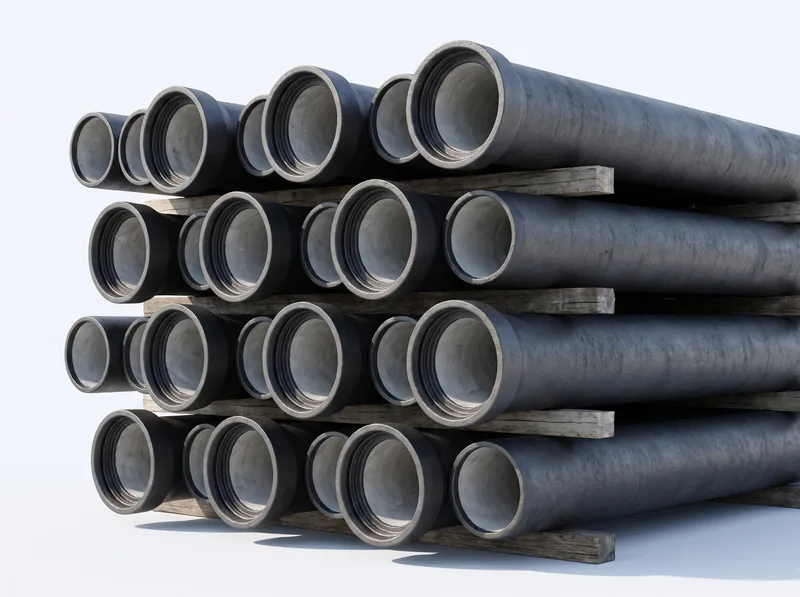
ductile iron · DN80–DN1200 · K9 / C40 · 6 m · ISO 2531 · EN 545
Ductile iron socket pipe
Centrifugally cast socket pipe K9 and C40 with cement mortar lining, DN80–DN1200, 6 m long
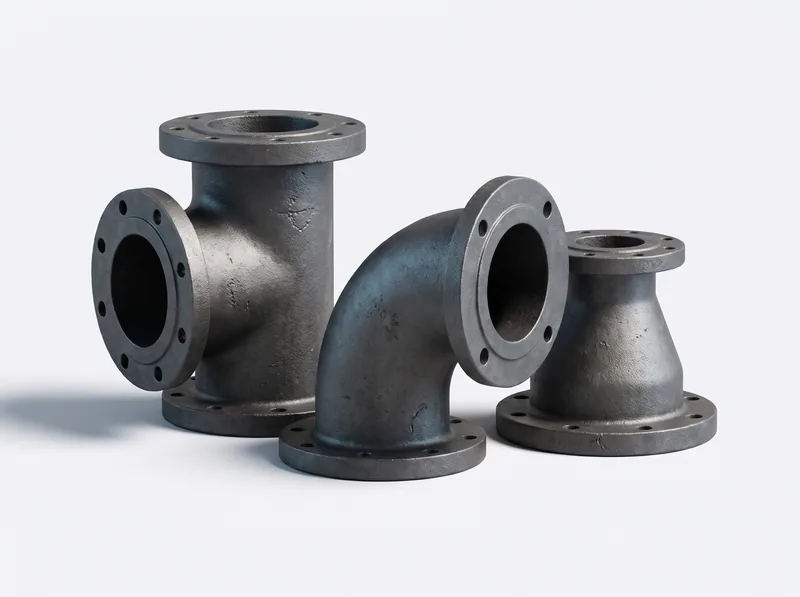
ductile iron · DN80–DN1200 · K12 · socket T / flange PN10–PN25 · EN 545
Bends, tees, reducers, collars and flanged pieces in class K12 for T-type sockets and PN10–PN25 flanges
| Parameters | |
|---|---|
| Nominal diameter | DN80–DN1200 |
| Thickness class | K12; tees K14 |
| Bend angles | 11¼°, 22½°, 45°, 90° |
| Joints | T-type socket for EPDM gasket; K-type mechanical socket; flange PN10, PN16, PN25 per EN 1092-2 |
| Coating | epoxy at least 250 µm per EN 14901 inside and outside; cement mortar inside on request |
| Casting | sand cast, annealed |
| Mechanical properties | Rm ≥ 420 MPa, A ≥ 5 %, hardness ≤ 250 HB |
| Fitting | Version | Thickness class | Joints |
|---|---|---|---|
| Double-socket bend | 11¼°, 22½°, 45°, 90° | K12 | socket-to-socket |
| Flanged bend | 11¼°, 22½°, 45°, 90° | K12 | flange-to-flange |
| Duckfoot bend | 90° | K12 | flange-to-flange |
| Tee | equal and reducing | K14 | socket or flange |
| Reducer | concentric | K12 | socket-to-socket or flange-to-flange |
| Double-socket collar | plain-end jointing, repair inserts | K12 | socket-to-socket |
| Flange-socket piece | — | K12 | flange-to-socket |
| Flange-spigot piece | — | K12 | flange-to-spigot |
| Double-flanged piece | length to specification | K12 | flange-to-flange |
| Cap / blank flange | socket or flange type | — | socket or flange |
Fittings for ductile iron pipe networks: bends of 11¼°, 22½°, 45° and 90°, tees, reducers, double-socket collars, flange–socket and flange–spigot pieces, double-flanged pieces and caps. They are cast from the same spheroidal graphite iron, but in sand moulds rather than centrifugally, with subsequent annealing; flanges are cast integrally with the body. For sand-mould castings the standard sets tensile strength not less than 420 MPa, elongation not less than 5 % and hardness not more than 250 HB.
Wall thickness follows class K12, for tees K14: e = K·(0.5 + 0.001·DN). T-type sockets take the spigots of pipes and pieces on an EPDM gasket; K-type mechanical sockets with a gland flange and bolts are used where a dismountable joint is needed; flanges are drilled to EN 1092-2 for PN10, PN16 or PN25 — pressure and drilling are set in the specification, not by default. The standard coating is epoxy to EN 14901, not less than 250 µm inside and outside; on request a cement mortar lining is applied inside and zinc with bituminous varnish outside.
During inspection at the plant the bureau measures the connection dimensions: outside diameter of spigots with a calliper and circumferential tape, inside diameter of the socket and groove with a bore gauge, wall thickness at the end faces with a calliper, and for flanges the bolt circle diameter, number and diameter of holes against the EN 1092-2 drawing; bend angles against a template, epoxy coating thickness with a thickness gauge. The cast marking — plant mark, DN, angle or reduction, class, year — is checked against the schedule, the heat number against the plant's mill test certificate (MTC). The full set of gaskets, bolts and seals and the packing by type are checked separately.
Fittings are packed on pallets or in timber crates by DN and type, flange faces closed with covers. Gaskets, bolt sets and seals are packed separately per the completeness schedule with a batch tag.
| GOST | GB (China) | ASTM | EN | Note |
|---|---|---|---|---|
| VCh45 (GOST 7293-85) | QT450-10 (GB/T 1348) | 65-45-12 (ASTM A536) | EN-GJS-450-10 (EN 1563) | Nearest equivalents by strength and elongation. Pipe standards specify mechanical properties directly; the casting grade in the plant certificate is for reference. |
| K9 (GOST ISO 2531-2012) | K9 (GB/T 13295) | — | K9 (EN 545:2006) | Wall thickness class: e = 9·(0.5 + 0.001·DN), not less than 6 mm. In the ISO 2531:2009 and EN 545:2010 editions pressure classification became the primary one, K9 is retained for continuity. AWWA C151 classifies by pressure; the thicknesses do not match. |
| C40 (GOST ISO 2531-2012) | C40 (GB/T 13295-2019) | — | C40 (EN 545:2010) | Class by allowable operating pressure of 40 bar. At the same DN the C40 wall is thinner than K9; the classes are not equated — the specification names one class and one edition of the standard. |
| Socket with rubber ring (GOST ISO 2531-2012) | Socket T-type (GB/T 13295) | Push-on (AWWA C111/A21.11) | Tyton / push-on (EN 545) | Tyton is a trade name of the joint. Socket seating dimensions are set by the standard, but the groove and gasket profile differs between plants: gaskets are ordered from the pipe manufacturer. |
| — | GB/T 21873 | — | EN 681-1 / ISO 4633 | EPDM sealing gaskets for drinking water. Gasket requirements are checked against EN 681-1 and ISO 4633, which GOST ISO 2531-2012 references. |
| — | GB/T 17457 | AWWA C104/A21.4 | ISO 4179 / EN 545 | Cement mortar lining. Nominal thickness to ISO 4179: 3 mm for DN80–DN300, 5 mm for DN350–DN600, 6 mm for DN700–DN1200. |
| GOST 33259-2015 (PN10, PN16) | GB/T 17241.6 | ASME B16.1 (Class 125) | EN 1092-2 (PN10, PN16, PN25) | Flange connection dimensions PN10 and PN16 to EN 1092-2 and GOST 33259 coincide for most DN and are checked against the drawing. ASME B16.1 has a different bolt-hole pattern and does not mate with EN flanges. |
Equivalents are the closest match, not identical: chemistry and tolerances differ between standards. The exact grade and standard are written into the contract.
ductile iron · DN80–DN1200 · K9 / C40 · 6 m · ISO 2531 · EN 545
Centrifugally cast socket pipe K9 and C40 with cement mortar lining, DN80–DN1200, 6 m long
Price request
Steel pricing depends on grade, size, tonnage and delivery terms on the day of contract. A number on the page would be wrong by the time you read it.
Request received