Bearings on a sheet machine: why they burn out and how to protect them
Bearings on a sheet machine are most often killed by water with cement: it passes through worn seals, turns grease into an emulsion and brings abrasive. They are protected by multi-stage seals, housings for the wet zone, regular regreasing that pushes dirt out, and careful washdown.
In short
5minutes to read
6sections
4sources
4catalog items
In this article
Contents
On a sheet machine bearings rarely fail from load. They are killed by the environment: water with cement and sand that passes through worn seals, hose washdown under pressure, and grease that has not been renewed for a long time. Water turns the grease into an emulsion that does not carry load, causes corrosion of the raceways, and cement adds abrasive. A bearing is protected by three things: a seal in several stages, correct regreasing that pushes dirt outward, and housings designed for the wet zone. If a bearing burns out again and again in the same place, what needs changing is the seal and the lubrication routine, not only the bearing.
Which units are the most vulnerable
- Shafts under the felt and at the vats: cylinder moulds, the drive and guide rolls of the felt, the stretch and guide rolls. Sprays work above them, and water with slurry is alongside.
- Format drum and press roll: a heavy load plus constant moisture.
- Agitators of vats and tanks: the shaft goes into the slurry, and the seal works in sludge.
- Slurry pumps: the bearing unit stands next to a gland that leaks.
- Conveyors after the machine and in the cutting area: cement dust and water from washdown.
Why a bearing "burns out"
- Water in the grease. Water mixes with grease and gives an emulsion. Such grease almost at once loses the ability to carry load. Metal begins to run on metal, and the bearing heats up. The sign is grease in the housing that has gone whitish, milky.
- Corrosion. Water oxidises the raceways. From the corrosion points the metal begins to spall, and the bearing is noisy long before failure.
- Abrasive. Cement and sand act as lapping paste. The clearance grows, and vibration appears.
- Washdown under pressure. The jet from a hose drives water into the housing through the seal if it is not in perfect condition and the grease is not renewed. A seal with microcracks and a hardened lip may look intact from outside.
- Overgreasing. Excess grease packed in under pressure forces out the seal and heats the bearing.
How to protect
Seals in several stages
For wet and dirty places bearing manufacturers offer not one seal but several barriers in a row. An example is a multi-stage labyrinth seal for split housings: a rotating ring throws off the water, the labyrinth holds the dirt, and grease is added through a built-in grease fitting to fill the labyrinth. The manufacturer names the pulp and paper industry among those where such seals are needed and notes protection against water even under pressure washdown. In addition they advise a lip seal or a V-ring on the outside: it helps push out the old grease and dirt when regreasing.
Regreasing as flushing
In the wet zone the grease is added so that the fresh grease pushes the old out through the seal. Then the dirt that has got in leaves together with the old grease. For this the housing needs a path for the grease to escape, and the grease needs resistance to water. The interval and quantity of grease are taken from the bearing manufacturer's catalog and corrected by experience: in a wet zone the intervals are usually shorter than in a dry one.
Housing and fit
Housings with a seal for the wet zone, covers without open gaps, deflectors on the shaft in front of the seal. A housing that water enters from above will in time fill up, however good the seal.
Washdown routine
Do not aim the jet straight at the housing seals. If it cannot be avoided, regrease the unit immediately after washing.
How to tell a bearing is heading for failure
- the housing temperature rises compared with neighbouring units;
- noise, knocking, vibration;
- milky grease or water comes out of the seal;
- play has appeared on the shaft.
A check by hand or with a thermometer on a round once a shift is cheaper than stopping the machine because of a seized shaft.
What to state in an order
- The full bearing number with suffixes: the letters after the digits tell about clearance, cage, tapered bore, seal.
- The unit where it sits and the housing type.
- Whether an adapter sleeve is needed (for bearings with a tapered bore, the letter K in the number).
- If you are changing the seal too, its type and dimensions.
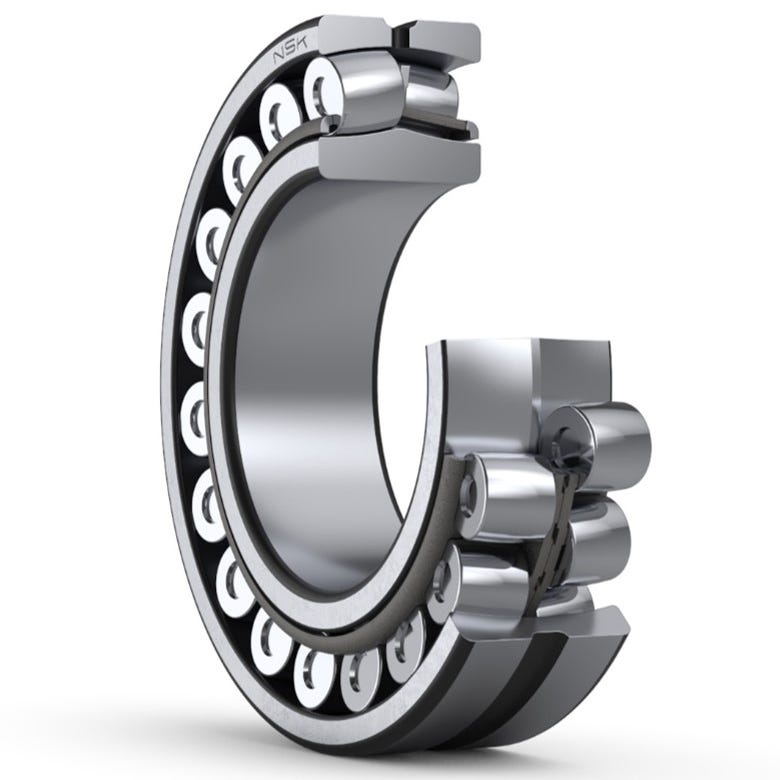
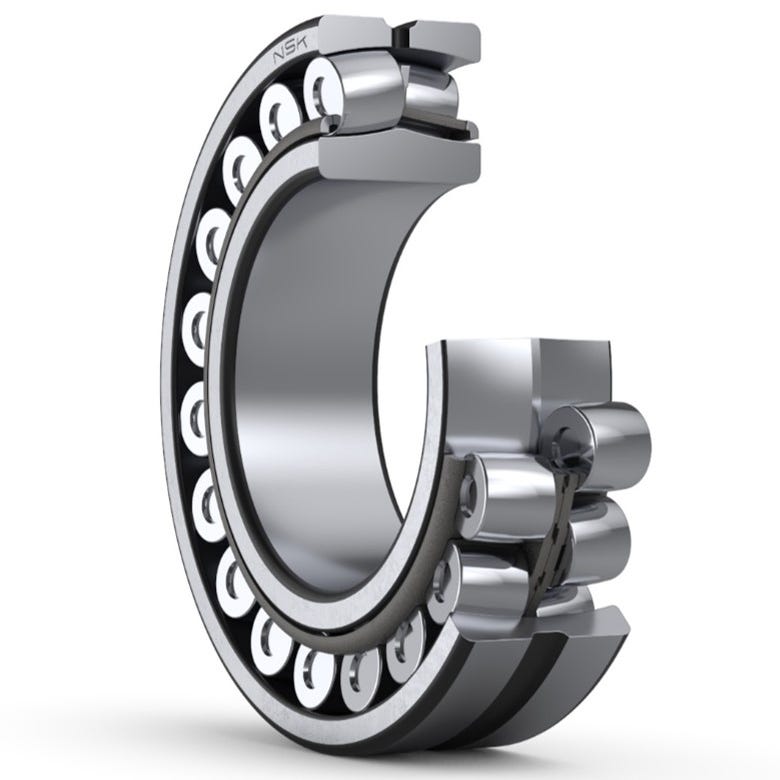
How to read a bearing number and what the letters mean is covered in separate articles. The catalog has NSK spherical roller bearings of various sizes, including with cylindrical and tapered bore, and insert bearings with a spherical outer surface for housed units.
How we do it
- By number, drawing or photo of the unit, we look for the item at the manufacturing plant. What we find, with the price, photos and specifications, we send before the order.
- We inspect the lot at the plant before shipment: part number, dimensions, lot, packaging.
What this article relies on
Below are the documents and materials we refer to, so that you can check what is said for yourself.
Reference materials
- SKF, the multi-stage Taconite labyrinth seal for split housings: protection against water in pressure washdown, regreasing, V-ring, fields of use: andoperationsengineer.org.uk ↗oemoffhighway.com ↗
- Reliability Magazine, "Why water ingress in bearings is a hidden threat" and "How washdown procedures destroy bearings when seal integrity fails": the ways water gets in, washdown under pressure, hidden seal defects: andreliamag.com ↗reliamag.com ↗
- IFS, "Problems with water contaminating grease": emulsification of grease and loss of load-carrying capacityifsworld.co.za ↗
- taminota.com catalog: NSK bearings of the 222 and 223 series and the UC210D1 insert.
Grease intervals and quantities are not given in the article: they depend on the bearing, speed and temperature and are taken from the manufacturer's catalog.