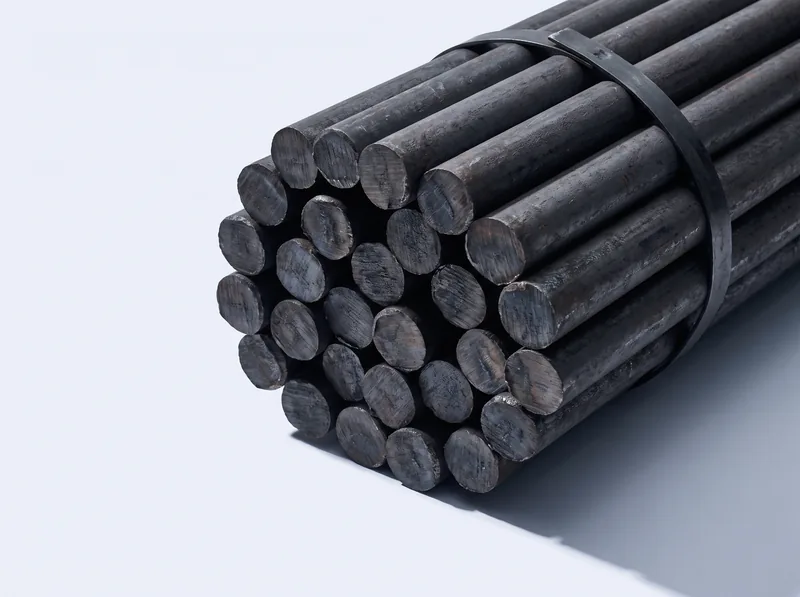
St3 · 20 · 45 · 40Kh · Ø10–300 · GOST 2590
Hot-rolled round bar
Round bar Ø10–300 mm in St3, 20, 45 and 40Kh to GOST 2590; equivalents Q235B, 20#, 45#, 40Cr
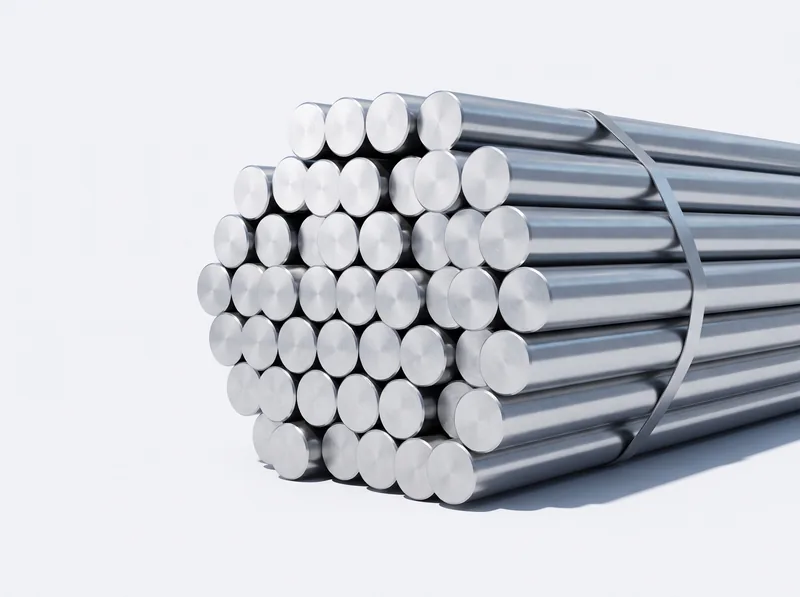
304 · 321 · 316L · Ø10–200 · GOST 5949
Austenitic steel bar Ø10–200 mm: 08Kh18N10, 12Kh18N10T, 03Kh17N14M3 to GOST 5949; equivalents 304, 321, 316L
| Parameters | |
|---|---|
| Diameter | 10–200 mm |
| Length | fixed length, to specification |
| Steel grade | 08Kh18N10, 12Kh18N10T, 03Kh17N14M3 |
| Delivery condition | heat-treated, solution annealed |
| Surface | hot-rolled turned, calibrated, ground |
| Magnetic properties | non-magnetic as delivered |
| Ø, mm | Weight, kg/m | Metres per tonne |
|---|---|---|
| 10 | 0.617 | 1 622 |
| 12 | 0.888 | 1 126 |
| 14 | 1.21 | 827.5 |
| 16 | 1.58 | 633.6 |
| 20 | 2.47 | 405.5 |
| 25 | 3.85 | 259.5 |
| 30 | 5.55 | 180.2 |
| 40 | 9.86 | 101.4 |
| 50 | 15.4 | 64.9 |
| 60 | 22.2 | 45.1 |
| 80 | 39.5 | 25.3 |
| 100 | 61.7 | 16.2 |
| 120 | 88.8 | 11.3 |
| 150 | 138.7 | 7.21 |
| 200 | 246.6 | 4.05 |
Theoretical weight at steel density 7.85 g/cm³. Actual batch weight is by scale and mill certificate.
Stainless round bar is a bar of corrosion-resistant austenitic steel: hot-rolled and peeled, cold-finished or ground. The technical conditions are set by GOST 5949-2018, the grades by GOST 5632-2014; mills in China roll the bar to GB/T 1220-2007, export specifications are read from ASTM A276/A276M and EN 10088-3. The delivery condition is heat-treated: solution annealing gives a non-magnetic structure and resistance to intergranular corrosion.
The grades differ in composition and service environment. 08Kh18N10 — equivalent to AISI 304 and 1.4301 — is the basic chromium-nickel steel for food, chemical and general equipment. 12Kh18N10T — equivalent to AISI 321 and 1.4541 — is titanium-stabilised and retains its resistance after welding and heating. 03Kh17N14M3 — equivalent to AISI 316L and 1.4404 — is molybdenum-bearing and low-carbon for chloride and acidic environments. Equivalents at mills in China are 06Cr19Ni10, 06Cr18Ni11Ti and 022Cr17Ni12Mo2 to GB/T 1220.
During inspection at the mill the bureau measures the diameter with a micrometer in two perpendicular directions and checks it against the tolerance in the specification — for cold-finished and ground bar the tolerance is read by ISO tolerance grade. The grade is confirmed by a rapid composition check with a portable spectrometer on bars from different bundles; the heat number on the tag is checked against the mill test certificate (MTC), which for stainless grades must state chromium, nickel, molybdenum, titanium and carbon. The surface is checked — free of cracks, scratches and traces of carbon steel — along with marking and packing that excludes contact with carbon steel products; the result is an inspection report with photographs before shipment.
The theoretical weight in the table is calculated for a density of 7.85 g/cm³; austenitic steels are denser, so the actual weight of the batch exceeds the calculated value by roughly 1–2 %. Shipment and acceptance go by actual weight from weighing.
Bundles in polymer film or wooden crates with spacers, kept separate from carbon steel products; mill tag with grade, heat, diameter, surface condition and weight.
| GOST | GB (China) | ASTM | EN | Note |
|---|---|---|---|---|
| St3sp | Q235B | A36 | S235JR | Nearest equivalents: carbon, manganese and impact toughness limits differ between the standards. The specification fixes the GOST grade and the control values. |
| Steel 20 | 20# | 1020 | C22E | Quality carbon steel; the equivalents match in carbon content, impurity limits are checked against the certificate. |
| Steel 45 | 45# | 1045 | C45E | Steel for heat treatment; hardness and delivery condition are checked — hot-rolled, normalised or annealed. |
| 40Kh | 40Cr | 5140 | 41Cr4 | Chromium alloy steel; the equivalents are close in composition, chromium content is confirmed by the heat certificate. |
| 09G2S | Q355B | A572 Gr. 50 | S355JR | Nearest equivalents by strength; 09G2S specifies impact toughness at minus 40 °C, the equivalents use other test temperatures. |
| St1kp | Q195 | 1008 | — | Wire rod for drawing and tying wire; the nearest equivalent by carbon content, there is no single EN grade for this class. |
| 08Kh18N10 | 06Cr19Ni10 | 304 | 1.4301 | Austenitic chromium-nickel steel; nearest equivalents: chromium and nickel ranges differ between the standards, composition is confirmed by the heat certificate. |
| 12Kh18N10T | 06Cr18Ni11Ti | 321 | 1.4541 | Titanium-stabilised; nearest equivalents: the upper carbon limit is 0.12 % for 12Kh18N10T and 0.08 % for 321 and 1.4541; titanium content is checked against the certificate. |
| 03Kh17N14M3 | 022Cr17Ni12Mo2 | 316L | 1.4404 | Molybdenum-bearing, low-carbon; nearest equivalents: the lower nickel limit of 03Kh17N14M3 is higher than that of 316L, composition is confirmed by the heat certificate. |
Equivalents are the closest match, not identical: chemistry and tolerances differ between standards. The exact grade and standard are written into the contract.
St3 · 20 · 45 · 40Kh · Ø10–300 · GOST 2590
Round bar Ø10–300 mm in St3, 20, 45 and 40Kh to GOST 2590; equivalents Q235B, 20#, 45#, 40Cr
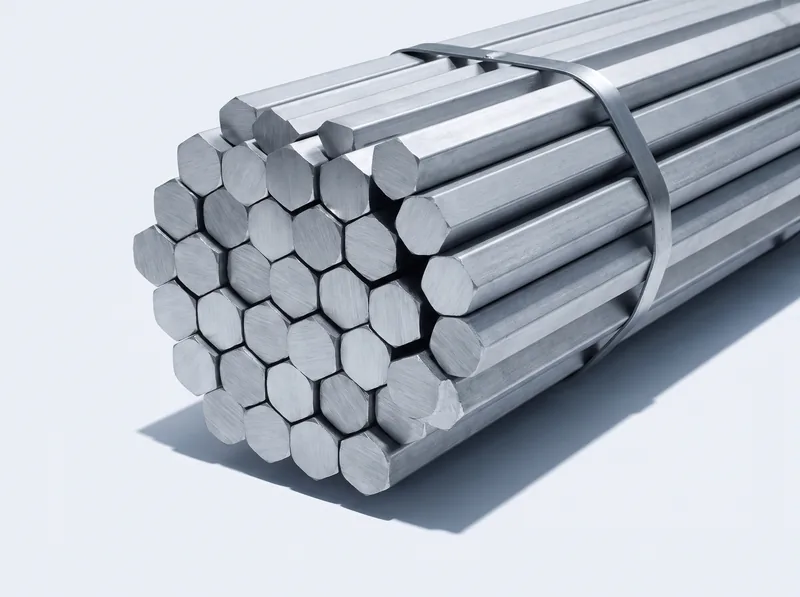
20 · 45 · 40Kh · S 10–75 · GOST 2879
Hexagonal bar 10–75 mm across flats in steels 20, 45 and 40Kh to GOST 2879; equivalents 20#, 45#, 40Cr
Price request
Steel pricing depends on grade, size, tonnage and delivery terms on the day of contract. A number on the page would be wrong by the time you read it.
Request received